
AI Hallucinations Are Becoming a Consulting Risk: Why Every Number Needs Verification
AI can produce a market-sizing analysis, summarise a due diligence report and draft a board presentation in minutes. But there is a critical difference between producing an answer and producing an answer that can withstand scrutiny.
For consulting firms, that difference matters. A fabricated citation in a legal filing can undermine a court submission. An unsupported market-size estimate can influence an investment decision. An incorrect financial assumption can change a recommendation presented to a board.
The problem is not simply that AI sometimes makes mistakes. It is that those mistakes can look convincing enough to pass through a professional workflow unnoticed.
As AI becomes more deeply integrated into consulting research and analysis, firms need to reconsider a basic question: when an AI-generated number reaches a client, can the team demonstrate where it came from and why it should be trusted?
When AI-generated errors reach the real world
On 22 October 2026, reports described a US federal appeals court overturning an order that contained apparent AI-generated errors, including references to nonexistent declarations, quotations that could not be found in the law cited and parties who were not involved in the case.
According to the reporting, a law clerk had drafted the order with AI, and it was entered on the docket by mistake. The appellate judge criticised the work, vacated the order and reassigned the case.
The incident illustrates a broader problem with AI-assisted professional work. A document can look formal, follow the expected structure and use authoritative language while containing material that cannot be substantiated.
It would be easy to treat this as a legal-sector problem. It is not.
Consulting firms use AI to summarise reports, generate competitor comparisons, estimate markets, extract figures from documents and prepare client-facing presentations. These activities involve the same underlying risk: a claim can enter a deliverable without adequate evidence that it is correct.
The consequences may differ between a courtroom and a consulting engagement, but the underlying question remains the same. Who checks whether the information is real before somebody relies on it?
The scale of AI-generated errors is becoming harder to ignore
What court decisions reveal
Researchers and legal technology observers have been tracking cases in which courts identify fabricated citations, nonexistent authorities or other AI-related errors in legal submissions.
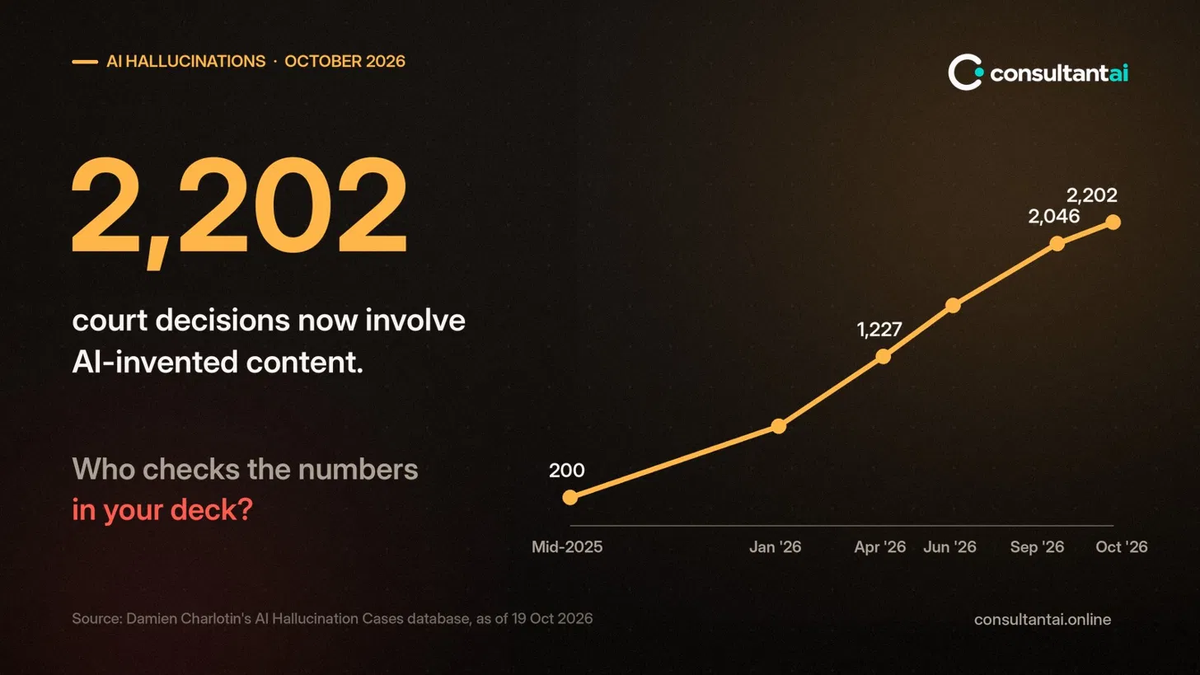
One publicly maintained database associated with researcher Damien Charlotin at HEC Paris has been cited in reporting about the growing number of these incidents. The figures supplied for this article indicate that the database grew from approximately 200 cases in mid-2025 to more than 2,200 by October 2026.
Those figures need to be interpreted carefully. A database of court decisions is not a complete measurement of every AI error committed by lawyers, and a growing number of recorded cases does not necessarily tell us how frequently AI tools fail across all legal work. It does, however, document a recurring category of professional failure: AI-generated material being submitted without adequate verification.
The distinction matters because fabricated references are not merely formatting problems. A nonexistent case or an invented quotation can undermine an argument, waste court time and damage the credibility of the person or organisation responsible for the submission.
The financial consequences can be substantial
The costs of these errors are not limited to corrections.
Depending on the circumstances and jurisdiction, professional consequences can include judicial criticism, sanctions, additional legal costs, reputational damage and greater scrutiny of future submissions. The severity depends on factors such as the nature of the error, the applicable rules, the conduct of the parties and whether reasonable verification took place.
For professional services firms, the commercial equivalent is easy to understand. A client who discovers that a supposedly authoritative figure cannot be traced may question the wider analysis, not just the individual figure.
That creates a potentially expensive chain reaction: additional review, revised deliverables, delayed decisions, difficult client conversations and reduced confidence in the team's work.
The lesson is not that every AI-generated mistake produces a financial penalty. It is that the cost of an error can extend well beyond the time required to correct it.
Consulting firms face the same underlying risk
Deloitte: errors in a government report
In October 2025, reporting by the Associated Press described Deloitte agreeing to partially refund the Australian government for a report valued at A$440,000 after concerns about apparent AI-generated errors. The reported issues included references to academic papers that did not exist and a fabricated quotation attributed to a court judgment.
The case is relevant to consulting because it demonstrates how a problem with research quality can become a wider issue involving client confidence and professional accountability.
A report may contain useful analysis and still require serious correction if some of its supporting material cannot be verified. The presence of sophisticated research methods or an established professional-services brand does not remove the need to check individual claims.
AI-focused thought leadership and invented sources
In August 2026, reporting also raised questions about invented sources in AI-related thought-leadership reports associated with PwC Middle East, following analysis attributed to the AI-detection company GPTZero.
Claims about individual reports should be checked against the original reporting and the documents involved before being repeated as established facts. Nevertheless, the broader lesson is relevant to any organisation publishing research: citations and references need to be inspected rather than accepted simply because they appear in a professionally presented document.
These examples should not be interpreted as evidence that all AI-assisted consulting work is unreliable. Instead, they show why the quality-control process must be designed to catch errors before publication or delivery.
For boutique consulting firms, this is particularly important. A smaller firm may not have a dedicated research verification team, yet it still has to maintain the standard of work clients expect.
Why the consulting workflow can let errors slip through
1. The first draft arrives before the evidence is checked
AI tools can quickly produce a structured narrative, a table of market figures or a slide with a clear recommendation. This changes the order in which work is often performed.
Traditionally, an analyst might collect evidence, check the source material, calculate the relevant figures and then write the conclusion. With AI-assisted workflows, the team may begin with a plausible draft and validate it afterwards.
That is not automatically wrong, but it creates a risk. Once a number has been incorporated into a polished presentation, people may become less likely to question it. The claim looks finished even when the underlying research is incomplete.
A more reliable workflow treats the first draft as a starting point, not as a completed analysis.
2. Reviewers may check the presentation rather than the evidence
A manager reviewing a deck may focus on whether the story makes sense, whether the slides are clear and whether the recommendation follows the overall narrative.
Those are important checks, but they are different from confirming every material claim against its original source.
A figure can fit neatly into the narrative while still being outdated, incorrectly calculated or taken from an inappropriate comparison group. A citation can look legitimate without supporting the statement attached to it.
Review processes should therefore distinguish between presentation review, analytical review and evidence verification. They complement one another, but one cannot reliably replace the others.
3. Responsibility becomes distributed across the team
Consulting deliverables often pass through several people. An analyst prepares the research, a manager revises the analysis, a partner approves the recommendation and the client receives the final document.
Each person may reasonably assume that another team member has checked the supporting information.
This creates a gap in accountability. If nobody is explicitly responsible for tracing material figures, verification can become an informal task that everyone expects somebody else to have completed.
The solution is not necessarily another layer of management. It is a clear process that assigns responsibility for the evidence and records the result.
4. Estimates and facts become mixed together
Consulting relies on both sourced facts and professional judgement. Market sizing, forecasting and strategic planning often require assumptions because complete information is unavailable.
The problem arises when the distinction disappears.
A market figure taken from an official report, an estimate calculated from several assumptions and an unverified claim from a secondary source should not be presented as though they have the same evidential status.
When those categories are mixed together, clients may interpret an estimate as a measured fact or an unverified claim as an established finding.
A transparent analysis makes these distinctions visible and explains how they affect the recommendation.
Why the problem matters beyond legal and consulting work
The same verification challenge applies to any professional workflow in which AI-generated information influences decisions.
In financial analysis, an incorrect assumption can distort a forecast. In due diligence, a nonexistent reference can undermine confidence in a finding. In procurement, an inaccurate description of a supplier can influence a risk assessment. In a board presentation, an unsupported market estimate can affect a strategic decision.
The common factor is not the industry or the particular AI tool. It is the distance between producing information and establishing that the information is reliable.
As AI becomes more capable of generating convincing documents, the ability to inspect the evidence behind those documents becomes increasingly important.
A five-step verification process for AI-assisted deliverables
Consulting teams do not necessarily need to buy a new tool before improving their process. They can start by introducing a consistent verification check for important numbers and claims.
Step 1: Trace every material number
Identify the figures that could influence the client's decision. These may include market size, growth rates, financial projections, cost estimates, competitor prices or expected savings.
Each figure should point to a specific source, such as a client document, dataset, published report or clearly documented calculation.
A vague note saying “industry research” is not sufficient when the number materially supports a recommendation. The reviewer should be able to identify the source and understand which part of it supports the claim.
Step 2: Confirm that the source exists and supports the claim
Open the original document where possible. Locate the figure, inspect its context and check that the source actually supports the statement being made.
Confirm the reporting period, geography, units and definitions. A report about a global market may not support a claim about one country, and a figure covering total revenue may not be a suitable proxy for the addressable market.
Do not treat a reference generated by AI as verified until the source has been located and inspected.
If the source cannot be found, mark the claim as unresolved rather than assuming the citation is correct.
Step 3: Recalculate important figures and normalise units
Not every error comes from a fabricated citation. Some result from simple inconsistencies in calculations, units or definitions.
For example, figures recorded as 3.2 million, 3,200,000 and 3.2 billion may look similar in a busy spreadsheet or presentation, but they describe very different quantities. Currency conversions, percentages, annualised values and inconsistent time periods can introduce further problems.
For material calculations, check the underlying inputs and reproduce the arithmetic independently. If a result comes from a model, record the assumptions and method so another reviewer can follow the calculation.
The objective is to establish that the number is not only traceable but also correctly interpreted and used.
Step 4: Record the verification status
Maintain a simple evidence register alongside the engagement. For each material claim, record the figure or statement, source, reporting period, verification status, reviewer and any outstanding action.
Use clear categories:
- Verified: The source or calculation has been checked and supports the claim.
- Estimated: The figure is based on stated assumptions or a documented model.
- To be validated: The evidence is incomplete, unclear or still requires review.
These labels are a practical control, not a guarantee of correctness. Their value is that they make uncertainty visible and prevent unresolved claims from quietly becoming accepted facts.
Keep the register with the engagement's working documents rather than relying on an individual analyst's inbox or memory.
Step 5: Make verification part of sign-off
The final reviewer should know which material claims have been checked, which remain estimates and which require further validation.
A partner should not need to repeat every research task personally. However, the sign-off process should provide enough evidence to show that the important figures and claims have been reviewed appropriately.
For high-impact recommendations, the team may also need a second reviewer, a documented calculation check or additional validation of critical assumptions.
This turns verification from an informal final-stage activity into a defined part of delivery.
The hidden cost of AI: the draft gets cheaper, but checking still takes work
AI can reduce the time required to organise research, create initial models and prepare presentation drafts. But the time needed to verify sources, test calculations and challenge assumptions does not necessarily fall at the same rate.
This is why measuring drafting speed alone can give consulting firms an incomplete picture of productivity.
A better approach is to track the complete delivery workflow: initial research and drafting, validation, revisions, senior review and any rework required after errors are discovered.
If AI saves time during preparation but creates additional checking work later, the firm should understand that trade-off. If a standardised workflow reduces repetitive verification tasks without compromising quality, that improvement should also be measured.
The objective is not to eliminate human review or to make every deliverable slower. It is to identify where verification effort is necessary, where it can be made more efficient and where preventable errors are consuming time.
For boutique firms, this can have a direct commercial benefit. Clearer evidence trails make it easier to review work, allocate responsibility, improve repeatable processes and explain recommendations to clients.
Where ConsultantAI fits into the verification workflow
ConsultantAI is focused on helping consulting teams improve analytical workflows, including activities such as market sizing and financial modelling. Those activities depend on understanding where the inputs came from, which assumptions drive the results and what still needs to be checked.
A structured evidence workflow can complement AI-assisted analysis by keeping source information, assumptions and review decisions visible throughout the engagement.
However, any specific capability to automatically trace figures against client documents, flag unsupported values or maintain a verification record should be described only if it is available and confirmed in the live product. These are useful requirements for a consulting workflow, but they should not be presented as existing product features without verification.
The broader principle is more important than any individual tool: use AI to accelerate repeatable work, and build a clear process for checking the output before a client relies on it.
The firms that win will be the ones clients can trust
AI-generated errors are no longer just an abstract concern about whether a model occasionally gets a fact wrong. Publicly documented incidents show that unsupported material can reach formal legal submissions and professional reports, with consequences for credibility, cost and accountability.
Consulting firms should take the lesson seriously without assuming that every AI-generated output is unreliable. The goal is to use AI where it creates value while retaining appropriate standards of evidence and review.
Start with a simple question: can your team trace every important number in its latest client deliverable?
If the answer is unclear, introduce a verification register, distinguish facts from estimates and assign responsibility for checking material claims. Measure the time required to complete that process, then improve it where possible.
The firms that use AI most effectively will not necessarily be the ones that generate the most slides or the fastest first drafts. They will be the ones that combine speed with transparent evidence, sound judgement and a process clients can trust.
Before the next AI-assisted deliverable leaves your team, make sure you know which numbers are supported, which are estimates and which still need to be checked.
Get new posts and free tools
Join the list: one email when we publish. No spam.