
AI Adoption Is Moving Faster Than Governance
Artificial intelligence is becoming part of everyday operations across professional services. Accounting firms are using AI to support research, prepare reports, organise information and reduce repetitive administrative work. Consulting firms are exploring similar opportunities across market research, financial analysis, presentations and client delivery.
The benefits are becoming easier to recognise. Teams can prepare initial work faster, handle more information and reduce the effort involved in routine activities. For smaller firms, these capabilities can be particularly useful because they often operate with limited resources and need to manage several client responsibilities simultaneously.
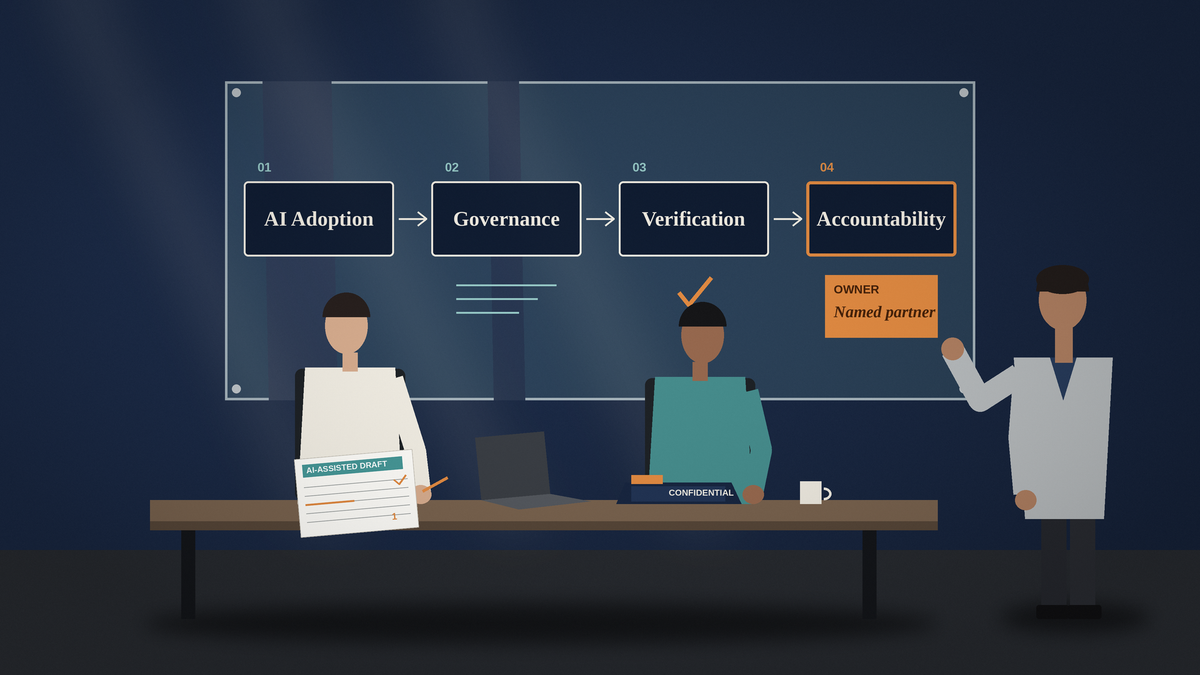
However, the growing use of AI also introduces a different challenge. As more employees begin using these tools, organisations need to establish which applications are approved, what information can be shared, how generated outputs should be reviewed and who is responsible when something goes wrong.
Recent research from Rightworks highlights this gap in the accounting profession. Its AI in Accounting 2026 Benchmark Report found that 71% of accounting and tax firms now use or test AI, compared with 40% in 2024. Yet 63% of firms using AI still do not have a formal AI policy.
The findings suggest that technology adoption is progressing faster than the processes required to manage it.
For consulting firms advising professional services businesses, this creates an important opportunity. Clients need more than recommendations about which AI tools to introduce. They need practical guidance on how to use those tools without weakening data protection, quality control or professional accountability.
The Numbers Behind the AI Governance Gap
Rightworks conducted its AI Tracker survey in October 2026, covering 206 accounting and tax firms and 224 small and medium-sized businesses. The findings offer a useful view of how AI adoption is developing and where organisations are experiencing difficulties.
Three figures deserve particular attention.
1. AI Adoption Has Increased Significantly
According to Rightworks, 71% of accounting and tax firms now use or test AI, compared with 40% in its 2024 study.
This indicates that AI is moving beyond isolated experimentation. More firms are beginning to incorporate it into everyday activities, including research, reporting, administrative work and tax-related processes.
For firm leaders, this creates pressure to understand how AI fits into existing operations. Employees may already be experimenting with tools, and clients may increasingly expect faster responses and more efficient service delivery.
However, wider adoption also means more opportunities for inconsistent usage. Without common guidelines, different employees may use different tools, enter different types of information and follow different review practices.
The challenge is no longer just encouraging adoption. It is making sure adoption happens in a controlled and consistent way.
2. AI-Using Firms Are Still Missing Formal Policies
The report found that 63% of firms using AI do not have a formal AI policy.
This is an important governance gap. Employees may understand how to use a particular tool, but that does not necessarily mean they understand the organisation's expectations around data handling, approved applications or the review of generated content.
For example, one employee might use an AI assistant to summarise public information, while another may enter sensitive client documents into a consumer AI platform without understanding the relevant data-handling implications.
Both activities involve AI, but they create very different levels of risk.
A formal policy helps establish clear boundaries. It tells employees which tools are approved, what information can be entered, which activities require additional review and who is responsible for overseeing AI use.
Without these expectations, organisations may find themselves managing AI usage after problems have already emerged.
3. Firms Are Reporting Higher Revenue Per Employee, but the Relationship Needs Context
Rightworks also reported that firms actively using AI had 39% higher revenue per employee than firms that were still testing or not using the technology.
This is an interesting business-performance finding, particularly for smaller professional services firms that need to make better use of their existing teams.
However, it is important to understand what the figure does and does not establish. It shows an association between active AI use and higher revenue per employee in the survey. It does not prove that AI alone caused the difference.
Other factors, including firm size, service mix, pricing, technology maturity and management practices, may also influence revenue per employee.
For consulting firms, the broader lesson is that AI adoption should be evaluated alongside the operating practices that support it. Simply introducing a tool does not guarantee improved financial performance.
Why Governance Has Not Kept Pace With AI Adoption
The gap between AI usage and formal governance is not necessarily caused by a lack of interest in responsible technology. In many cases, firms are adopting tools faster than they can establish the processes required to manage them.
Several practical challenges contribute to this situation.
1. Employees Are Adopting Tools Before Policies Are Established
AI tools are widely accessible, and employees can begin experimenting with them without waiting for a formal organisational rollout.
This makes adoption relatively easy, but it also creates the possibility of shadow AI: employees using tools that have not been formally reviewed or approved by their organisation.
A firm may have a clear understanding of the software it officially provides while having limited visibility into the additional tools employees use independently.
This becomes particularly concerning when client information is involved.
Organisations need to understand not only which tools they have purchased, but also how employees are using AI across their everyday work.
2. Client Data Is More Sensitive Than General Business Information
Professional services firms often handle information that clients do not want exposed outside agreed systems and processes.
For accounting firms, this may include financial records, payroll details, tax information and personal data. Consulting firms may handle acquisition plans, commercial strategies, internal financial information and confidential market research.
Using an AI tool without understanding its data-handling arrangements can create unnecessary exposure.
Rightworks' November 16, 2026 announcement identified data privacy as a major concern among accounting firms. It reported that 68% cited data privacy and 62% cited inaccuracy as concerns associated with AI use.
This highlights why firms need to evaluate AI tools before allowing employees to use them with sensitive information.
The important questions include where information is processed, how it is retained, who can access it and whether the tool's contractual and technical protections meet the firm's requirements.
3. AI-Generated Outputs Still Require Professional Review
AI can generate a response quickly, but speed does not establish accuracy.
A generated financial summary may contain an incorrect figure. A research document may reference an outdated source. A report may present an assumption as an established fact.
In professional services, these errors can affect the quality of work delivered to clients.
Rightworks found that 61% of AI-using firms identify checking AI output against original sources as their most common safeguard.
This is an important practice because it keeps the original evidence at the centre of the review process.
Employees should not assume that a generated answer is reliable simply because it is clearly written or confidently presented. Important claims, calculations and references need to be checked before they are used in professional work.
4. Accountability Is Often Unclear
When AI becomes part of a workflow, responsibility can become distributed across several people.
An employee may generate the initial output, another may edit it and a manager may approve the final document. If there is no defined review process, it can become difficult to establish who is responsible for checking the information.
Organisations should make ownership clear.
Every important AI-assisted workflow should have someone responsible for ensuring that the tool is being used appropriately and that the final output meets the firm's standards.
This does not mean every employee needs a complicated approval process for every AI task. The level of oversight should reflect the sensitivity and potential consequences of the work.
What a Practical AI Governance Framework Should Include
A formal AI policy does not need to be a lengthy technical document that employees rarely read. It should provide clear instructions that people can follow during everyday work.
For professional services firms, a useful framework should cover five areas.
1. Approved AI Tools
Create a clear list of AI applications that employees are permitted to use for professional activities.
The review should consider the tool's security arrangements, data retention practices, contractual terms, access controls and suitability for the intended task.
Employees should know which tools are approved and where to seek guidance before introducing a new application.
2. Client Data and Information Handling
Define what information can and cannot be entered into AI systems.
For example, public information may be suitable for use with a general-purpose tool, while confidential client documents may require an approved enterprise environment with appropriate contractual and security protections.
The policy should also explain how employees should handle personal information, commercially sensitive material and client-provided documents.
3. Human Review and Verification
Establish which AI-generated outputs require review before being shared externally or used in important decisions.
The review process should cover source accuracy, calculations, assumptions, confidentiality and whether the final output is appropriate for the client.
For accounting and consulting work, this is particularly important because a convincing presentation does not guarantee that its underlying analysis is correct.
4. Roles and Accountability
Assign responsibility for approving tools, maintaining policies, handling concerns and reviewing AI-assisted work.
Employees should know who to contact when they are unsure whether a particular activity is permitted.
Managers should also understand their responsibility for ensuring that AI use within their teams follows the firm's requirements.
5. Training and Regular Policy Reviews
AI tools and their capabilities change frequently. A policy that was suitable several months ago may not address new applications or emerging risks.
Firms should review their guidelines periodically and provide practical training so employees understand how to use approved tools responsibly.
Training should cover real work situations rather than only general explanations of AI.
The Consulting Opportunity: Helping Clients Move From Adoption to Control
The Rightworks findings are relevant beyond accounting. Many professional services organisations face a similar challenge: employees are adopting AI, but management practices are still developing.
This creates a practical opportunity for boutique consulting firms.
Rather than recommending more technology as the first response, consultants can help clients understand how AI is already being used and where the biggest gaps exist.
Begin With an AI Usage Assessment
The first step is to understand the current situation.
Consultants can examine which AI tools employees use, what activities they support, what information is being shared and whether existing policies cover those activities.
This provides a clearer picture of actual usage instead of relying only on management's understanding of official technology adoption.
Identify the Most Important Risks
Not every AI activity creates the same level of risk.
Using AI to organise publicly available research is different from entering confidential client financial information into an unapproved platform.
Consultants should help clients prioritise risks based on the sensitivity of information, the importance of the workflow and the potential consequences of inaccurate outputs.
Design Practical Controls
Once the main gaps are understood, firms can help clients establish suitable policies and review procedures.
This may include approved-tool lists, data-handling rules, output verification requirements and clear ownership.
The objective is to make responsible AI use part of normal operations rather than creating a separate governance process that employees struggle to follow.
Measure Whether Governance Is Working
A policy is useful only when it changes behaviour.
Organisations should periodically review whether employees are using approved tools, whether important outputs are being checked and whether sensitive information is being handled appropriately.
This allows leadership to identify gaps and improve the framework as AI usage expands.
For boutique consulting firms, this approach creates a more commercially useful advisory engagement. It connects technology adoption with operational readiness, risk management and business performance.
Where ConsultantAI Fits Into This Shift
ConsultantAI provides AI-powered tools designed for analytical activities used in management and strategy consulting, including market sizing and financial modelling.
These tools can support parts of the analytical preparation process, helping consultants structure their work and examine business assumptions.
However, responsible AI adoption requires more than choosing useful tools. Consultants still need to evaluate the information they use, validate assumptions and ensure their recommendations reflect the client's actual business requirements.
The wider opportunity is to use AI to make preparation more manageable while maintaining the professional standards that clients expect.
Explore the available tools at ConsultantAI.
Conclusion: AI Adoption Needs Governance to Become Sustainable
The Rightworks 2026 findings highlight an important challenge facing professional services firms. AI adoption is increasing, but formal policies and review practices are not developing at the same pace.
The fact that 71% of accounting and tax firms now use or test AI demonstrates how quickly the technology is entering everyday operations. Yet the finding that 63% of AI-using firms lack a formal policy shows why adoption alone is not enough.
Firms need to understand which tools employees use, how client information is protected, how generated outputs are reviewed and who is accountable for the final work.
For boutique consulting firms, this creates an opportunity to help clients build practical governance frameworks that support innovation without overlooking operational risks.
The goal should not be to slow down AI adoption. It should be to make sure that adoption is supported by clear responsibilities, reliable safeguards and measurable business objectives.
AI adoption creates the opportunity. Governance makes it manageable.
Sources and Further Reading
Get new posts and free tools
Join the list: one email when we publish. No spam.