
AI Is Reshaping Consulting Teams: What Stays Human When AI Does More of the Work?
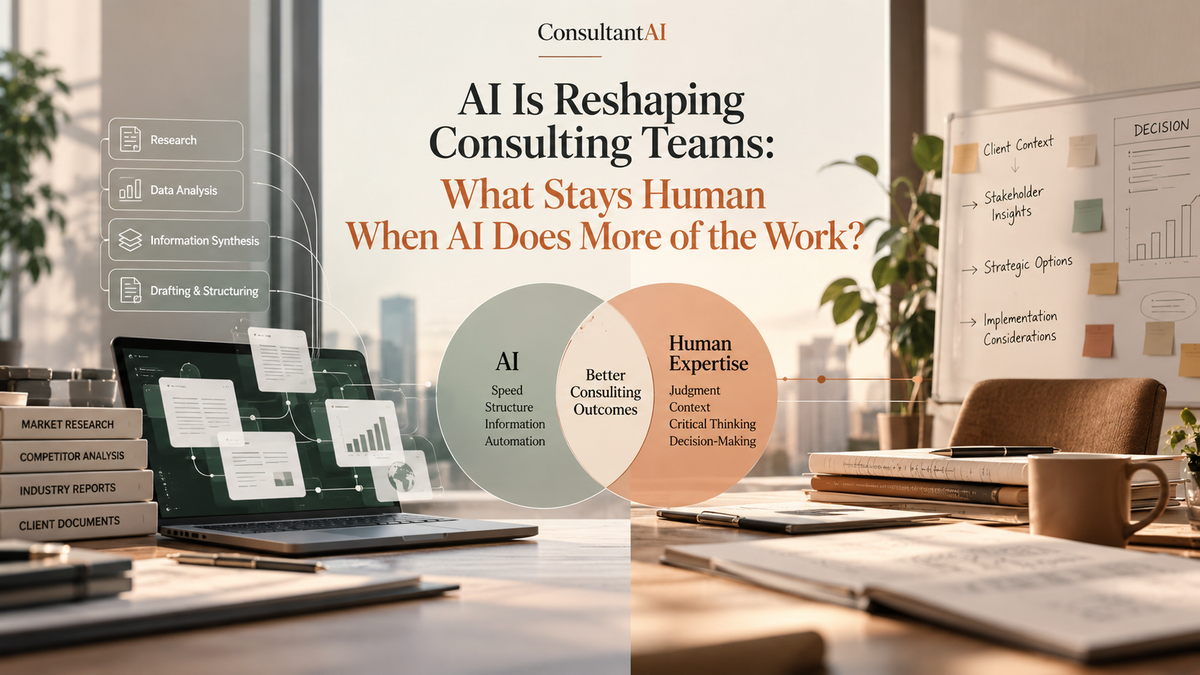
Artificial intelligence is changing how consulting teams research markets, analyze information, prepare presentations, and develop recommendations. Tasks that once required hours of manual work can now be supported by AI tools that summarize lengthy documents, organize research findings, compare information across sources, and produce structured first drafts. As these capabilities become part of everyday consulting workflows, the conversation is moving beyond how much time AI can save. A more important question is emerging: as AI takes on more of the work, where does human expertise create the greatest value?
For consulting firms, this question has implications for how projects are delivered, how teams collaborate, and how consultants develop their professional skills. The traditional consulting workflow often involves substantial effort spent gathering information, organizing evidence, building analytical frameworks, and preparing deliverables. AI can assist with several of these activities, but consulting is not simply the production of documents or the processing of data. It also involves understanding ambiguous business problems, recognizing organizational constraints, evaluating competing explanations, managing stakeholder expectations, and deciding what a client should do next.
These responsibilities become particularly important when information is incomplete, the consequences of a decision are significant, or different stakeholders disagree about the underlying problem. AI can help consultants work through these situations by organizing evidence and exploring alternatives, but the final interpretation requires context, professional judgment, and accountability. The opportunity is therefore not to remove the consultant from the workflow. It is to reconsider how human expertise and AI capabilities can complement one another.
How AI Is Changing the Consulting Workflow
Consulting projects typically combine research, analysis, communication, and decision support. A team may begin by understanding a client's business problem, gathering internal and external information, developing hypotheses, evaluating possible solutions, and translating its findings into recommendations. Each stage requires different skills, and AI can contribute differently depending on the task, the quality of the available information, and the level of risk involved.
Research and information processing are among the most accessible areas for AI assistance. A consultant working on a market-entry project, for example, may need to review industry reports, competitor websites, public filings, customer feedback, and internal documents. AI can help organize this material, summarize relevant sections, identify recurring themes, and prepare an initial research structure. The consultant can then spend more time examining the evidence, identifying gaps, and determining which findings matter to the client's decision.
Similar changes are possible during analysis and deliverable preparation. AI can assist with structuring a presentation, drafting an initial explanation of a market trend, comparing strategic alternatives, or converting research notes into a more organized document. These capabilities can reduce repetitive effort, although their usefulness depends on the quality of the inputs and the amount of verification required.
From Manual Execution to Supervised Workflows
The important change is not that every consulting task can now be automated. It is that the way tasks are completed can be redesigned. Instead of performing every step manually, a consultant may define the objective, provide relevant context, ask an AI system to complete a bounded task, review the resulting work, and refine the next step based on what the evidence reveals.
Consider a team preparing a competitive landscape assessment. AI might help identify competitors, organize publicly available information, and create an initial comparison of product positioning. The consultant still needs to check whether the competitor set is appropriate, verify important claims, distinguish marketing statements from demonstrated capabilities, and interpret what the findings mean for the client.
This approach changes where effort is concentrated. Less time may be needed for certain repetitive preparation tasks, while greater attention can be directed toward evaluating evidence, challenging assumptions, and making the analysis relevant to the business problem. The resulting benefits will vary across projects, but the underlying principle is consistent: automation is most useful when it improves the quality and efficiency of a workflow rather than merely increasing the volume of output.
Problem Framing Remains a Human Responsibility
One of the most important consulting skills is identifying the problem that actually needs to be solved. Clients often approach a consulting team with an initial diagnosis, a proposed solution, or a visible symptom of a deeper business issue. The first request does not always capture the full problem, and answering it without further investigation can lead to recommendations that address the wrong issue.
A company experiencing declining sales, for example, might assume that it needs a new marketing strategy. However, the underlying cause could involve changes in customer retention, pricing, distribution, product positioning, or the quality of its sales pipeline. A useful consulting engagement must distinguish between the client's initial explanation and the evidence-supported problem that deserves attention.
AI can help generate possible explanations, organize available data, and identify questions that the team should investigate. It can also help compare different problem statements or develop a preliminary set of hypotheses. What it cannot reliably determine on its own is which interpretation best fits the client's full business context when that context is incomplete, contested, or not represented in the available information.
Asking Better Questions Before Seeking Answers
Effective problem framing requires consultants to decide what information is missing, which assumptions should be tested, and what evidence would change the direction of the analysis. These decisions influence every stage of the project, from research priorities to the structure of the final recommendation.
Suppose a client wants to reduce operating costs across several business units. An AI system could help classify expenses, identify unusual patterns, and suggest areas for further investigation. The consulting team must still determine whether the objective is to reduce short-term expenditure, improve long-term efficiency, protect service quality, or redesign the operating model. Each objective could lead to a different analysis and a different recommendation.
This is where consulting expertise remains valuable. The consultant establishes the decision that needs to be made, determines the boundaries of the investigation, and evaluates whether the proposed analysis will produce information that is useful to the client. AI can support this process, but a poorly framed question can still produce an impressive answer that does not solve the underlying problem.
Critical Thinking Matters More When AI Makes Analysis Easier
As AI makes it easier to generate summaries, comparisons, and possible explanations, the ability to evaluate those outputs becomes increasingly important. A system can produce a coherent narrative from incomplete information, overlook a relevant contradiction, or emphasize a pattern that does not explain the business outcome. The presence of a plausible explanation does not establish that it is correct.
Consultants therefore need to examine not only what an AI-generated analysis concludes but also how well the evidence supports that conclusion. This involves checking source quality, identifying assumptions, considering alternative explanations, and understanding the limitations of the available data. The objective is not to distrust every AI output. It is to apply the same professional scrutiny that would be expected of any analytical work used to inform a business decision.
Distinguishing Evidence From Interpretation
Imagine that an AI-assisted analysis identifies a correlation between higher marketing expenditure and stronger revenue growth across a group of companies. That relationship may be worth investigating, but it does not establish that increased marketing expenditure caused the growth. Differences in market conditions, product quality, pricing, distribution, or existing brand strength could also influence the result.
A consultant needs to distinguish the observed pattern from the interpretation attached to it. The next step might involve examining the time period, reviewing the underlying sources, comparing businesses with similar characteristics, or identifying additional evidence that supports or challenges the hypothesis.
This distinction is important in strategy, operations, financial analysis, and market research. AI can make it easier to explore possibilities, but professional judgment is needed to decide which possibilities are sufficiently supported to influence a recommendation. Strong consulting work depends not on producing the most confident narrative but on reaching conclusions that are proportionate to the available evidence.
Client Context Cannot Be Reduced to a Document Summary
Consulting recommendations are implemented by people working within organizations, and those organizations have constraints that are not always visible in formal documents. A strategy may appear attractive on paper but depend on capabilities the client does not possess, require changes that employees are unlikely to adopt, or conflict with existing contractual, operational, or regulatory obligations.
Understanding these factors often requires conversations with stakeholders, observation of how work is actually performed, and careful interpretation of organizational priorities. Different teams may describe the same problem in different ways because they have different responsibilities, incentives, and measures of success. Recognizing these differences is part of understanding the environment in which a recommendation must work.
AI can assist by summarizing interview notes, grouping recurring concerns, and identifying differences between stakeholder perspectives. It can also help consultants prepare follow-up questions or compare interview findings with existing documentation. However, the system's summary should not replace the original evidence or remove the nuance that gives a stakeholder's perspective its meaning.
Reading the Situation Behind the Information
Consider a transformation project in which leadership wants to introduce a standardized process across multiple departments. The documented process may appear inefficient, and an AI-assisted analysis might recommend centralization as a way to improve consistency. Conversations with the teams could reveal that departments operate under different customer requirements, local constraints, or approval processes that the documentation does not capture.
The consultant must determine which variations are unnecessary and which exist for legitimate reasons. That requires understanding the organization, testing assumptions with the people involved, and balancing efficiency with operational reality.
This is not an argument that human interpretation is always correct or that AI cannot contribute meaningfully to organizational analysis. Rather, it recognizes that context is often distributed across conversations, relationships, informal practices, and competing priorities. Effective consulting brings these sources of information together before translating analysis into action.
Recommendations Require Judgment, Not Just Analysis
Producing analysis is only one part of a consulting engagement. Clients ultimately need to decide what to do, which trade-offs to accept, and how to allocate limited resources. Several recommendations may be defensible based on the available evidence, but they can differ in cost, risk, implementation time, reversibility, and strategic importance.
AI can help compare these alternatives by organizing their advantages, disadvantages, dependencies, and potential consequences. It can support scenario analysis, identify questions that decision-makers should consider, and help teams communicate the reasoning behind different options. These contributions can make the decision process more structured, especially when a project involves many variables or a large amount of information.
The decision itself, however, depends on more than analytical ranking. An organization may choose a slower implementation because it needs to protect customer relationships, or it may accept a higher initial investment because the long-term capability is strategically important. Such decisions depend on business priorities, risk tolerance, timing, and the consequences of being wrong.
Making Trade-Offs Explicit
A useful consultant does not simply present a recommendation as though there were no meaningful alternatives. The consultant explains why a particular option is preferred, which assumptions support it, what risks remain, and what would cause the recommendation to change.
For example, a client considering entry into a new market might have three options: launch quickly with a limited offering, invest in a broader launch, or conduct further research before committing resources. AI can help structure the comparison and summarize available market evidence. The consulting team must still evaluate the reliability of that evidence, the client's ability to execute each option, and the implications of delaying or accelerating the decision.
This is where professional judgment turns analysis into decision support. AI can expand the range of alternatives a team considers, but a recommendation must remain grounded in the client's objectives and constraints. The final output should help the client understand the decision rather than obscure uncertainty behind a polished presentation.
Communication and Storytelling Still Shape the Outcome
Consulting teams often work with large amounts of research and analysis, but decision-makers rarely have the time to examine every detail. They need a clear explanation of what the team learned, why it matters, and what action should follow. Communicating that reasoning requires more than summarizing information. It requires choosing the right level of detail, organizing ideas into a coherent argument, and anticipating the questions that matter to the audience.
AI can support the preparation of presentations, executive summaries, reports, and supporting materials. It can help simplify complex language, suggest alternative structures, or adapt an explanation for different audiences. These uses can be valuable when the underlying analysis has already been reviewed and the intended message is clear.
The challenge is that a presentation can be well written and visually polished while still failing to communicate the most important insight. It may contain too much detail, emphasize secondary findings, or present a recommendation without explaining the assumptions that make it appropriate. A consultant must decide what deserves attention and how the story should guide the audience through the evidence.
Turning Information Into a Clear Business Narrative
Suppose a team has identified several operational inefficiencies across a client's business. An AI tool might produce a comprehensive summary of the findings and generate a draft presentation. The consultant still needs to decide which inefficiencies are strategically significant, how they relate to the client's stated objectives, and which findings should lead the discussion.
The final narrative should make the logic of the recommendation visible. It should explain the business problem, establish the evidence, address important alternatives, and clarify the action being proposed. Supporting details should strengthen that argument rather than distract from it.
Communication also involves responding to questions and recognizing when an explanation has not addressed a stakeholder's concern. These interactions can change the direction of a discussion and reveal information that was not available during the initial analysis. AI can help prepare for such conversations, but consultants remain responsible for interpreting the response and adapting their reasoning.
Accountability and Professional Responsibility Do Not Disappear
AI involvement does not remove the need to establish who is responsible for reviewing and approving consulting deliverables. When an AI-assisted output contains an error, omits an important limitation, or uses information inappropriately, the organization still needs clear processes for identifying and addressing the problem.
This becomes especially important when deliverables contain financial analysis, market claims, client information, or recommendations that may influence significant business decisions. The appropriate level of review depends on the task and its potential consequences. A routine internal summary may require a different review process from a client-facing recommendation involving material financial or operational risk.
Consulting teams should therefore define which tasks AI may perform independently, which outputs require verification, and which decisions must remain with an accountable professional. They should also establish expectations for handling confidential information, documenting important assumptions, and escalating uncertainty or unexpected results.
Designing Review Around Risk
A practical approach is to apply stronger controls where the consequences of an error are greater. Research summaries, early-stage brainstorming, and draft outlines may be suitable for lighter review, provided that the information is used appropriately. Outputs containing important factual claims, sensitive client information, financial conclusions, or final recommendations warrant more careful examination.
The review process should focus on substance rather than appearance. Checking grammar and formatting is not enough if the underlying sources are unreliable or the conclusion does not follow from the evidence. Reviewers need to examine important claims, test assumptions, and confirm that the deliverable answers the client's actual question.
Accountability also requires transparency about limitations. If the evidence is incomplete, the source cannot be verified, or the analysis depends on an assumption that has not been tested, the final work should make that uncertainty clear. A responsible workflow does not conceal uncertainty to make an output appear more authoritative.
How Consulting Teams Can Divide Work Between AI and Humans
The most effective division of work depends on the task, the quality of the available information, and the consequences of an error. There is no universal boundary that makes every task suitable for automation or every decision exclusively human. Instead, teams can evaluate individual workflow steps according to how repeatable they are, how much judgment they require, and how easily the results can be checked.
Tasks that involve organizing large volumes of information, preparing first drafts, extracting structured details, or applying consistent formatting may be good candidates for AI assistance. These activities often have relatively clear objectives and outputs that can be reviewed against defined criteria. AI can also support more complex analysis by generating alternatives or identifying patterns, provided that the findings are validated before they influence important decisions.
Human involvement becomes particularly important when a task requires ambiguous problem framing, contextual interpretation, significant trade-offs, stakeholder alignment, or final accountability. In these situations, AI can contribute evidence and structure, but the workflow should preserve space for professional judgment.
A Practical Framework for AI-Human Collaboration
Consulting teams can begin by mapping a workflow into its main stages and deciding what contribution AI and humans should make at each stage. During research, AI might retrieve and organize information while the consultant determines which sources are authoritative and what evidence is missing. During analysis, AI might compare alternatives or identify patterns while the consultant tests the assumptions and interprets their business significance.
During deliverable preparation, AI can help produce a structured draft, but the consultant should ensure that the argument is coherent, the recommendations reflect the client's priorities, and the claims are supported by evidence. Before delivery, a defined review process should confirm that the work meets the engagement's quality, confidentiality, and approval requirements.
This framework should be adjusted as teams gain experience. Some tasks may become more automated when they are well defined and consistently validated, while others may require additional human review when the data is uncertain or the potential impact is high. The aim is to create a workflow in which responsibility is explicit and the contribution of each participant is appropriate to the task.
The Skills Consultants Need to Develop
As AI takes on more routine execution, consultants may need to place greater emphasis on the skills that help them direct, evaluate, and apply its output. Technical familiarity with AI tools can be useful, but tool proficiency alone does not guarantee strong consulting performance. Consultants also need to understand how to define tasks clearly, provide relevant context, assess evidence, and recognize when a generated result requires further investigation.
Analytical judgment remains central because consultants must distinguish between an observation and a conclusion, identify weaknesses in the evidence, and explain why one interpretation is more useful than another. Communication is equally important because AI-assisted analysis still needs to be translated into clear recommendations that clients can understand and act upon. Stakeholder management, business understanding, and the ability to work through disagreement remain relevant for the same reason: decisions are made within organizations, not in isolation from them.
Learning to Direct and Evaluate AI
Consultants should learn to specify the desired output, define constraints, provide relevant source material, and establish criteria for reviewing the result. They should also understand the limitations of the tools they use, including the possibility of inaccurate claims, incomplete retrieval, and misleading summaries.
A practical way to develop these skills is to compare AI-assisted work with a verified reference or a carefully reviewed manual analysis. Teams can examine where AI saved effort, where it missed relevant information, which assumptions required correction, and what review was necessary before the output became usable. Over time, these observations can inform better prompts, clearer workflow instructions, and more appropriate controls.
The objective is not to make every consultant an AI engineer. It is to help consultants become effective users and reviewers of AI-assisted work. As the tools evolve, the ability to ask precise questions, evaluate answers, and connect analysis to business decisions will remain valuable.
What This Means for Consulting Firms
For consulting firms, the shift toward AI-assisted work has implications beyond individual productivity. It can influence project planning, quality assurance, team structure, training, and the way client value is measured. If a firm introduces AI without redesigning the workflow, it may simply add another tool to existing processes. The potential benefits are more meaningful when the organization identifies where AI can reduce repetitive effort, where human review remains necessary, and how the overall process should change.
Firms may need to establish shared standards for approved tools, source validation, confidentiality, documentation, and review. They may also need to reconsider how junior consultants learn core skills when some research and preparation tasks become increasingly automated. These tasks have traditionally provided opportunities to develop familiarity with industries, analytical methods, and client problems. If AI performs more of the initial execution, training should deliberately preserve opportunities for consultants to understand the underlying reasoning rather than simply review completed outputs.
Project leaders should also distinguish between faster production and better client outcomes. Producing a report more quickly is useful only when the report is accurate, relevant, and actionable. The more important questions are whether AI helps the team investigate the problem more thoroughly, evaluate alternatives more effectively, communicate findings more clearly, and make better use of its available expertise.
The Future Is Not AI Versus Consultants
The question facing consulting teams is not whether AI will perform more of the work. It is how teams will organize that work so that automation strengthens rather than weakens the quality of their service. AI can reduce the effort involved in research, information processing, drafting, and other repeatable activities. These capabilities can create room for deeper analysis and more thoughtful client engagement, but only when the workflow includes the right context, validation, and human oversight.
Consultants will continue to contribute value by identifying the right problems, challenging assumptions, interpreting organizational realities, evaluating trade-offs, and helping clients make decisions. These responsibilities are not separate from analytical work; they determine how analytical work should be conducted and what conclusions can reasonably be drawn from it.
The firms that adapt effectively will be those that treat AI as part of a broader operating model rather than as a substitute for professional expertise. They will define where automation is appropriate, build review into their workflows, train teams to evaluate AI outputs, and measure success through the quality and usefulness of the work delivered.
Final Takeaway
AI is changing the way consulting work gets done, but the value of consulting has never depended solely on how quickly information can be processed or documents can be produced. Clients need help understanding complex situations, deciding which evidence matters, navigating competing priorities, and choosing a course of action when the answer is not obvious.
AI can make many parts of that process more efficient and can help consultants explore information and alternatives that might otherwise require more effort. It cannot eliminate the need to frame the problem correctly, evaluate the evidence, understand the client, and take responsibility for the final recommendation.
The opportunity is to build consulting workflows in which AI handles appropriate execution while human expertise guides interpretation, judgment, and decisions. When these responsibilities are clearly defined, teams can use AI to improve the way they work without confusing automated output with professional insight.
The future of consulting is not about making humans less important. It is about using AI to make human expertise more effective.
Get new posts and free tools
Join the list: one email when we publish. No spam.