
On 22 September 2026, Deloitte announced that its M&A Platform now embeds AI across the entire deal lifecycle, from due diligence through transaction structuring to post-deal integration. The platform is supported by what Deloitte calls an "agentic harness" that helps scale, govern and manage AI agents, and Deloitte says it is already in use across more than 1,000 client engagements.
For anyone who advises on deals, that is a signal worth paying attention to. It is also a signal that is easy to misread. If you run a boutique advisory firm, an independent practice or a lean corporate development team, the headline can sound like a gap you will never close. Large firms have budgets for engineering teams, proprietary data and dedicated technology functions. Most boutiques do not.
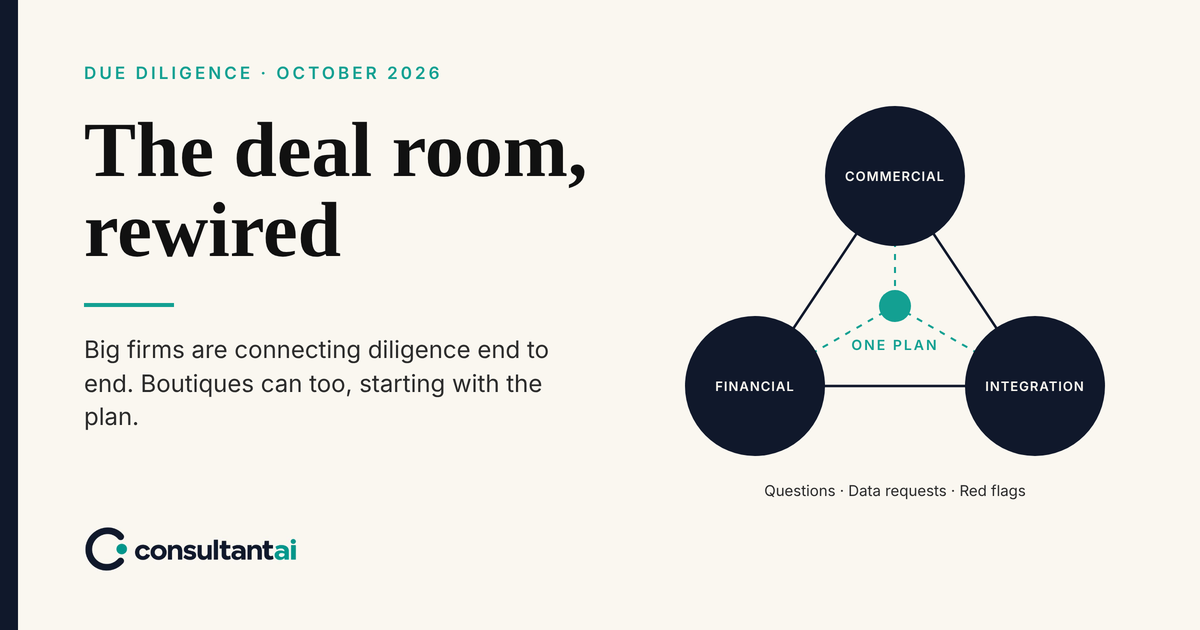
But the most important part of the announcement is not the software. It is the way of working the software is built to support: diligence run as one connected piece of work, where the questions, the workstreams and the risks are linked from the first day. That way of working does not depend on a platform. It depends on a plan.
This guide explains what Deloitte announced and how to read it, what has actually changed in the way leading firms approach diligence, and why small teams are well placed to adopt the same approach. It then walks through how to build a connected diligence plan step by step, the questions that link each workstream to the others, a worked example, a four-week timeline, and practical guidance on using AI tools responsibly. By the end, you should have everything you need to run your next diligence in a more connected way, whatever tools you use.
What Deloitte Announced
What the platform does
Deloitte describes its M&A Platform as an AI-enabled solution designed to help organisations make cross-capability, better-informed deal decisions. According to the announcement, it embeds AI across the deal lifecycle to support deeper due diligence, stronger transaction structuring and end-to-end integration.
The phrase that drew the most attention was the "agentic harness". In Deloitte's description, this is the layer that helps scale, govern and manage the AI agents working inside the platform. In plain terms, it is the structure that lets multiple AI agents carry out tasks across different parts of a deal while staying coordinated and under control.
Deloitte also stated that the platform is in use across more than 1,000 client engagements. Whatever view you take of vendor announcements, that is a sign the approach has moved beyond experiments and into routine use at one of the largest advisory firms.
The survey behind the announcement
Alongside the launch, Deloitte shared results from its GenAI in M&A pulse survey of 500 corporate and private equity leaders. The headline figures:
- 90% of respondents said they use AI in M&A.
- 37% said they use it across multiple stages of the deal lifecycle.
- 35% said they see the greatest value when technology is combined with advisory support, which Deloitte notes is more than three times the share citing task-specific tools.
- The most commonly reported benefits were automated status reporting (66%), better decision-making (60%) and smoother cross-functional coordination (51%).
How to read these numbers
These are Deloitte's own figures, published in an announcement about a Deloitte product. They have not been independently verified, and the survey design, sample selection and question wording are not set out in the release. Treat them as a direction of travel rather than an industry benchmark.
Even with that caution, three points are worth drawing out.
First, the gap between 90% and 37% matters. Most respondents use AI somewhere in their deals, but far fewer use it across several stages. In other words, AI use is common, but connected AI use is not. That gap is exactly what Deloitte's platform is designed to close.
Second, the reported benefits are mostly about coordination. Status reporting and cross-functional coordination are not glamorous capabilities. They are the work of keeping a deal team aligned. That tells you where respondents feel the pain.
Third, the 35% figure is good news for advisors. When asked where they see the most value, the largest group pointed to technology combined with advisory support, not tools on their own.
What Changed: Diligence as One Connected Piece of Work
Set aside the vendor framing and one shift stands out. Large firms are starting to treat due diligence as a single connected piece of work rather than a sequence of handoffs between separate teams.
The traditional handoff model
In a typical diligence process, each workstream runs on its own track. The commercial team builds a view of the market, the competitive position and the customer base. The financial team works through quality of earnings, working capital, debt and debt-like items. Legal reviews contracts, litigation, intellectual property and change-of-control terms. Tax, HR, IT and operations teams each run their own reviews. Integration planning often starts only once most of that work is finished.
Each team keeps its own question list and sends its own data requests. Findings move between teams through meetings, memos and email threads. The deal lead pulls everything together at the end into a report or an investment committee paper.
Where the handoff model breaks down
That structure works, and it has worked for decades. But it has predictable weak points.
Findings travel slowly. A red flag found in one workstream can take days to reach the team it affects most. By then, the questions that should have changed have already been asked, and the management calls that could have tested the issue have already happened.
Data requests multiply. When each workstream writes its own request list, the target receives overlapping requests in different formats. It answers the easy ones first. The documents that matter most often arrive late, and management's patience runs out before the important follow-ups are asked.
Nobody owns the connections. Each workstream owns its own conclusions. The links between them, such as how a commercial finding affects valuation or how a contract clause affects integration, often belong to no one until the final report is being written.
Integration starts too late. Many issues that cause trouble after closing were visible during diligence. They were missed because no one was asking integration questions at the time.
What a connected process looks like
In a connected process, the workstreams share one plan from the start. Take a simple example. The commercial team finds that the target's three largest customers account for most of its revenue. In a connected process, that finding immediately:
- changes the questions the financial team asks about revenue quality, contract renewal dates and pricing terms;
- prompts legal to check those customers' contracts for change-of-control, termination and exclusivity clauses;
- leads the operations team to look at who manages those relationships day to day; and
- shapes the integration team's plan for retaining those accounts in the first 100 days.
Nothing about that requires advanced technology. It requires the questions, the workstreams and the risks to be linked before the work begins, and a working rhythm that moves findings between teams quickly.
Why AI agents depend on the plan
AI agents are useful in diligence mainly because they can carry context across those boundaries quickly. They can summarise long documents, compare figures across sources, flag inconsistencies, track which requests are outstanding and keep status reports current.
But an agent is only as useful as the plan it is working from. Give it a disconnected set of question lists and it will speed up a disconnected process. It will produce faster summaries of the wrong things, and more status updates that nobody connects. Give it a coherent plan, with clear questions, dependencies and owners, and it can genuinely help the team see the whole deal.
That is the part of Deloitte's announcement most relevant to smaller firms. The platform is the delivery mechanism. The connected plan is the advantage.
What It Means for Boutique Advisors
You do not need to build a platform
A boutique is not going to build software used across 1,000 engagements, and it does not need to. The value large firms are chasing comes from a diligence process where everything is joined up from day one. That is a planning discipline first and a technology investment second.
The practical implication is that the first investment for a boutique is not in software. It is in the time spent at the start of a deal building a plan that connects the work. That costs hours, not budget, and it pays back in every later week of the diligence.
Small teams have a structural edge
Connecting workstreams is hard at scale because many people across many teams need to stay aligned. Large firms need platforms partly because their diligence teams are large, spread across offices and staffed from different service lines.
A boutique often has the opposite situation: a handful of people who already talk every day. That makes it easier, not harder, to run one shared plan. The partner who scopes the deal can see every workstream's questions in a single document. A finding made in the morning can change the afternoon's management call. Changes reach everyone on the same day without a system to route them.
Clients want judgment, supported by tools
The survey finding that stands out for advisors is the 35% who see the greatest value when technology is combined with advisory support. Clients are not asking for tools on their own. They want experienced judgment, made faster and more thorough by good tools.
That is exactly the position a boutique can occupy. Senior people tend to be close to the work, so clients get experienced judgment on the issues that matter. The task for the boutique is to make sure its process is organised well enough for tools to help rather than add noise.
Where boutiques are genuinely exposed
It would be wrong to say the shift carries no risk for smaller firms. There are real areas of exposure:
- Speed expectations. As large firms compress timelines, clients may expect faster turnaround from everyone. A boutique running a disconnected process will feel that pressure first.
- Status visibility. Clients used to live dashboards may expect regular, clear updates on what is outstanding and what has been found.
- Breadth of coverage. Large firms can staff many specialist workstreams at once. A boutique needs to be clear about what is in scope, what is not, and where it brings in specialists.
None of these is solved by buying a platform. Each is addressed by a better plan: clearer scope, clearer ownership and a regular rhythm of reporting.
Signs Your Current Diligence Process Is Disconnected
Before changing anything, it helps to know where your current process stands. Look back at your last two or three deals and ask whether any of the following happened.
The target received overlapping requests
If management asked why they were being sent the same request twice in different formats, your workstreams were writing their own lists. That is the clearest sign that the plan was not shared.
A key finding surfaced in the final week
If an issue that changed the price or the terms was first discussed close to signing, ask when it was actually found. Often it was spotted early by one workstream and only reached the deal lead later.
The final report was hard to assemble
If pulling the report together meant reconciling different numbers, different customer lists or different conclusions from each workstream, the work was not connected while it was being done.
Integration surprises appeared after closing
If the first months after closing brought problems with key customers, key people or systems that nobody had flagged, integration questions were missing from the diligence.
Status updates took too long to prepare
If preparing a client update meant chasing every workstream for its latest position, there was no single place where findings were being recorded.
If two or more of these sound familiar, a connected plan will likely make a visible difference on your next deal. If none of them do, the steps below may still help you work faster and report more clearly.
How to Build a Connected Diligence Plan in Seven Steps
The steps below work for a buy-side diligence on a small or mid-sized target, and they scale down to a quick pre-LOI review. They assume a small team, but the same structure works for larger ones.
Step 1: Start from the deal thesis
Every diligence should begin with a clear statement of why the buyer wants this deal and what has to be true for it to work. Write it in a few sentences. For example: "We are buying this business for its recurring service contracts with mid-market manufacturers, and we expect to grow margins by cross-selling our existing products to its customers."
Then list the assumptions the thesis depends on. In this example, they might include: the contracts really are recurring; the customer base is stable; margins can improve; and the customers are a good fit for the buyer's products. Each assumption becomes a test the diligence has to run. This is the anchor for everything else in the plan.
Step 2: Scope the workstreams against the thesis
Decide which workstreams are in scope and how deep each one needs to go. A thesis that depends on customer retention needs a strong commercial and contractual review. A thesis that depends on cost savings needs a deeper operational review. Not every workstream needs equal weight.
Be explicit about what is out of scope and where specialists will be brought in, for example for tax structuring, environmental reviews or cyber security assessments. Clients value a clear scope, and it protects the team from being blamed for issues it was never asked to examine.
Step 3: Write one plan, not five lists
Before any data requests go out, put every workstream's key questions in a single document. Group them by workstream, but keep them in one place. Each question should link back to an assumption from Step 1.
Then mark the dependencies: where one workstream's answer will change another's questions. If revenue quality depends on churn data, the commercial and financial teams should see that link before the first management call, not after it. A simple column labelled "affects" next to each question is enough.
Step 4: Name the likely red flags up front
For the specific target, list the five or six issues most likely to change the price or stop the deal. Common examples include customer concentration, dependence on a founder or key employee, large swings in working capital, open litigation, regulatory exposure and change-of-control clauses in major contracts.
Assign each one an owner and a workstream, and note which other workstreams it touches. A red flag with no owner is the one most likely to surface late. Revisit the list at the end of each week, as some flags will be cleared and new ones will appear.
Step 5: Tie every data request to a question
Every item on the information request list should trace back to a question in the plan. Requests that do not are usually the ones the target answers first, because they are easy to export, while the documents you actually need arrive late.
Prioritise the list. Mark which requests are needed in week one, which can follow, and which are nice to have. Give each request an owner on your side and, where possible, a named contact at the target. A shorter, prioritised request list with owners and dates will often get you further in the first week than a long generic one.
Step 6: Set a shared rhythm for findings
Agree how and when findings move between workstreams. For a small team this can be as simple as a short daily check-in and a single findings log that everyone updates. Each entry in the log should record what was found, which assumption it affects, which other workstreams need to know, and what follow-up is needed.
The point is that a finding in one workstream reaches the others within a day, so the plan can change while there is still time to act on it. The same log becomes the backbone of your client updates and, eventually, your final report.
Step 7: Plan for integration from the start
Integration questions should sit in the plan from the first day, not after signing. If the deal depends on keeping key customers or key people, the diligence needs to test how realistic that is. If it depends on combining systems or teams, the diligence needs to find out what that will involve.
Building those questions in early also gives your client a clearer view of what the first 100 days will involve, and it often surfaces issues that affect price or deal terms, such as retention arrangements for key employees.
Workstream by Workstream: Questions That Connect
The value of a connected plan comes from the links between workstreams. Below are typical questions for each workstream, with notes on how each one connects to the others. Adapt them to your deal; they are a starting point, not a checklist.
Commercial
Core questions: How large and how fast-growing is the target's market? Who are its main competitors, and how does it win business? How concentrated is its customer base, and how long do customers stay? What is the pipeline, and how reliable has it been historically?
Connections: Customer concentration and churn feed directly into the financial team's view of revenue quality. Key customer names go to legal for contract review. Pricing and competitive pressure inform the margin assumptions in the valuation. Findings about how the business wins work shape integration plans for the sales team.
Financial
Core questions: What are the normalised, recurring earnings once one-off items are removed? How does working capital move through the year? What debt and debt-like items exist? How accurate have past budgets and forecasts been?
Connections: Revenue by customer should reconcile to the commercial team's customer analysis. Unusual items often point to legal matters, such as settlements, or to operational issues, such as a lost supplier. Working capital patterns affect the price mechanism and the completion accounts, which legal will draft. Forecast accuracy tells the commercial team how far to trust management's pipeline.
Legal
Core questions: Do major customer and supplier contracts contain change-of-control, termination or exclusivity clauses? Is there current or threatened litigation? Who owns the key intellectual property? Are employment terms for key staff in order?
Connections: Contract terms for key customers determine whether the commercial team's revenue assumptions survive the transaction. Litigation findings feed into the financial team's provisions and the deal's indemnity package. Intellectual property ownership affects technology and integration plans. Employment terms affect retention planning.
Tax
Core questions: Are there historical tax exposures? How will the deal structure affect tax for the buyer? Are there transfer pricing, indirect tax or payroll tax issues?
Connections: Exposures identified here feed into the price, the indemnities and the warranties legal will negotiate. The preferred structure may affect integration, for example if entities need to be merged or kept separate. Tax work usually needs specialist input, so scope it clearly in Step 2.
Operations and people
Core questions: Who are the key people, and how dependent is the business on them? How are services delivered, and where are the capacity limits? What are the main supplier dependencies? What is the culture, and how will it fit with the buyer's?
Connections: Key-person dependency is often the most important link to integration and to deal terms, such as earn-outs and retention arrangements. Capacity limits test the commercial team's growth assumptions. Supplier dependencies go to legal for contract review and to finance for cost analysis.
Technology and data
Core questions: What systems does the business rely on, and how old are they? Is there technical debt that will need investment? How is customer and employee data handled, and does that meet the relevant data protection requirements? What is the cyber security position?
Connections: Investment needs feed into the financial model as capital expenditure. Data protection findings go to legal for risk assessment. System compatibility is one of the main inputs to integration planning and cost.
Integration
Core questions: What has to happen in the first 100 days to protect value? Which customers and employees must be retained? What systems and processes will be combined, and when? What synergies are assumed, and how realistic are they?
Connections: Integration is where every other workstream's findings meet. That is why it belongs in the plan from day one rather than after signing. Each red flag from Step 4 should have a note on what it means for the first 100 days.
A Worked Example: Diligence on a Regional B2B Services Firm
The following example is illustrative. It is not based on a real transaction, but it shows how a connected plan changes the course of a diligence.
The deal
A mid-sized buyer is acquiring a regional business that provides maintenance services to manufacturing sites under annual contracts. The deal thesis is that the contracts are recurring and that the buyer can sell its own monitoring products to the target's customers.
Week one: a commercial finding
In the first week, the commercial team analyses revenue by customer and finds that four customers account for a large share of revenue, and that two of those contracts come up for renewal within six months of the planned completion date.
How the finding travels
In a handoff model, this finding might appear in the commercial report two or three weeks later. In a connected plan, it goes into the findings log the same day, tagged as affecting the "contracts are recurring" assumption. As a result:
- the financial team adds a question on historical renewal rates and pricing at renewal for these customers;
- legal moves the four contracts to the top of its review and checks for change-of-control and termination clauses;
- the operations team asks who manages each relationship and finds that one senior account manager looks after three of the four; and
- the integration team adds retention of that account manager and early meetings with the four customers to the first 100 days plan.
The outcome
By the end of week two, the buyer has a clear view of a risk that would otherwise have surfaced late. In this example, it uses the findings to negotiate a retention arrangement for the account manager and to link part of the price to the renewal of the two contracts. The deal still goes ahead, but on terms that reflect the risk.
None of this required specialist software. It required a plan that linked the workstreams and a habit of moving findings between them quickly.
Running the Plan: A Four-Week Timeline
Every deal has its own timetable, but a typical four-week diligence on a small or mid-sized target might run as follows.
Week 1: Plan and request
Agree the deal thesis and its assumptions with the client. Scope the workstreams, write the single plan, name the red flags and send a prioritised information request. Hold the first management meeting with questions drawn from the plan. Start the findings log on day one.
Week 2: Analyse and connect
Work through the first data. Update the findings log daily and hold short check-ins across workstreams. Revise the plan as findings change the questions. Send a focused second request for what is still missing. Give the client a short update on early findings and open red flags.
Week 3: Test and deepen
Run follow-up management sessions on the issues that matter most. Test the key assumptions against the evidence. Clear the red flags that have been resolved and escalate the ones that have not. Start drafting the integration priorities.
Week 4: Conclude and report
Bring the findings together into a report structured around the deal thesis: which assumptions held, which did not, and what that means for price, terms and integration. Because the findings log has been kept throughout, most of the report is already drafted.
Using AI Tools Responsibly in Diligence
AI tools can make a connected diligence faster and more thorough, but only if they are used with care. A few principles help.
Use AI where it saves time without replacing judgment
Good uses include drafting first versions of plans and request lists, summarising long documents, comparing figures across sources, tracking outstanding requests and preparing status updates. These are tasks where a person can quickly check the output and where speed matters.
Keep people accountable for conclusions
Any conclusion that reaches a client should be reviewed by the person responsible for that workstream. AI tools can miss context, misread documents or state things with more confidence than the evidence supports. The advisor's name is on the work, so the advisor must stand behind it.
Check claims against the source
When an AI tool summarises a contract or a set of accounts, check the key points against the original document before relying on them. A summary that cites a document is not the same as a summary the document supports.
Protect confidential information
Deal information is highly confidential. Before using any AI tool, check how it handles the data you enter, whether that data is stored or used for training, and whether its use is consistent with your engagement terms and any non-disclosure agreements. If in doubt, ask the client.
Be transparent with clients
Clients increasingly expect advisors to use AI, but they also want to know how it is used and how the work is checked. A short explanation of your approach in the engagement letter or the first update builds trust.
Common Mistakes to Avoid
- Adding AI to a broken process. Tools speed up whatever process they are given. If the workstreams are disconnected, AI makes the disconnection faster rather than fixing it.
- Starting without a deal thesis. Without a clear statement of what has to be true, the diligence has no way to decide what matters most.
- Using a generic checklist as the plan. Standard checklists are a useful starting point, but the red flags and dependencies are specific to each target. A plan that could apply to any company has not been tailored enough.
- Treating the request list as the plan. A data request list is an output of the plan, not a substitute for it. Without the underlying questions, there is no way to tell which documents matter.
- Letting findings sit in one workstream. A finding that is not shared within a day or two loses much of its value.
- Leaving integration until after signing. Many post-deal problems are visible during diligence if someone is asking the right questions.
- Quoting tool output without checking it. Anything an AI tool produces should be reviewed by the person responsible for that workstream before it reaches the client.
Where to Start
The connected plan is where we would start, and it is what our Due Diligence Planner is built for. Describe the target, choose the deal type, and add the industry and focus areas if you want. The planner lays out workstreams, key questions, data requests and risks in one place, and you can export the result to refine with your team.
Use it as a first draft for Steps 2 to 5 above, then add your deal thesis, your dependencies and your judgment. The tool is currently available as a free preview.
Try the Due Diligence Planner preview, free
Frequently Asked Questions
What is agentic due diligence?
It is a diligence process where AI agents carry out or support tasks across several workstreams, such as reviewing documents, tracking status and flagging issues, within a framework that manages and governs those agents. Deloitte's announcement describes its platform as being supported by an "agentic harness" for this purpose.
Do boutique firms need their own AI platform to compete?
No. The main advantage comes from a connected diligence plan in which questions, workstreams and risks are linked from the start. Small teams can build that plan with simple tools, and any AI tools they add will work better on top of it.
Are the Deloitte survey figures independent?
No. They come from Deloitte's own GenAI in M&A pulse survey of 500 corporate and private equity leaders, as reported in its press release. They are useful as an indication of direction but have not been independently verified.
What should a diligence plan include?
At minimum: the deal thesis and its key assumptions, the workstreams in scope, the key questions for each, the dependencies between them, the most likely red flags with named owners, and a data request list where every item traces back to a question.
How long does it take to build a connected diligence plan?
For a small or mid-sized target, a first version can usually be drafted in a day by an experienced team, and faster with a planning tool. The plan then evolves throughout the diligence as findings come in.
Can a connected plan work for sell-side diligence too?
Yes. On the sell side, the same structure helps the seller anticipate the buyer's questions, prepare documents in advance and deal with likely red flags before they are raised. The deal thesis becomes the buyer's likely thesis, and the plan tests whether the business can support it.
Is it safe to put deal information into AI tools?
It depends on the tool and on your obligations to the client. Check how the tool stores and uses data, whether that is consistent with your engagement terms and non-disclosure agreements, and ask the client if you are unsure.
Get new posts and free tools
Join the list: one email when we publish. No spam.