
AI Is Saving Time. But What Happens to That Time?
Artificial intelligence is increasingly being introduced into everyday business activities. Employees use it to prepare reports, summarise information, draft communications, conduct research and complete tasks that previously required more manual effort. For organisations, the expectation is straightforward: if AI reduces the time required to complete work, employees should have more capacity to focus on activities that create greater value.
But the reality is more complicated.
Saving time on a task does not necessarily mean an employee becomes more productive across the working day. The time gained may be absorbed by additional assignments, higher output expectations, new responsibilities or the effort required to review AI-generated work. In some cases, employees may complete more tasks without having more time for strategic thinking or professional development.
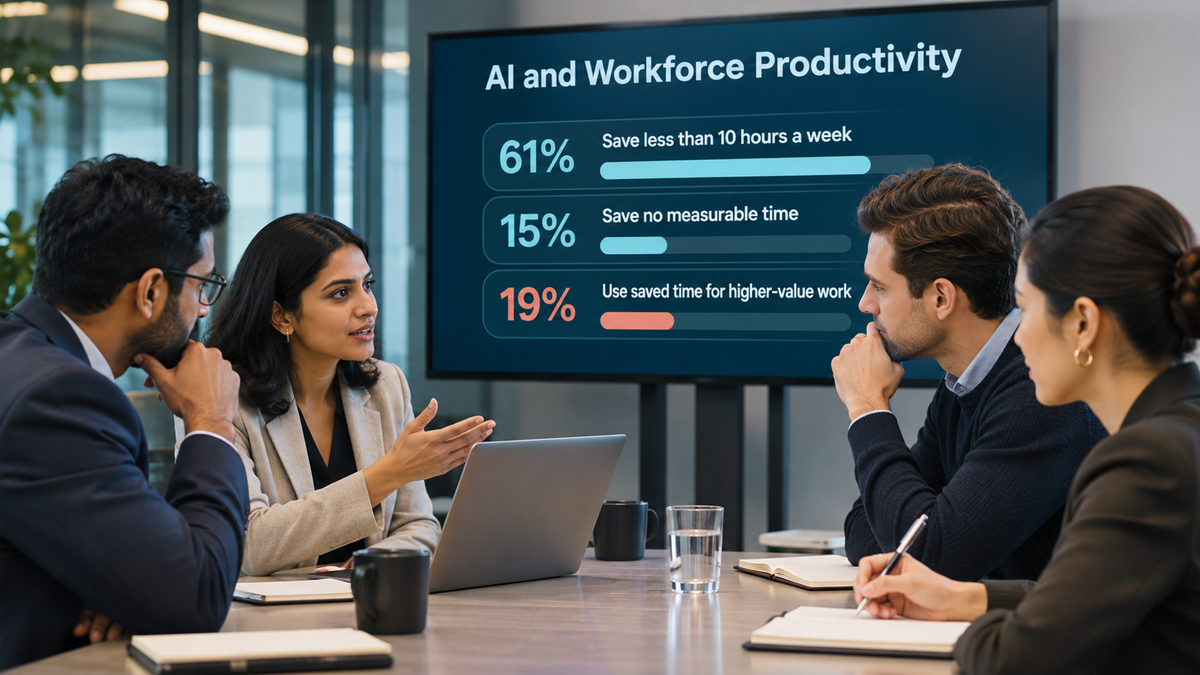
Payscale's 2026 AI Workforce Impact Report, released on November 10, highlights this disconnect. According to its employee survey, 61% of respondents say AI saves them less than 10 hours a week, while 15% report no measurable time savings. More importantly, only 19% say the time saved goes into higher-value work.
The findings raise an important question for business leaders: if AI is helping employees work faster, why isn't more of that capacity translating into better business outcomes?
For consulting firms, this is an opportunity to help clients look beyond AI adoption metrics. The focus needs to shift towards how work is redesigned, how saved capacity is allocated and how organisations measure whether AI is genuinely improving performance.
The Productivity Gap: Saving Time Is Not the Same as Creating Value
Most organisations initially evaluate AI through relatively simple measures. They look at how quickly a task can be completed, how many processes can be automated or how much manual effort can be reduced.
These measures are useful, but they capture only one part of the productivity equation.
Consider an employee who previously spent three hours preparing a weekly report. With an AI assistant, the initial draft may take considerably less time. However, the employee still needs to check the figures, validate the information, correct errors and prepare the report for stakeholders.
The task may be faster, but the total workflow has not necessarily improved by the same amount.
The situation becomes more complicated when the organisation expects the employee to use the remaining time to complete additional reports. The business may see an increase in output, but the employee may not experience a meaningful reduction in workload or an opportunity to focus on higher-value responsibilities.
This distinction matters because organisations often confuse three separate outcomes:
- Time saved: A task requires fewer working hours than before.
- Productivity improved: The employee or team produces more useful output with the available resources.
- Business value created: The improvement contributes to a measurable outcome, such as better decision-making, lower operating costs, improved service quality or increased revenue.
These outcomes can be connected, but they are not interchangeable. Organisations need to understand what happens between them.
What the Payscale Report Reveals About AI and Employee Workloads
The Payscale report offers a useful view of how employees experience AI-related productivity changes.
Its research draws on two surveys conducted in August 2026: one covering 500 employers and another covering 1,000 employees at organisations with 100 or more employees. The employee findings reflect reported experiences and perceptions, rather than a direct measurement of every organisation's productivity.
Three findings deserve particular attention.
1. Most Employees Report Relatively Modest Time Savings
The report found that 61% of employees say AI saves them less than 10 hours a week. Another 15% report no measurable time savings.
This challenges the assumption that AI adoption automatically produces substantial time savings across the workforce.
The impact varies depending on the task, the employee's role, the tools available and how well AI fits into existing processes. An employee who regularly handles repetitive research or documentation may experience a different level of benefit from someone whose work involves complex coordination, decision-making or client relationships.
For organisations, this means productivity expectations should be based on actual workflow improvements rather than broad assumptions about what AI can achieve.
2. Saved Time Is Often Absorbed by Additional Work
The report found that 28% of employees say they are completing more work in the same amount of time because of AI. On the employer side, 26% expect employees to use AI-generated time savings to complete more work.
This creates a potential gap between the purpose of adopting AI and the way its benefits are distributed.
An organisation may introduce AI to reduce repetitive tasks, but if the only response is to increase output expectations, employees may experience a faster working pace rather than a more effective way of working.
There is nothing inherently wrong with increasing output. In some roles, producing more work with the same resources is a meaningful business improvement. The issue is whether the additional workload is sustainable and whether the organisation is measuring quality alongside volume.
3. Only 19% Report Using Saved Time for Higher-Value Work
Perhaps the most important finding is that only 19% of employees say the time saved through AI goes into strategic or higher-value work.
This highlights the difference between introducing a productivity tool and redesigning the way people work.
Employees may have access to AI, but without clear direction, they may not know which responsibilities should receive the additional capacity. Managers may continue assigning work based on existing processes, while employees focus on completing more tasks rather than improving the quality of their contribution.
The opportunity is to make saved capacity intentional. Organisations need to decide what employees should do with the time AI creates and how that change will contribute to business priorities.
Why Organisations Struggle to Convert AI Time Savings Into Business Outcomes
The productivity gap is not simply a technology problem. It is also a management and operating-model challenge.
AI can make individual tasks faster, but organisations still need to coordinate people, processes and responsibilities around the new way of working.
Several issues can prevent time savings from becoming meaningful business value.
1. AI Is Added to Existing Workflows Instead of Redesigning Them
Many organisations introduce AI into an existing process without questioning whether the process itself needs to change.
For example, a consulting team may use AI to prepare initial research summaries but retain the same manual review stages, approval steps and reporting requirements. The tool reduces the time spent on one activity, but the overall workflow remains largely unchanged.
This can limit the benefit because AI is improving an individual task rather than addressing the wider process.
Organisations should examine the complete workflow, identify unnecessary steps and understand where human review is genuinely required. The objective should be to improve how the work gets done, not simply add an AI tool to the existing process.
2. Managers Measure Output but Not the Quality of Work
When employees can complete tasks faster, managers may naturally expect higher output. However, measuring only the number of completed tasks can create the wrong incentives.
An employee may produce more reports, summaries or presentations, but the additional volume does not necessarily improve the quality of decisions.
For instance, a consulting team could generate more market research documents using AI. Yet if those documents contain repetitive insights or require extensive corrections, the increase in output may not translate into better client outcomes.
Productivity measurement should therefore consider accuracy, relevance, usefulness and the amount of review required, not only speed or volume.
3. Employees Spend Time Reviewing AI-Generated Work
AI-generated output often requires human checking before it can be used confidently.
Employees may need to verify sources, check calculations, correct inaccurate information, assess assumptions and adapt the result to the specific business context.
This review is an important part of responsible AI use, but organisations should recognise that it takes time.
If the original task becomes faster but the review process becomes more demanding, the net productivity gain may be smaller than expected.
Leaders need to understand the complete cost of an AI-assisted workflow, including the human effort required to validate its output.
4. Saved Capacity Has No Clear Owner
Even when employees gain time, there may be no agreed plan for how that capacity should be used.
Managers may continue assigning tasks as they arise. Different departments may have competing priorities, and employees may not have the authority to redirect their time towards more valuable activities.
Without clear ownership, the organisation can end up absorbing time savings into general workload without creating a measurable improvement.
A better approach is to identify who is responsible for allocating the additional capacity and which business priorities should benefit from it.
5. Employees Are Not Given Enough Opportunity to Develop New Skills
AI changes the skills required to perform many roles. Employees may need to become better at evaluating AI outputs, interpreting information, managing workflows and making decisions based on generated analysis.
However, if all saved time is redirected towards additional tasks, employees may have little opportunity to develop these capabilities.
Organisations that expect employees to work effectively alongside AI should also consider how training and skill development fit into the redesigned workflow.
The Consulting Opportunity: Help Clients Redesign Work, Not Just Adopt Tools
For boutique consulting firms, this issue creates an opportunity to offer more practical AI transformation advice.
Many clients already understand that AI can improve productivity. What they may not understand is how to translate that potential into changes across their operating model.
Consultants can help clients move from technology adoption to workforce and process redesign.
Start With the Work, Not the Technology
Before recommending another AI tool, consultants should understand how work currently gets done.
Which activities consume the most time? Where do employees repeat the same tasks? Which processes involve unnecessary handoffs? Where is human judgment essential, and where could AI provide useful support?
This assessment helps identify opportunities where AI can improve the wider workflow rather than simply accelerate one isolated task.
Identify Where Saved Capacity Should Go
Once a workflow has improved, the organisation needs to decide how the additional capacity will be used.
Depending on the business objective, this could involve:
- Giving employees more time for client-facing activities.
- Improving the depth of research and analysis.
- Reducing delays in internal decision-making.
- Investing more time in quality assurance.
- Developing employee skills for AI-enabled roles.
- Supporting strategic projects that previously lacked capacity.
The right allocation will differ between organisations. What matters is that the decision is deliberate and connected to a business priority.
Redesign Performance Measurement
Traditional productivity metrics may not fully capture the impact of AI-assisted work.
Consultants should help clients establish measures that reflect the intended outcome. For example, if AI is introduced to support research, the organisation may want to assess not only research completion time but also the quality of findings, the time required for verification and how effectively the research supports decisions.
This provides a more complete picture of whether the workflow is improving.
A Practical Framework for Turning AI Time Savings Into Business Value
Organisations do not need to redesign every department at once. They can begin with a specific workflow and use a structured process to evaluate the impact.
Step 1: Establish a Baseline
Measure how the process works before introducing AI. Record the time required, the people involved, the output produced, the common delays and the quality expectations.
Without a baseline, it becomes difficult to determine whether AI has genuinely improved performance.
Step 2: Measure the Net Time Saved
Do not measure only how quickly AI generates an initial output. Include the time spent preparing inputs, reviewing results, correcting errors and completing the remaining workflow.
The objective is to understand the actual change in total effort.
Step 3: Define the Intended Use of Additional Capacity
Decide what the organisation wants employees to do with the time saved. This could be higher-value client work, improved analysis, training or increased output.
The decision should reflect business priorities rather than automatically increasing workloads.
Step 4: Assign Ownership
Managers and team leaders should be responsible for ensuring that saved capacity is used as intended. Employees should understand which activities are being prioritised and how their responsibilities may change.
Step 5: Track Quality and Business Impact
Review the results against the original baseline. Measure whether the process is faster, whether output quality has improved and whether the additional capacity has contributed to the intended business outcome.
If the expected benefit is not appearing, examine whether the workflow, training or resource allocation needs to change.
Step 6: Reassess the Process Regularly
AI tools and business requirements continue to evolve. A workflow that delivers value today may need adjustment as the technology, team capabilities or client expectations change.
Regular reviews help organisations avoid treating AI implementation as a one-time project.
What Boutique Consulting Firms Should Help Clients Ask
The conversation around AI productivity needs to move beyond questions such as how many hours a tool can save or how many tasks it can automate.
Consultants should encourage clients to ask more commercially relevant questions:
- Which business process is actually improving?
- How much time is saved after accounting for review and correction?
- Where is the additional employee capacity being allocated?
- Are employees producing better outcomes or simply more output?
- What new skills are required to work effectively with AI?
- How will management know whether the investment is creating value?
These questions help clients connect technology decisions with operating performance.
They also give boutique consulting firms an opportunity to differentiate their work. Instead of delivering generic AI adoption recommendations, they can help clients make specific decisions about processes, workforce capacity, performance measurement and implementation priorities.
Where ConsultantAI Fits Into the Consulting Workflow
ConsultantAI provides AI-powered tools designed to support analytical activities used in management and strategy consulting, including market sizing and financial modelling.
These tools can support parts of the analytical preparation process, helping consultants structure their work and develop an initial basis for further examination.
However, the wider productivity opportunity depends on how consultants use the time and capacity these tools create. Faster preparation should create room for stronger analysis, more thoughtful recommendations and better client engagement.
The objective is not simply to produce more documents in less time. It is to make the consulting process more effective while preserving the professional judgment that clients rely on.
Explore the available tools at ConsultantAI.
Conclusion: The Value of AI Depends on What Organisations Do With the Time It Saves
AI can reduce the effort required for many tasks, but the benefits do not automatically translate into better business performance.
Payscale's 2026 AI Workforce Impact Report highlights this challenge. While many employees report some time savings, only 19% say that saved time is going towards higher-value work. For organisations investing in AI, this should be a reason to examine how workflows, responsibilities and performance expectations are changing.
The next stage of AI adoption needs to focus on more than deploying tools. Businesses must decide how work should be redesigned, how employees should use the additional capacity and how the resulting improvements will be measured.
For consulting firms, the opportunity is to help clients make that transition. By connecting AI adoption with workforce planning, process improvement and measurable business outcomes, consultants can help organisations capture more value from the technology they already use.
AI can give employees more time. Turning that time into meaningful business progress is a management decision.
Sources and Further Reading
Get new posts and free tools
Join the list: one email when we publish. No spam.