
The Technology Is Changing. Is the Work Changing With It?
Artificial intelligence is becoming increasingly embedded in business operations. Organisations are introducing AI tools to support research, improve productivity, automate repetitive activities and help employees make better use of information.
For many business leaders, the first priority has been selecting the right technology. They are evaluating platforms, improving data availability and identifying opportunities to introduce AI into existing processes.
These investments matter, but they do not automatically change how an organisation operates.
An employee may receive a new AI assistant but continue following the same reporting process. A department may introduce automation without changing the approval structure around its work. A company may invest in better technology while employees remain uncertain about how their responsibilities should evolve.
This creates a gap between technology adoption and organisational transformation.
Research from Eagle Hill Consulting, conducted by Ipsos in August 2026, highlights this difference. Among 306 senior business leaders surveyed, 52% identified data quality and availability as a leading factor contributing to AI success, while 47% pointed to technology platforms and infrastructure. However, only 18% identified work redesign and just 9% cited organisational culture.
Yet, when asked specifically about cultural barriers, 84% reported at least one factor limiting their organisation's AI success.
The findings suggest that organisations may be paying more attention to the tools they introduce than to the working practices required to make those tools valuable.
For boutique consulting firms, this creates an important opportunity: helping clients move beyond technology implementation and redesign the way their people, processes and systems work together.
AI transformation is not complete when a tool goes live. It begins when the organisation changes how work gets done.
The Research Behind the AI Transformation Gap
Eagle Hill Consulting's AI Capabilities Survey, conducted by Ipsos from August 3–6, 2026, examined how senior business leaders view AI adoption, organisational readiness and the factors influencing successful implementation.
The survey included 306 directors and above at US companies with annual revenue of at least $100 million where AI adoption was established.
Four findings stand out.
1. Data and Technology Receive the Most Attention
The survey found that 52% of leaders identified data quality and availability as a leading contributor to AI success. Another 47% identified technology platforms and infrastructure.
These findings reflect the importance of having reliable information and suitable systems in place before introducing AI into business operations.
Without accessible data and compatible technology, even a well-designed AI initiative can struggle to deliver useful results.
However, these capabilities represent only part of the transformation process. Having the right platform does not automatically mean employees will use it effectively or that existing workflows will improve.
2. Work Redesign Receives Far Less Attention
Only 18% of respondents identified redesigning work itself as a major contributor to AI success.
This is an important gap because AI often changes how individual tasks are completed, which can affect responsibilities, approval processes, collaboration and the overall structure of a workflow.
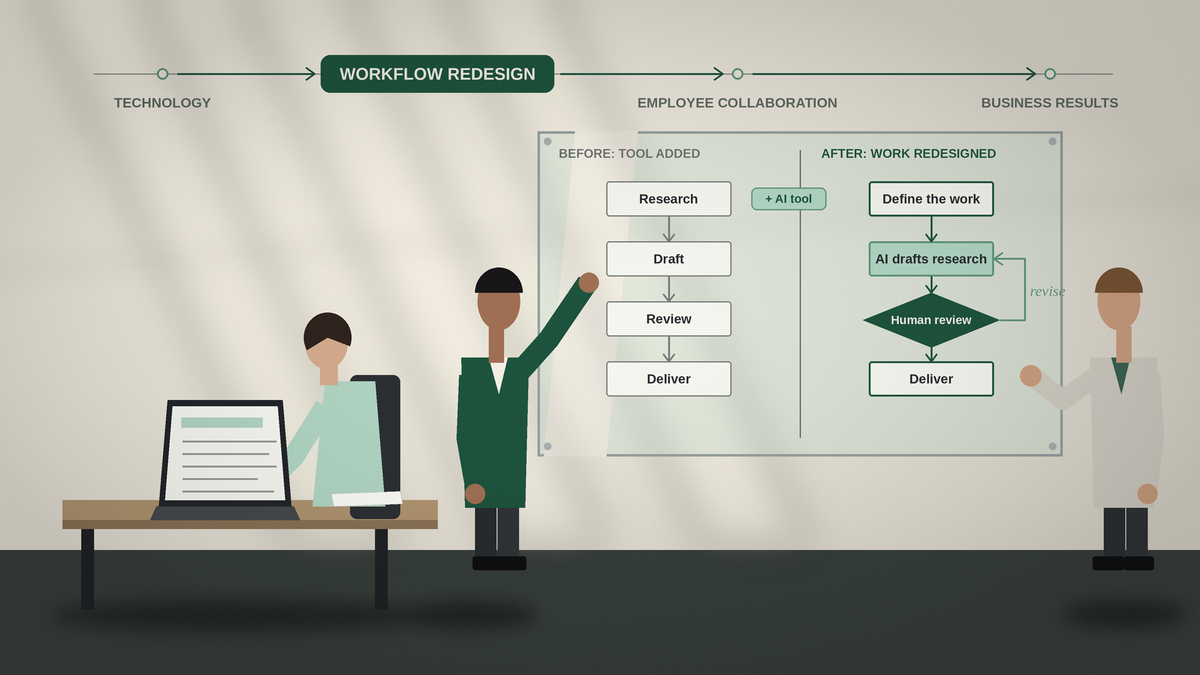
For example, an organisation may introduce AI to support research preparation. Employees can now organise information more quickly, but the organisation may still require the same manual handoffs and approval stages.
The technology has improved one activity, but the wider process has not changed.
This limits the potential benefit because the organisation is adding AI to an existing way of working rather than reconsidering how the work should be performed.
3. Organisational Culture Receives Even Less Attention
Only 9% of leaders identified organisational culture as a leading factor contributing to AI success.
However, the same research found that 84% of respondents reported at least one cultural factor limiting their organisation's AI success.
This difference deserves attention.
Culture may not be the first thing leaders consider when planning an AI initiative, but it can influence whether employees adopt new practices, experiment with unfamiliar tools and change established ways of working.
An organisation can provide access to advanced technology and still struggle if employees are reluctant to change their routines or managers do not create opportunities to use AI effectively.
4. Cultural Barriers Are Already Affecting Adoption
The research identifies several specific cultural challenges:
- 30% reported that employees hesitate to change established ways of working.
- 27% identified governance processes that slow experimentation and learning.
- 26% said short-term priorities crowd out AI experimentation and learning.
These findings show that the challenge is not simply whether employees have access to AI.
It is also whether the organisation creates the conditions for people to learn, experiment responsibly and incorporate new capabilities into their everyday responsibilities.
Why Introducing AI Tools Does Not Automatically Improve Work
Organisations often approach AI implementation as a technology project. They select a platform, configure it, provide access to employees and measure whether people are using it.
This approach can help establish adoption, but it does not necessarily establish business value.
The wider process needs to be examined.
1. Existing Workflows Remain Unchanged
Many organisations introduce AI into processes that were designed before the technology existed.
Employees may use AI to prepare an initial report, but the remaining process continues to involve the same reviews, handoffs and approvals.
In some cases, this can create additional work because employees now need to review AI-generated material alongside their existing responsibilities.
The opportunity is to examine the entire workflow rather than focusing only on the task being automated.
Consultants should help clients identify which activities can be redesigned, which review stages remain necessary and where responsibilities need to change.
2. Employees Are Expected to Adapt Without Enough Preparation
Introducing a new tool does not automatically give employees the skills or confidence required to use it effectively.
Some employees may not understand where AI is appropriate. Others may be uncertain about the accuracy of its outputs or the implications of using it with business information.
Without practical guidance, employees may continue using familiar processes even when better alternatives are available.
Training should therefore be connected to actual responsibilities. Employees need to understand how AI fits into their work, what they remain accountable for and when human review is necessary.
3. Managers Continue Measuring the Old Definition of Productivity
AI can change the time required to complete certain tasks, but traditional performance measures may not recognise the difference.
For example, a team may use AI to reduce research preparation time. However, managers may continue measuring performance only through the number of reports completed.
This overlooks whether employees are spending more time on deeper analysis, client communication or higher-value responsibilities.
Organisations need to reconsider what good performance looks like when AI becomes part of the workflow.
4. Experimentation Is Not Supported by the Operating Environment
Employees may identify useful AI applications but struggle to test them because approval processes are unclear or governance requirements are difficult to navigate.
Responsible controls are important, particularly when confidential information or important business decisions are involved. However, organisations also need a practical process that allows suitable experimentation.
The goal should be to make responsible adoption possible, not to make every new use case unnecessarily difficult to evaluate.
The Opportunity: Redesign Work Around What AI Can Actually Do
For consulting firms, the findings create an opportunity to support a different kind of AI transformation engagement.
Instead of starting with a list of tools, consultants can begin by understanding how work currently happens and identifying where AI can make a meaningful difference.
This requires examining people, processes, technology and organisational behaviour together.
Start With the Existing Workflow
Before recommending AI, understand the process the client wants to improve.
Identify where employees spend time, where information is transferred between teams, which tasks are repetitive and where decisions are delayed.
For example, a consulting client may spend considerable time preparing weekly management reports. The problem may not simply be report generation. It could involve information being collected from multiple systems, repeated manual checks and unclear ownership of the final review.
AI may help with some activities, but the entire process should be examined before deciding where it belongs.
Identify Where Human and AI Responsibilities Should Change
Not every activity should be automated, and not every task needs the same level of human involvement.
Consultants should help clients distinguish between activities where AI can provide assistance and responsibilities that require professional judgment.
Research organisation, initial drafting and information preparation may be suitable for AI support. Decisions involving business priorities, sensitive information or significant consequences may require more extensive human oversight.
The objective is to establish a sensible division of responsibilities rather than applying automation indiscriminately.
Build Employee Development Into the Transformation
AI adoption changes the skills employees need.
Teams may require stronger capabilities in evaluating generated information, interpreting data, reviewing outputs and managing AI-assisted workflows.
Eagle Hill's research highlights a gap in this area. Only 31% of surveyed leaders said employee development for AI was planned as part of broader business and workforce planning.
This suggests that training is not always being treated as part of the wider transformation.
Consultants can help organisations identify the skills required for redesigned roles and establish practical development plans that reflect how work is changing.
Establish a Process for Continuous Improvement
Work redesign should not be treated as a one-time activity completed during implementation.
AI tools evolve, business requirements change and employees discover new ways to use technology.
Eagle Hill found that only 45% of respondents said their organisations had established management practices to continuously review and improve work as AI and business needs evolve.
Consulting firms can help clients introduce regular reviews of workflows, employee feedback, performance and operational requirements.
This makes AI transformation an ongoing management discipline rather than a project that ends when the technology is deployed.
A Practical Framework for AI-Driven Work Redesign
For organisations moving beyond experimentation, a structured approach can help connect AI adoption with actual changes in business operations.
Step 1: Map the Current Way of Working
Document how the existing process operates, including tasks, responsibilities, handoffs, approval stages and common delays.
This provides a baseline for understanding where AI may create value.
Step 2: Identify the Most Suitable Opportunities
Evaluate which activities could benefit from AI based on their frequency, effort, complexity, business importance and associated risks.
Prioritise opportunities that address genuine business problems rather than selecting use cases simply because the technology is available.
Step 3: Redesign the Workflow
Determine how the process should operate once AI becomes part of it.
Clarify which activities can be supported by AI, where human review remains necessary and whether responsibilities or approval stages need to change.
Step 4: Prepare Employees and Managers
Explain how the new workflow will operate and provide training that reflects employees' actual responsibilities.
Managers should understand how to support adoption and evaluate performance in the redesigned environment.
Step 5: Measure the Results
Establish whether the new process is improving the intended business outcome.
Measures may include processing time, output quality, error rates, employee capacity, customer experience or operational costs.
The appropriate measures will depend on the workflow being redesigned.
Step 6: Review and Improve Continuously
Collect feedback, monitor performance and identify where additional adjustments are required.
This ensures that AI continues to support the organisation as its processes and business requirements evolve.
What This Means for Boutique Consulting Firms
The findings from Eagle Hill Consulting reinforce an important point: clients do not necessarily need more AI tools. They need help understanding how those tools should change the way their organisations operate.
For boutique consulting firms, this creates several opportunities.
AI readiness assessments: Help clients evaluate whether their people, processes and data are prepared for AI adoption.
Workflow redesign: Identify repetitive activities, unnecessary handoffs and opportunities to introduce AI into existing processes.
Change management: Help employees and managers understand how responsibilities should evolve as AI becomes part of daily work.
Performance measurement: Establish meaningful ways to evaluate whether AI is improving productivity, quality and business outcomes.
Continuous improvement: Help clients create management practices for reviewing and adapting workflows as AI capabilities develop.
These activities allow consulting firms to connect technology decisions with operational improvements.
They also create opportunities for longer-term client relationships because work redesign and organisational adaptation require ongoing attention.
Where ConsultantAI Fits Into the Consulting Workflow
ConsultantAI provides AI-powered tools designed for analytical activities used in management and strategy consulting, including market sizing and financial modelling.
These tools can support parts of the analytical preparation process, helping consultants structure information and examine business assumptions.
However, the broader value of consulting work comes from how professionals interpret the information, understand the client's circumstances and develop appropriate recommendations.
The objective is to make analytical preparation more manageable while keeping human judgment, strategic thinking and client-specific decision-making central to the process.
Explore the available tools at ConsultantAI.
Conclusion: The Next AI Advantage Will Come From Changing How Work Gets Done
Eagle Hill Consulting's research highlights a gap that many organisations may be overlooking.
While leaders recognise the importance of data quality and technology platforms, far fewer identify work redesign and organisational culture as major contributors to AI success. Yet 84% report at least one cultural factor limiting their organisation's ability to benefit from AI.
This suggests that the next stage of AI transformation requires more than technology investment.
Organisations need to reconsider workflows, prepare employees, support responsible experimentation and establish management practices that continuously improve how work gets done.
For boutique consulting firms, the opportunity is to help clients connect AI adoption with these organisational changes.
The firms that create lasting value will not simply help clients introduce new tools. They will help them build better ways of working around those tools.
AI provides the capability. The organisation determines how much value that capability creates.
Sources and Further Reading
- Eagle Hill Consulting – New Research Finds AI Is Reshaping How Organizations Work, but Leadership and Culture Lag Behind (September 8, 2026)
- Eagle Hill Consulting – New Research: Companies Risk Falling Behind in AI Race as Workforce Strategies Fail to Keep Pace (November 17, 2026)
- Eagle Hill Consulting – AI Transformation: Three Risks Leaders Must Manage
Get new posts and free tools
Join the list: one email when we publish. No spam.