
"If it takes just as much time to verify the work than it takes to do the work, AI is not really helpful."
Lucas Adams, VP of Engineering at Thomson Reuters, said that on 22 October 2026, at the launch of the company's upgraded AI platform for tax, audit and accounting work. It's an unusual thing to hear at a product launch, and it's the most honest description of where enterprise AI is right now.
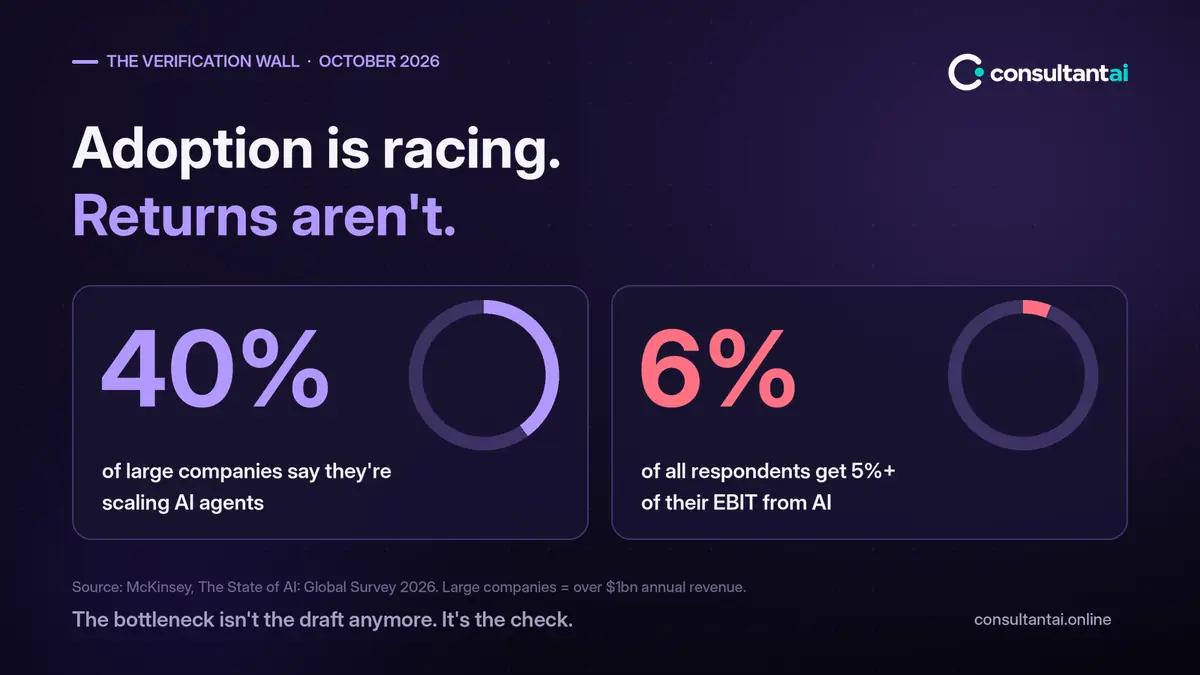
Adoption is racing. Returns aren't.
McKinsey's State of AI survey for 2026 shows how wide the gap has become:
- 40% of respondents at large companies (over $1 billion in annual revenue) say they are scaling AI agents, up from 27% a year earlier.
- Only about 6% of all respondents say AI generates at least 5% of their EBIT, a share that has stayed flat since last year.
- 37% of respondents attribute at least some EBIT impact to AI, about the same as last year.
These figures come from different groups, so they aren't a single before-and-after comparison. But the direction is clear: companies are putting AI into far more of their work, and far fewer are seeing it in their profits.
McKinsey frames the gap as an organisational problem. Thomson Reuters points to a more specific one. When AI produces work that someone has to check line by line, the time saved on drafting gets spent again on review.
What this looks like inside a consulting firm
We've been running a benchmark with boutique consulting firms on how they actually use AI. One founder of a commercial due diligence boutique gave us the clearest version of the problem.
AI cut the first draft of an interim client deck from three to four weeks of analyst time to about one week. But every stat, quote and source still has to be checked by hand against the original before anything ships. In their words, that verification step "is where most of the time savings get spent back."
That matches what we hear again and again. The draft is no longer the slow part. The check is.
And the check is expensive, because it usually lands on the most senior person on the engagement. A partner signing a deck has to be confident that every number in it is real. If AI wrote the first version, that confidence takes time.
What boutique firms told us about AI
Across the replies to our benchmark so far, the same pattern keeps showing up: AI is already part of the workflow, but trust stops it at the edge of the deliverable. A few examples, shared anonymously:
- A US commercial due diligence boutique uses AI for secondary research and market sizing, expert-call transcription and first-pass synthesis, interview guides, deck skeletons and proposal drafting. It does not use AI for the final client-facing analysis, the recommendations, or the numbers that go in the report.
- An ex-McKinsey independent advisor in the US uses AI across research, slides, modelling and proposals, and says a first draft can take under an hour, depending on the depth required. Their blockers: accuracy and confidentiality.
- A strategy, M&A and transformation advisory in Copenhagen uses AI for research and as a sparring partner.
- A strategy consultancy in Spain uses AI mainly for client relationship management so far, not yet for consulting work or document preparation.
The spread is wide, from firms where AI touches almost every step to firms that haven't let it near a client document. But the line they draw is remarkably consistent: AI can help produce the work, and people still own the numbers.
The two blockers we hear most often are accuracy and confidentiality. Both are, at heart, about the same question: can the firm stand behind what goes to the client?
Verification is a confidentiality question too
Confidentiality comes up alongside accuracy for a reason. Checking AI output properly means putting it next to the client's own material: the data room, the management accounts, the interview notes. Many firms are rightly careful about where that material is allowed to go.
So a verification step can't just be "paste it into another chatbot and ask if it's right". Asking a general-purpose model to check its own work moves client data into another tool and still doesn't prove anything, because the same question can come back with a different answer. Verification has to happen against the source documents, in a place the firm controls, with a record it can keep.
Five questions to ask before the next deck goes out
If you lead engagements, these five questions will tell you quickly whether your team has a verification step or just a review habit:
- Which numbers in this deck came from AI, and which came straight from the client's material?
- For each figure, can someone open the source document and point to it?
- Were any quotes, citations or references generated rather than copied from a source?
- Which figures are estimates, and are they clearly labelled as estimates?
- If the client asked in six months where a number came from, could we show them?
If the honest answer to any of these is "not sure", the deck isn't verified yet, however good it looks.
What changes when verification is built in
When checking is a defined step instead of a heroic effort the night before a readout, three things change. Partners spend their review time on judgment rather than on hunting for sources. Teams can use AI more freely in drafting, because they know nothing unverified will reach the client. And the firm ends up with an evidence trail for every engagement, which is useful long after the project closes, whether a client questions a figure or a new team picks up the work.
Why the verification wall hits consultants hardest
Three things make consulting especially exposed:
- The output is the numbers. A strategy deck or due diligence report lives or dies on its figures. One wrong market size or misquoted source can undo the whole deliverable.
- Pricing doesn't flex. On a fixed-fee engagement, hours spent re-checking AI output come straight out of margin.
- Nobody is assigned to check. In a court, the other side checks every citation. In consulting, a draft moves from analyst to manager to partner to client, and nobody is specifically paid to trace every number back to its source.
Getting past the wall
The answer isn't to stop using AI, or to trust it more. It's to make verification a defined step rather than an informal one:
- Trace every number in a deliverable to a specific source document.
- Confirm that the source exists and actually contains the figure.
- Normalise units before comparing, so "3.2M" and "3,200,000" are recognised as the same number.
- Record which figures were verified, which are estimates, and which couldn't be traced, and keep that record with the engagement.
- Make the verified list part of the partner's sign-off.
Done by hand, this is slow. That's exactly the work we're building ConsultantAI for: comparing the numbers in a deliverable against the client's own documents, flagging the ones that don't trace back, and recording the result with the engagement, so the verification doesn't all land on the partner.
The takeaway
The first wave of AI in consulting was about speed. That wave has largely arrived: drafts that took weeks now take days. The next wave is about trust. The firms that pull ahead won't be the ones generating the most AI output. They'll be the ones who can show, number by number, that their output is right.
Where does verification eat your team's time today?
Sources
- SiliconANGLE, "Thomson Reuters folds AI into its professional tax and audit software" (22 October 2026): https://siliconangle.com/2026/10/22/thomson-reuters-folds-ai-into-its-professional-tax-and-audit-software/
- McKinsey, "The State of AI: Global Survey 2026": https://www.mckinsey.com/capabilities/quantumblack/our-insights/the-state-of-ai
- McKinsey, "The AI operating system: A new way for CEOs to run the enterprise" (13 October 2026): https://www.mckinsey.com/capabilities/quantumblack/our-insights/the-ai-operating-system-a-new-way-for-ceos-to-run-the-enterprise
Get new posts and free tools
Join the list: one email when we publish. No spam.