
Over the past month we asked boutique consulting founders three simple questions about AI: what they use it for today, how long a first-draft deliverable takes now, and what holds them back from relying on it more.
Nine founders and partners answered in full, from the US, Germany, Denmark, Spain and the Netherlands. Most run strategy, M&A, due diligence or transformation practices, and six of the nine spent part of their careers at McKinsey or Bain. All nine agreed to be quoted anonymously, so the answers below are paraphrased and unattributed.
In October we shared early answers from the first founders who replied. This is the fuller picture, with all nine.
Nine answers is not a statistically representative sample. But these are experienced operators describing their own work, and the pattern in their replies was clear enough to share.
1. AI is already in the workflow
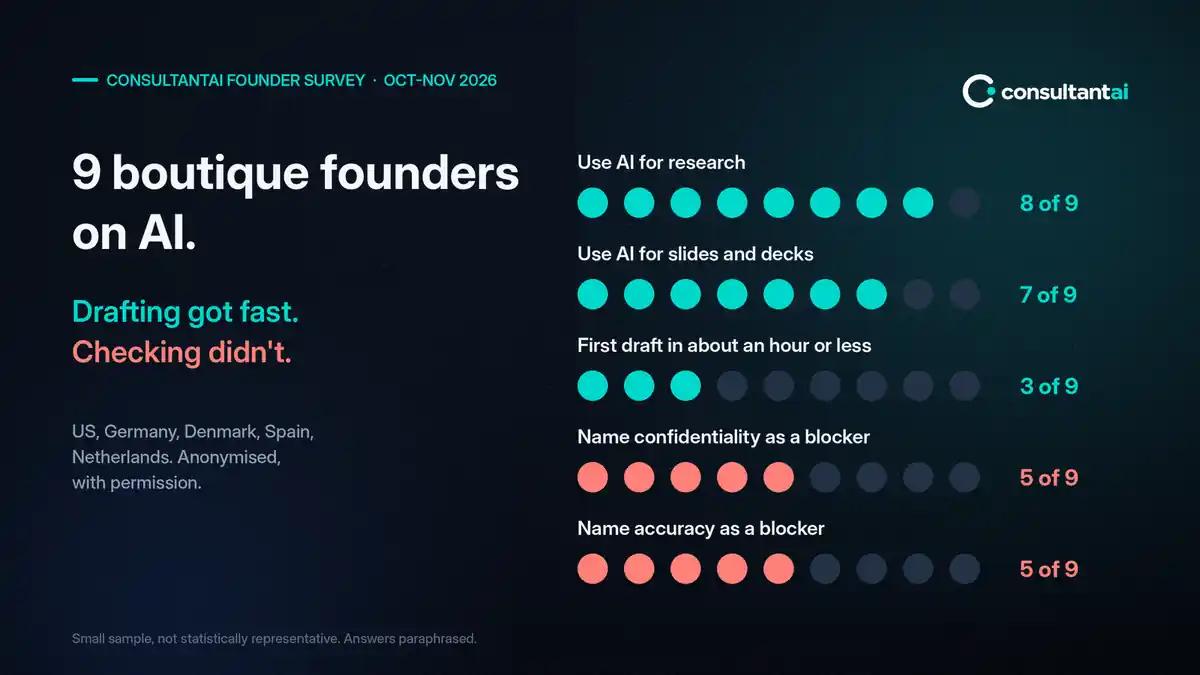
This is no longer a group deciding whether to use AI. Eight of the nine use it for research. At least seven use it to build slides and decks. Several described AI running through most of their process:
- Secondary research and market sizing
- Expert-call transcription and first-pass synthesis
- Interview guides written from the statement of work
- Deck skeletons, slide copy and proposal drafts
- Modelling and client communications
Only one founder said AI is not yet part of their consulting work. They use it for client relationship management instead, and are watching how the tools mature.
2. Drafting got fast, but the answers vary widely
When we asked how long a first-draft deliverable takes now, we got nine different answers:
- Three founders said a first draft now takes about an hour or less.
- One estimated AI saves about 80% of slide time. Another expects a 40-60% reduction.
- A US due-diligence founder said an interim deck that used to take three to four weeks of analyst time now takes about one week.
- Three said they couldn't give a single number: the work is too varied, big projects still take weeks, and drafts are still human-driven.
Same broad set of tools, very different results. The difference wasn't how advanced the model was. It was what each firm still has to do after the draft exists.
3. Checking didn't get faster
The most useful answer came from the due-diligence founder whose drafting time dropped from weeks to days. Models still fabricate quotes, sources and numbers, he said, so every statistic in the deliverable is verified by hand. That verification takes back most of the time AI saved.
His team does not use AI for the final client-facing analysis, the recommendations, or the numbers in the report. Those stay human.
That matches what other founders described. AI produces a draft quickly. Making it something a partner will sign is still slow, because each number has to be traced back by hand.
4. Confidentiality and accuracy are the real blockers
When we asked what holds them back, two answers dominated:
- Five of nine named confidentiality: putting client data into tools they don't control.
- Five of nine named accuracy: invented sources, wrong numbers, weak logic.
A Danish strategy and M&A advisor put it in terms of what clients will pay for. AI output often lacks logic, precision and traceability, he said, and its slides usually have to be redone. As a client himself, he would refuse to pay for automated output.
A Spanish strategy firm said it wants tools that meet legal, tax and advisory standards before relying on them. Two founders also said the gap is partly know-how: they want to get better at using AI, not just get better tools.
5. Founders draw a clear line
Almost every founder described the same boundary, in different words. AI does the gathering, the first pass and the formatting. The judgment stays with them.
A Dutch founder said it best: it is responsible to let AI work for you, not think for you. His firm uses AI for research and operational tasks, but the draft deliverables themselves are not created by AI.
That line matters commercially. Clients pay boutique firms for senior judgment. If AI blurs where the judgment came from, it weakens the thing the client is paying for.
6. Saved time goes into depth, not discounts
One more detail from the due-diligence founder: the time AI saved went into more expert calls and tighter synthesis, not into billing fewer hours. Faster drafting let the team do more of the work clients actually value.
That is the optimistic version of the story. It only holds if the saved time isn't swallowed by re-checking the AI's output.
What this means for boutique firms
- Measure the whole workflow, not the draft. If verification takes back most of the saving, the real bottleneck is checking.
- Decide what AI is not allowed to do. The founders who were most comfortable with AI had the clearest line around final analysis, recommendations and numbers.
- Treat confidentiality as a buying criterion. Five of nine founders named it. Ask any tool where client data goes and whether it is used for training.
- Make sources visible. A number you can trace in seconds is a number you can defend in front of a client.
How we're using this at ConsultantAI
We started this survey to understand how boutique firms actually use AI, before deciding what to build. The answers point in one direction: the problem isn't generating drafts. It's trusting them.
So ConsultantAI is built around checking. Every figure in a deliverable is traced back to its source, there is a human review at every stage, and client data is never used to train models. The goal isn't a faster first draft. It's a draft you can verify quickly and sign with confidence.
About this survey
We contacted boutique consulting founders and partners in the US and Europe through LinkedIn between October and November 2026. Nine answered all three questions in full. All nine agreed to be quoted anonymously, and their answers are paraphrased here. With nine responses, these findings describe a pattern, not a statistic.
If you run a boutique consulting firm and want to add your answers, or receive the full benchmark when it closes, contact us at consultantai.online.
Get new posts and free tools
Join the list: one email when we publish. No spam.