
The Difference Between Producing Work and Creating Value
A consulting engagement often begins long before the first recommendation is presented to a client. Consultants may spend hours reviewing contracts, examining operational reports, analysing financial records, comparing industry benchmarks and organising information collected from multiple sources. These activities are necessary because a recommendation is only as strong as the information and analysis supporting it. However, the amount of time spent preparing documents does not necessarily reflect the value a client ultimately receives from the engagement.
Consider a company that brings in a boutique consulting firm to identify opportunities to improve its operating model. The consulting team may need to review supplier agreements, analyse operational expenses, examine performance reports and understand existing business processes. These documents provide the information required to understand the situation, but the client is not simply paying someone to read them and prepare a summary. The client expects the consulting team to identify where money is being lost, understand why certain processes are inefficient, recognise risks that may not be immediately visible and recommend changes that can improve business performance.
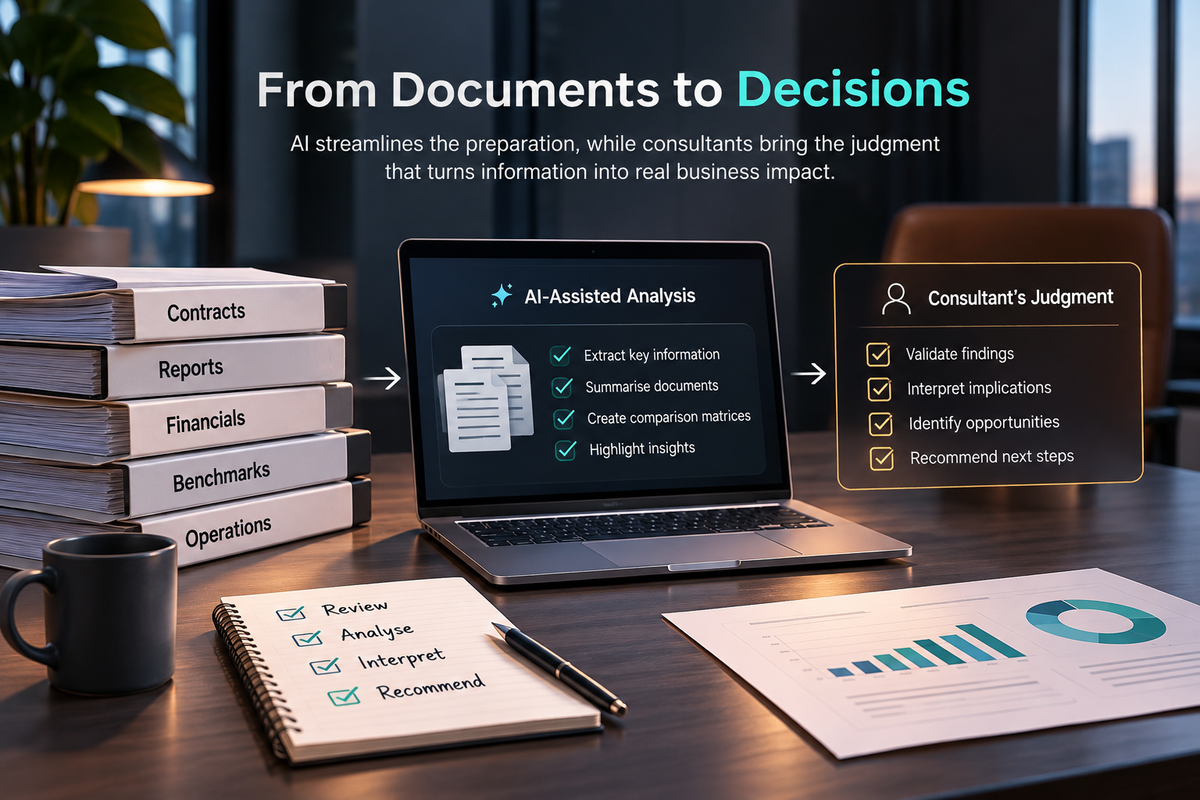
This distinction is becoming increasingly important as AI tools enter consulting workflows. Tasks such as document summarisation, information extraction, research organisation and initial analysis can increasingly be supported by AI. That creates an opportunity for consultants to spend less time on repetitive preparation and more time evaluating findings, challenging assumptions and developing recommendations. However, faster document production alone does not create better consulting outcomes.
Clients hire consultants for the judgment that turns information into business decisions, not simply for the documents assembled along the way.
The Hidden Cost of Document-Heavy Consulting Work
For boutique consulting firms, time and expertise are two of their most important resources. Unlike larger consulting organisations with extensive research and delivery teams, boutique firms often operate with smaller teams where the same consultants are responsible for gathering information, analysing data, communicating with clients and preparing final recommendations. When a significant portion of their working hours is consumed by repetitive preparation, it becomes difficult to allocate enough attention to the strategic aspects of an engagement.
The problem is not that documentation is unnecessary. Contracts need to be reviewed, financial information needs to be organised and research findings need to be presented clearly. The challenge is that these activities can become disproportionately time-consuming when information is scattered across different formats, repeated across multiple documents or difficult to compare. Consultants may end up spending more time locating and restructuring information than interpreting what it actually means for the client's business.
1. Research and Document Review Consume Valuable Time
Consulting projects frequently involve large collections of documents, including contracts, annual reports, internal presentations, financial spreadsheets, interview notes and industry research. A consultant may need to examine several sources to answer what appears to be a relatively straightforward business question. The difficulty increases when information is inconsistent, when the same figures appear differently across documents or when important details are buried within lengthy reports.
For example, a consultant evaluating procurement performance may need to compare supplier agreements, payment terms, renewal provisions and historical spending records. Reading each document is only the first step. The consultant must identify relevant information, check whether the figures are comparable and understand which findings deserve further investigation. When this process is repeated across multiple suppliers or business units, the preparation workload can grow considerably.
2. Organising Findings Creates Additional Work
After reviewing the available information, consultants must transform their findings into something that can be understood and used by the project team and the client. This might involve preparing comparison matrices, summarising research, structuring financial information, creating working documents or transferring findings into presentation slides. Each of these activities requires attention to detail, especially when the information needs to remain consistent across different deliverables.
The difficulty is that organising information can become a repetitive process. Consultants may find themselves extracting the same figures into different formats, updating several working documents when a new source becomes available or repeatedly restructuring findings to match the requirements of a presentation. Although this work is part of delivering a professional engagement, it does not always require the same level of expertise as evaluating the commercial implications of the findings.
3. Rework Can Reduce the Benefits of Faster Preparation
Producing an initial draft quickly does not mean that the work is ready for a client. Research findings may contain gaps, financial assumptions may need to be checked and comparisons may need to be revised when new information becomes available. Senior consultants must still examine whether the analysis is accurate, whether the sources support the conclusions and whether the recommendations make sense within the client's business context.
This is where poorly designed workflows can create additional work. A team might receive a research summary faster but spend considerable time checking its sources. A financial model might be generated quickly but require extensive correction because the underlying assumptions were incomplete. The initial time saving can therefore be reduced by the effort required to validate and improve the output. The real objective should be to improve the entire process, including review and rework, rather than focusing only on how quickly the first draft is produced.
Where AI Can Change the Consulting Workflow
AI creates an opportunity to reduce some of the repetitive work involved in consulting research and preparation. Depending on the task and the quality of the underlying system, AI-assisted workflows can help extract information from documents, organise findings, summarise relevant material, compare selected information and prepare initial drafts for further review. These capabilities can be useful when consultants are dealing with large volumes of information and need a more structured starting point for their analysis.
However, the purpose of introducing AI should not be to automate every activity simply because automation is possible. Consulting work involves context, commercial priorities and decisions that cannot be evaluated through document processing alone. A tool may identify a clause in a supplier agreement, but understanding whether that clause creates a meaningful commercial risk requires further examination. Similarly, a system may summarise a financial report, but determining which cost variations require management attention involves interpretation and business judgment.
A more effective approach is to identify the parts of the workflow where AI can reduce repetitive preparation while keeping important analytical and decision-making responsibilities with the consulting team. This creates a clearer division of work: technology supports information processing, while consultants focus on validating findings, understanding implications and developing recommendations.
An Example: From Manual Review to AI-Assisted Preparation
Imagine a boutique consulting firm conducting a procurement review for a client with multiple supplier relationships. The team needs to examine supplier contracts, compare renewal terms, identify relevant commercial conditions and understand how these agreements relate to the client's procurement strategy. Traditionally, consultants may spend a considerable amount of time locating the relevant clauses, extracting information and assembling comparison tables before they can begin discussing potential improvements.
An AI-assisted workflow could help prepare an initial overview by extracting selected contract information, organising it into a comparison matrix and highlighting sections that may require closer examination. The consultant can then review the extracted information against the original agreements, investigate inconsistencies and identify which commercial terms deserve attention. Instead of beginning with a blank document and manually collecting every detail, the team has a structured starting point for its analysis.
The important distinction is that the AI-assisted output is not the final recommendation. The consultant still needs to understand the client's objectives, evaluate the commercial implications of the findings, consider negotiation options and decide what actions should be recommended. The technology supports the preparation process, but the quality of the advisory work continues to depend on professional judgment and appropriate validation.
The Real Consulting Value Lies in Interpretation
Information is useful only when it helps someone understand a situation or make a better decision. Consulting teams are often brought into complex business situations because clients need an external perspective, structured analysis and experience that helps them evaluate problems from different angles. This is why the ability to interpret findings is more important than simply collecting them.
Identifying Business Problems That Are Not Immediately Visible
A report may show that a company's operating expenses have increased over a particular period. An initial summary can describe the increase, identify the affected categories and present the figures. However, the client needs to understand what caused the change and what can be done about it. Was the increase driven by supplier pricing, higher utilisation, inefficient processes, additional headcount or changes in business demand? Are the cost increases temporary, or do they indicate a deeper structural problem?
Answering these questions requires consultants to connect information from multiple sources and examine the relationship between different business activities. A cost report may need to be compared with supplier agreements, operational data and internal processes before the underlying issue becomes clear. The consultant's contribution lies in identifying which patterns matter, which explanations need further investigation and where an intervention could create measurable value.
Challenging Assumptions Before Making Recommendations
Every consulting analysis involves assumptions. Market-sizing exercises depend on estimates, financial models depend on inputs, and operational recommendations depend on how accurately the current situation has been understood. Even when information is presented in a structured and convincing format, consultants need to examine whether the assumptions are reasonable and whether the evidence actually supports the conclusion.
For instance, a market opportunity may appear attractive when evaluated using a broad industry growth rate. However, the opportunity could look very different after considering the client's target segment, competitive position, pricing constraints and ability to enter the market. A consultant must be willing to question the initial conclusion, examine alternative explanations and identify what additional evidence is required before making a recommendation. This critical evaluation is one of the most important differences between producing an analytical document and providing meaningful advisory support.
Turning Analysis into Decisions
Clients do not commission consulting engagements simply to receive information. They need support in making decisions that can affect costs, operations, growth, investment and organisational priorities. The consultant must therefore translate analytical findings into practical options and explain the advantages, disadvantages and risks associated with each direction.
A procurement review, for example, may identify opportunities to renegotiate supplier terms, consolidate vendors or redesign purchasing processes. Each option may offer different financial benefits and operational trade-offs. The consultant's role is to assess these alternatives in the context of the client's priorities and recommend a realistic course of action. This requires more than extracting information from documents; it requires understanding how the business operates and what the proposed changes would mean in practice.
Why This Shift Matters for Boutique Consulting Firms
Boutique consulting firms often compete through specialised expertise, closer client relationships and the ability to provide focused advice. Their smaller teams can make them more flexible, but they also mean that individual consultants frequently carry multiple responsibilities across an engagement. When experienced team members spend a large amount of time on repetitive research and document preparation, the firm may have less capacity to focus on client discussions, strategic analysis and business development.
AI-assisted workflows can help address parts of this challenge by supporting the preparation activities that frequently consume consulting time. If a team can organise research more efficiently, extract relevant information from documents and create structured first drafts, consultants may be able to redirect some of their attention towards activities that require deeper expertise. This could also help smaller teams manage complex information without necessarily increasing the amount of manual preparation involved.
However, boutique firms should avoid assuming that automation automatically improves profitability or client satisfaction. Every workflow has its own requirements, and the time saved during preparation must be considered alongside verification, correction and implementation effort. If an AI-generated output requires extensive manual rework, the expected efficiency gain may not materialise. Firms should therefore evaluate whether the complete workflow is becoming more effective, rather than measuring success only through the speed of document production.
For fixed-fee engagements, unnecessary preparation and rework can directly affect project margins. For time-based advisory work, they can affect how consultants allocate their hours between analysis, client interaction and delivery. In both situations, the commercial benefit comes from improving the balance between effort, output quality and the value delivered to the client.
Five Ways Consulting Firms Can Keep Human Judgment at the Centre
Adopting AI does not require consulting firms to remove professional oversight from their workflows. Instead, teams should establish clear boundaries between activities that can be supported by automation and responsibilities that require human evaluation. A practical approach starts with a few basic principles that can be applied across research, financial analysis, document review and client deliverables.
1. Automate Repetitive Preparation, Not Every Decision
Consulting teams should first identify activities that involve repeated information handling and can be supported without compromising the quality of the work. Document extraction, initial summarisation, information categorisation and preparation of draft comparison tables may be suitable starting points, depending on the tools being used and the sensitivity of the information involved. These tasks can provide a structured foundation for the next stage of analysis.
However, the decision about what the findings mean should remain with the consultant. Automating the extraction of supplier contract terms, for example, is different from deciding whether the client should renegotiate a supplier agreement. Keeping this distinction clear helps firms use AI where it can be useful without confusing automated preparation with professional advice.
2. Maintain References to Original Sources
A consulting recommendation should be supported by information that can be examined and challenged. When AI is used to prepare summaries, extract facts or organise findings, teams should retain access to the original documents and relevant source references wherever possible. This makes it easier for reviewers to understand where a figure or statement originated and whether the information has been interpreted correctly.
Source references are particularly important in financial analysis, due diligence and market research, where a single incorrect figure or unsupported assumption can influence subsequent decisions. A polished summary should never become a substitute for checking the evidence behind it. Consultants should be able to return to the original material whenever a finding is unclear or consequential.
3. Validate Assumptions and Calculations
AI-generated analytical outputs can provide a useful starting point, but consultants should not treat them as automatically correct. Financial calculations, market estimates, comparisons and business assumptions need to be reviewed according to the requirements of the task. If a model uses an unsuitable growth rate or a comparison includes companies that are not genuinely comparable, the final output may be misleading even if it is presented professionally.
Validation should therefore be built into the workflow rather than added as an afterthought. Teams should identify the assumptions that have the greatest influence on the conclusion, check the relevant inputs and investigate any inconsistencies before using the analysis in client-facing recommendations.
4. Keep Recommendations Under Professional Control
The final recommendation should reflect the client's business context, objectives, constraints and risk appetite. AI can help organise available information and generate possible directions for further consideration, but the consulting team must evaluate whether those options are appropriate. A recommendation that appears attractive in isolation may be impractical because of implementation costs, organisational limitations, regulatory considerations or dependencies that were not captured in the initial analysis.
Consultants should therefore remain responsible for selecting, refining and explaining the recommendations presented to clients. Their role is not simply to approve an automated output, but to examine the reasoning behind it and determine whether it genuinely addresses the client's problem.
5. Measure Value Beyond Time Saved
A workflow should not be considered successful simply because it produces a document more quickly. Consulting firms should also consider the quality of the analysis, the amount of manual correction required, the reliability of supporting information and whether the final output helps the client make a better decision. These factors provide a more complete understanding of whether AI is improving the engagement.
For example, a research workflow that produces a summary in minutes may appear efficient, but if the consultant spends several additional hours locating missing sources and correcting inaccuracies, the overall benefit may be limited. A slightly slower process that produces more structured and reviewable findings could be more useful. The objective should be to improve the complete delivery process while maintaining the quality clients expect.
The Commercial Impact: More Time for Higher-Value Advisory Work
When consultants spend less time on repetitive preparation, the potential benefit extends beyond faster delivery. The firm may be able to allocate more attention to client interviews, scenario analysis, strategic discussions and the development of recommendations. These activities can strengthen the quality of the engagement because they allow consultants to focus on understanding the client's situation rather than concentrating primarily on assembling information.
There is also an opportunity to improve how senior expertise is used. Senior consultants bring experience in evaluating trade-offs, understanding commercial priorities and identifying risks that may not be obvious from the available data. If their time is heavily occupied by reviewing repetitive drafts or restructuring documents, the firm may not be using that expertise as effectively as it could. Better-designed workflows can help create more space for senior team members to concentrate on analysis, client communication and important decisions.
This does not mean that firms should automatically reduce project timelines or increase the number of engagements they take on. The appropriate outcome depends on the type of work, the client's expectations and the quality of the process. What matters is that improvements in preparation translate into a meaningful benefit somewhere in the engagement, whether through better analysis, reduced rework, more focused client interaction or stronger project economics.
Ultimately, the commercial opportunity is to make consulting expertise more productive, not to replace it with a larger volume of automated documents.
How ConsultantAI Fits into This Shift
ConsultantAI provides AI-powered tools that support analytical tasks used in management and strategy consulting, including market sizing and financial modelling. These are areas where consultants regularly work with assumptions, structured information and analytical outputs before developing recommendations for clients.
For boutique consulting teams exploring AI-assisted workflows, the objective should be to use such tools as part of a broader analytical process. A market-sizing exercise, for example, can provide a structured starting point for evaluating an opportunity, while the consultant still needs to assess the assumptions, examine the market context and determine whether the result supports the client's strategic objectives. Similarly, financial modelling can support the examination of business scenarios, but the interpretation of those scenarios and the decisions based on them require further evaluation.
The wider shift is about making analytical preparation more manageable while keeping consultants involved in the reasoning and decisions that shape client outcomes. Technology can support parts of the process, but professional expertise remains essential to understanding the context behind the numbers and determining what action should follow.
You can explore ConsultantAI's available tools and capabilities at consultantai.online.
Conclusion: The Future of Consulting Is About Better Judgment, Not More Documents
As AI capabilities continue to develop, many of the activities involved in preparing consulting deliverables may become faster and more structured. Research can be organised more efficiently, large document collections can be easier to examine and initial analytical drafts can be prepared with less repetitive manual effort. These changes may reshape how consulting teams approach their day-to-day work, particularly for boutique firms that need to make the most of limited resources.
But the importance of consulting expertise does not disappear when document preparation becomes easier. Clients still need people who can understand complex business situations, challenge assumptions, recognise commercial risks and explain which decisions are worth making. The ability to connect information with business context and turn analysis into practical recommendations remains central to the value of advisory work.
For boutique consulting firms, the opportunity is to reconsider how time and expertise are allocated across an engagement. Rather than measuring productivity only through the number of reports produced or the speed of the first draft, firms should examine whether their workflows create more room for meaningful analysis and stronger client outcomes. AI can support that transition when it is introduced thoughtfully, with appropriate validation and clear professional responsibility.
The real value of consulting has never been the number of documents a team can assemble. It is the quality of judgment that helps a client understand what matters, decide what to do and move the business forward.
Get new posts and free tools
Join the list: one email when we publish. No spam.