
Shadow AI in Consulting: The Governance Gap Firms Can't Ignore
Artificial intelligence is becoming part of everyday consulting work. Teams use it to research markets, analyse information, prepare presentations, summarise documents and accelerate client deliverables. But while firms are paying attention to the AI tools they officially adopt, another form of usage is growing outside their immediate visibility.
An analyst might use a personal AI account to summarise a client spreadsheet. A consultant might use an unapproved tool to organise research before a deadline. A project team might experiment with an AI agent without involving IT or documenting how it is being used.
These activities may appear harmless. They may even help employees finish their work faster. However, they create a question that consulting leaders cannot afford to overlook: Does the firm actually know which AI tools are influencing its work?
This is the challenge of Shadow AI.
What Is Shadow AI, and Why Should Consulting Firms Care?
Shadow AI refers to the use of artificial intelligence tools, applications or agents without the knowledge, approval or appropriate oversight of an organisation.
It is not necessarily driven by employees trying to bypass company policies. Often, it emerges because people are under pressure to deliver faster, explore new tools and find practical ways to reduce repetitive work.
Consulting firms are particularly exposed to this behaviour. Their teams regularly work with client information, commercially sensitive documents, financial models, market research and strategic recommendations. When employees use external AI tools without clear guidelines, the firm may lose visibility into how that information is processed and how AI-generated outputs enter client work.
The issue is therefore bigger than whether employees are using approved software. It is about maintaining control over the entire process through which information is handled and recommendations are produced.
The Numbers Behind the AI Oversight Gap
Dataiku's Global AI Confessions Report: CIO Edition 2026, based on a Harris Poll survey of 685 CIOs across eight countries, highlights several concerns around AI agent oversight.
The reported findings include:
- 90% of CIOs say they track their AI agents.
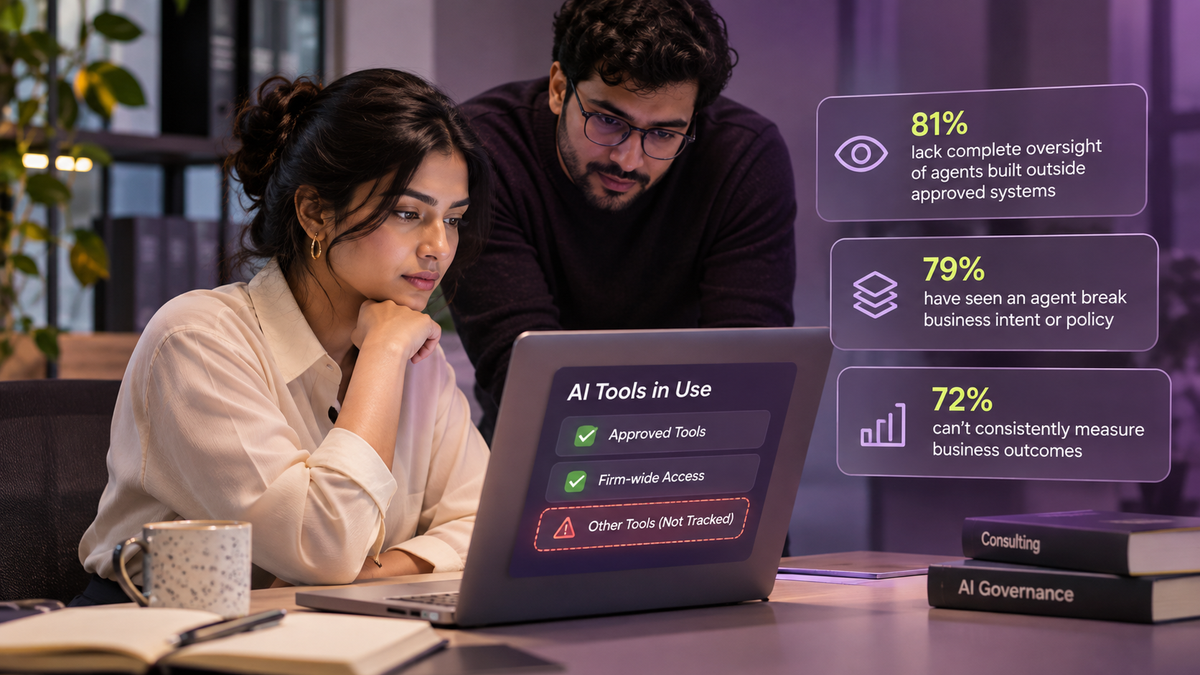
- 81% lack complete oversight of agents built outside approved systems.
- 79% have seen an agent break business intent or policy while staying within its technical limits.
- 72% cannot consistently measure whether their agents deliver business outcomes.
These findings point to an important distinction: tracking AI agents does not automatically mean an organisation has complete oversight of them.
An organisation may monitor its approved systems while remaining unaware of tools and agents operating elsewhere. It may also have technically functioning AI agents that do not consistently follow the organisation's broader business expectations.
The survey covers CIOs across multiple industries, not consulting firms specifically. However, the underlying concerns are relevant to consulting leaders who are increasingly integrating AI into research, analysis and client delivery.
Why Shadow AI Can Become a Consulting Business Risk
1. Client information can move beyond approved workflows
Consultants regularly handle information that clients expect to remain confidential. If an employee uploads a client document, spreadsheet or internal report to an unapproved AI tool, the firm may not have sufficient visibility into how that information is handled.
The concern is not that every external AI tool automatically misuses uploaded information. It is that the organisation may not have reviewed the tool's data practices, permissions or suitability for confidential client work.
2. AI-generated work can enter deliverables without clear accountability
AI can help produce research summaries, draft recommendations and analytical outputs. But if a firm cannot identify where AI was used, it becomes harder to establish who reviewed the output and whether its conclusions were checked.
A technically correct response is not necessarily a commercially sound recommendation. Consultants remain responsible for applying judgment, validating important information and ensuring that client-facing work meets the required standard.
3. Technical controls do not guarantee business alignment
One of the notable findings in the Dataiku survey is that 79% of CIOs have seen an AI agent break business intent or policy while remaining within its technical limits.
This distinction matters. An AI agent can perform the task it was configured to perform and still produce an outcome that conflicts with the organisation's expectations.
For example, an agent might generate a client-facing summary using information that should not have been included, or complete a workflow without considering a relevant approval requirement. These are illustrative scenarios, but they demonstrate why technical functionality alone is not enough.
4. Firms may struggle to connect AI activity with business value
Adopting more AI tools does not automatically improve consulting performance.
If leaders cannot consistently measure whether AI agents deliver business outcomes, they may struggle to understand which workflows are genuinely useful, which introduce unnecessary risk and where human review remains essential.
Without that visibility, AI adoption can become a collection of disconnected experiments rather than a deliberate improvement to the firm's operating model.
How Boutique Consulting Firms Can Reduce Shadow AI Risks
Smaller consulting firms may not have dedicated AI governance teams or large IT departments. That does not mean they need to approach oversight casually. A practical governance framework can begin with a few clear steps.
Establish an approved AI tool list
Identify the AI applications and platforms employees are permitted to use for different types of work. Make the distinction between tools approved for general research and those suitable for handling confidential client information.
The list should be reviewed periodically as tools, permissions and business requirements change.
Define what information can be shared
Employees should understand which information can be entered into AI tools and which information must remain within approved systems.
Client contracts, confidential financial information, personal data and commercially sensitive documents may require specific handling restrictions. These expectations should be clear before employees begin using AI in their workflows.
Make AI usage visible
Consulting leaders should understand where AI is being used across research, analysis, document preparation and client delivery.
This does not necessarily require monitoring every employee interaction. It requires establishing enough visibility to identify unapproved tools, understand important AI-assisted workflows and review areas where sensitive information or client-facing outputs are involved.
Introduce human review for important outputs
AI-generated research, calculations, summaries and recommendations should be reviewed according to their potential impact.
The level of review should reflect the nature of the work. A preliminary brainstorming exercise does not carry the same risk as a financial model or a recommendation that may influence a client's strategic decision.
Measure outcomes, not just adoption
Counting AI tools or agent deployments tells leaders very little about actual business value.
Firms should evaluate whether AI-assisted workflows improve turnaround time, reduce repetitive effort, maintain output quality and support better client outcomes. They should also examine whether the additional review and governance effort changes the overall value of using AI.
The Goal Is Not to Stop AI Adoption
The answer to Shadow AI is not to prohibit every new tool or discourage employees from experimenting with technology.
Consultants need room to explore better ways of working. AI can support research, reduce repetitive tasks and help teams move through complex information more efficiently.
But experimentation needs boundaries, particularly when client information and professional recommendations are involved.
The objective is to create an environment where employees know which tools they can use, leaders understand how AI is entering important workflows and human accountability remains clear.
For boutique consulting firms, this balance is especially important. Their reputation depends on the quality of their judgment, the confidentiality of client information and the reliability of their deliverables.
Final Thoughts: If You Cannot See the Workflow, You Cannot Govern It
The growth of Shadow AI is a reminder that AI governance cannot stop at the list of tools officially approved by a company.
Consulting leaders need to understand what is happening beyond those approved systems, how AI-generated work enters client deliverables and whether the organisation can measure the outcomes.
The important question is not simply whether your team uses AI.
It is whether you know where it is being used, what information it touches and who remains accountable for the final work.
AI adoption may begin with individual employees. Responsible AI adoption requires organisation-wide visibility.
Get new posts and free tools
Join the list: one email when we publish. No spam.