
A Simple Rule for Using AI in Consulting
Artificial intelligence is changing how consulting firms approach everyday work. Research that once required hours of manual preparation can now be organised more quickly. Initial presentation structures can be developed with AI assistance, and repetitive operational activities can become easier to manage.
For boutique consulting firms, these capabilities are particularly relevant. Smaller teams often work across several client engagements while managing research, analysis, presentations and internal operations. Finding ways to reduce repetitive work without compromising the quality of client delivery is an important business priority.
However, adopting AI does not mean handing over every part of the consulting process.
One strategy founder in the Netherlands shared a particularly clear principle during our recent survey of boutique consulting founders:
"Let AI work for you. Not think for you."
His firm's approach reflects a deliberate division of responsibilities. AI supports research and operational tasks, including presentation preparation, while the team retains responsibility for developing the actual deliverables and making decisions.
When asked what prevents him from using AI more extensively, his response was that nothing does. The important distinction is that he established what AI should be responsible for from the beginning.
This perspective raises an important question for consulting firms: instead of asking how much work AI can take over, should firms first decide which responsibilities should remain human-led?
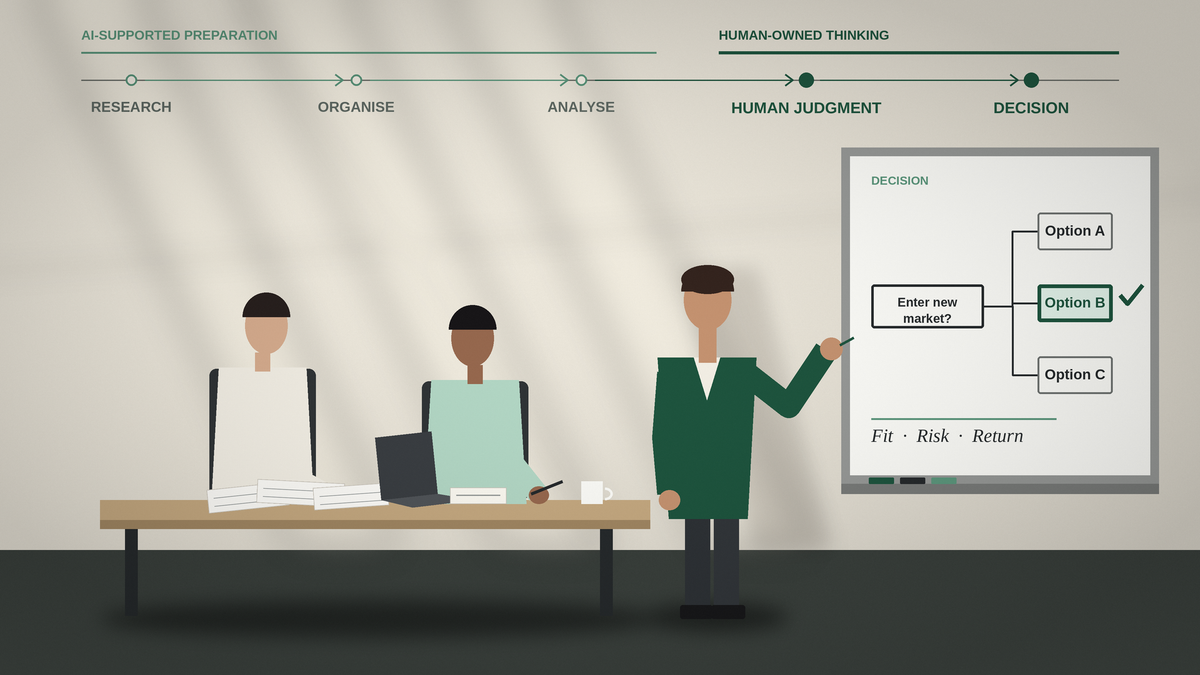
Why Consulting Firms Need a Clear Division of Responsibilities
Consulting is not simply about producing research documents or preparing presentations. Clients engage consultants because they need someone who can understand a business problem, evaluate different possibilities and recommend an appropriate course of action.
AI can support several activities involved in this process, but the responsibilities are not interchangeable.
Consider a typical strategy engagement. The team may need to understand an industry, review competitors, examine market information and prepare materials for a client discussion.
AI can assist with organising research, creating initial summaries and structuring information. These activities can reduce preparation effort and give consultants a useful starting point.
But deciding which information matters, identifying the implications for the client and determining what action should be recommended requires a different level of judgment.
A market trend may look attractive in isolation, but it may not be relevant to a particular client's capabilities or commercial priorities. A competitor may appear to have a successful strategy, but copying it may not make sense for another business.
These decisions require an understanding of context that goes beyond producing a plausible answer.
The most effective approach is therefore not to treat AI and consultants as competing alternatives. It is to establish where each contributes most effectively.
What AI Should Handle in a Consulting Workflow
The founder's approach offers a practical way to think about AI adoption. Instead of allowing AI to take responsibility for the entire engagement, firms can use it to support activities that involve preparation, organisation and repetitive execution.
1. Research Preparation and Information Organisation
Research is a regular part of consulting work. Teams need to explore markets, understand industries, review competitors and organise information before developing recommendations.
AI can help create initial research structures, summarise supplied material and identify questions that require further investigation.
For boutique firms, this can reduce the effort involved in getting started. Consultants can spend less time organising the first layer of information and more time examining the findings that matter.
However, AI-generated research should not automatically be treated as verified evidence. Important claims, statistics and references still need to be checked against original sources.
The objective is to accelerate preparation, not remove research discipline.
2. Presentation Preparation and Structure
Consulting teams regularly translate research and analysis into presentations for clients, partners and internal stakeholders.
AI can assist with developing an initial slide sequence, organising key points and suggesting ways to communicate complex information more clearly.
This can make the early preparation stage more manageable, especially when teams are working under tight deadlines.
But a presentation is more than a collection of organised slides. Its effectiveness depends on the argument, the supporting evidence and the relevance of its recommendations.
The consultant should decide what the presentation needs to communicate, which findings deserve attention and how the information supports the client's decision.
3. Repetitive Operational Tasks
Not every activity in a consulting firm requires the same level of professional judgment.
Internal documentation, routine information organisation, meeting preparation and other repetitive activities can consume time that consultants could otherwise spend on client work.
AI may help reduce some of this preparation effort, depending on the task and the tools being used.
The opportunity is to make routine operations more manageable without allowing automation to introduce unnecessary complexity or additional review work.
What Should Remain With the Consulting Team?
If AI is helping with research and preparation, the next question is where human responsibility becomes essential.
For boutique consulting firms, three areas deserve particular attention.
1. Understanding the Client's Actual Problem
A client may approach a consulting firm with a specific request, but the underlying business problem may be different from what initially appears.
For example, a client may ask for a market-entry assessment because it wants to expand into a new region. However, the real challenge could involve limited distribution capabilities, weak customer demand or an unclear competitive position.
AI can help organise information about the market, but the consultant must understand what the client is actually trying to achieve.
This requires asking the right questions, examining the business context and identifying the problem that deserves attention.
2. Interpreting Findings and Challenging Assumptions
Research findings do not automatically produce useful recommendations.
A market may be growing, but that does not mean entering it is the right decision. A competitor may have achieved strong results, but the reasons behind those results may not apply to the client.
Consultants need to examine the assumptions behind the analysis, compare different possibilities and understand the limitations of the available evidence.
This is where professional experience becomes important.
AI can help organise information and suggest possible interpretations. The consulting team must decide whether those interpretations make sense in the context of the engagement.
3. Making and Taking Responsibility for Recommendations
Ultimately, clients need recommendations they can evaluate and act upon.
The consulting team must be able to explain why a particular direction is being recommended, what assumptions support it, what risks exist and what alternatives were considered.
A recommendation should not be accepted simply because an AI tool produced a convincing explanation.
The consultant remains responsible for the quality of the advice and the reasoning behind it.
This is the difference between using AI to support professional work and allowing it to replace the judgment that makes the work valuable.
The Risk of Giving AI Too Much Responsibility
The convenience of AI can encourage teams to expand its role without first considering whether the additional responsibility is appropriate.
A workflow may begin with using AI to organise research. Over time, the team may start relying on it for analysis, interpretation and final recommendations without introducing the review processes needed to support those activities.
This can create several problems.
Faster Output Can Hide Weak Reasoning
AI can produce well-structured responses that appear complete. However, presentation quality does not guarantee that the underlying reasoning is correct.
An attractive slide or detailed report can still contain unsupported assumptions, incomplete research or conclusions that do not follow from the evidence.
Consultants need to evaluate the substance of the work rather than relying on how professionally it is presented.
Teams Can Lose Sight of the Original Business Question
When AI generates large amounts of information, it can become tempting to focus on what the tool has produced rather than what the client actually needs.
A research document may become longer without becoming more useful. A presentation may contain additional analysis without improving the decision being discussed.
Consultants should continuously bring the work back to the original business objective.
Responsibility Can Become Unclear
If AI contributes to multiple stages of a consulting engagement, teams need to understand who is responsible for checking the output and approving the final deliverable.
Without clear ownership, important assumptions may go unchallenged and errors may move from internal preparation into client-facing work.
A clear division of responsibilities helps ensure that AI assistance does not create confusion about professional accountability.
A Practical Framework for Boutique Consulting Firms
The principle of letting AI work without allowing it to replace thinking can be translated into a practical operating approach.
Step 1: Identify Tasks Suitable for AI Assistance
Start by examining the activities that consume significant preparation time.
Identify repetitive tasks, information organisation, initial research support and other activities where AI may provide useful assistance.
Do not begin by trying to automate the entire consulting engagement. Start with specific activities where the potential benefit is clear.
Step 2: Define What AI Is Allowed to Produce
Establish clear expectations about the role of AI in each workflow.
For example, AI may prepare an initial research summary or suggest a presentation structure, while the consulting team remains responsible for validating the information and developing the final argument.
This makes it easier for employees to understand where AI assistance ends and human responsibility begins.
Step 3: Establish Verification and Review
Important information should be checked before it influences client recommendations.
Teams should review source material, validate figures, examine assumptions and identify limitations in AI-generated analysis.
The level of review should reflect the importance of the decision being supported.
Step 4: Keep Strategic Decisions Human-Led
The consulting team should retain responsibility for defining the client's problem, evaluating alternatives and deciding which recommendations are appropriate.
AI may contribute information and possible approaches, but the final judgment should come from professionals who understand the client and the engagement.
Step 5: Measure Whether the Workflow Is Actually Improving
Finally, firms should evaluate whether AI is making the consulting process more effective.
This means looking beyond the number of tasks automated or documents generated.
Consider whether preparation time has decreased, whether research is easier to review, whether consultants have more capacity for client work and whether the quality of deliverables has improved.
The purpose of AI adoption should be better consulting outcomes, not simply more AI-generated output.
Why This Approach Matters More for Boutique Consulting Firms
Large consulting organisations may have dedicated technology teams, internal AI policies and specialised resources for implementing new tools.
Boutique firms often operate with smaller teams and more limited operational capacity. Their consultants may be responsible for research, client communication, project coordination and final deliverables within the same engagement.
This makes it particularly important to use technology where it provides genuine value.
A well-designed AI-assisted workflow can help smaller teams manage preparation more efficiently while preserving the expertise that differentiates their services.
However, boutique firms should avoid adopting tools simply because they are popular or because competitors are using them.
The better approach is to identify the firm's actual bottlenecks, select appropriate tools and define how the technology will support the existing consulting process.
The competitive advantage will not come from allowing AI to perform every activity. It will come from combining efficient preparation with strong judgment, industry knowledge and client understanding.
Where ConsultantAI Fits Into This Approach
ConsultantAI provides AI-powered tools designed for analytical activities used in management and strategy consulting, including market sizing and financial modelling.
These tools can support parts of the preparation and analytical process, giving consultants a structured starting point for examining business questions and developing their work.
However, the broader consulting process still depends on the professional using those tools. Assumptions need to be evaluated, findings need to be interpreted and recommendations need to reflect the client's specific circumstances.
The objective is to make analytical preparation more manageable while keeping strategic thinking and professional judgment with the consulting team.
Explore the available tools at ConsultantAI.
Conclusion: Let AI Handle the Work. Keep the Thinking Yours.
The perspective shared by the strategy founder in the Netherlands offers a useful reminder for consulting firms navigating AI adoption.
AI can support research, organise information, assist with presentation preparation and reduce repetitive operational effort. These capabilities can make smaller teams more efficient and create additional capacity for client-focused activities.
But efficiency should not come at the cost of independent thinking.
Consultants still need to understand the client's problem, challenge assumptions, evaluate evidence and make recommendations they can confidently explain and defend.
The most effective AI strategy is therefore not about giving technology responsibility for everything. It is about deciding where it can contribute, where human review is required and which decisions should remain with the people delivering the work.
For boutique consulting firms, this distinction can help build workflows that are both efficient and dependable.
Let AI work for you. Not think for you.
Source and Research Note
This article draws on an anonymised and paraphrased response from a strategy founder in the Netherlands, shared with permission as part of a boutique consulting founder survey. The account represents one founder's approach and should not be interpreted as a representative industry-wide finding.
Get new posts and free tools
Join the list: one email when we publish. No spam.