
Most Scope Creep Starts With a Two-Line Brief: How Consultants Can Define Better Engagements
A client sends a short message: “We are considering entering a new market. Can you help us assess the opportunity?” Another asks, “We need to improve profitability. Could your team review our costs?” Both requests sound straightforward. They establish a business problem, suggest a direction and give the consulting team enough information to begin a conversation. However, neither defines the complete scope of an engagement.
What does the client mean by entering a new market? Is the objective to estimate demand, evaluate competitors, assess regulatory requirements, compare locations or build a financial business case? When a client asks for a profitability review, are they looking for a cost-reduction programme, pricing recommendations, an operating model assessment or a complete transformation plan? Until these questions are answered, the client and the consulting team may have different expectations about what the work will include.
This is where scope creep often begins. It rarely starts with a major request to change the engagement. More commonly, it develops through a series of reasonable-sounding additions: one more analysis, an extra stakeholder interview, a revised presentation, a deeper financial model or another round of recommendations. Each request may appear manageable in isolation, but together they can change the amount of work, the delivery timeline and the economics of the project.
For boutique consulting firms, where teams are often lean and senior consultants remain closely involved in delivery, these changes can have a disproportionate impact. Preventing scope creep does not mean refusing every additional request. It means establishing a shared understanding of the work before delivery begins, then managing changes deliberately when the client's needs evolve.
Why a Short Client Brief Can Create a Long Delivery Problem
A brief is designed to communicate an initial need, not necessarily to specify an entire consulting engagement. Clients may know that a decision needs to be made without knowing which analyses will support it. They may understand the commercial problem but have not yet considered the data required, the stakeholders involved or the limitations of the available evidence.
Consultants, meanwhile, are trained to explore problems from multiple angles. A market-entry question can lead to market sizing, customer segmentation, competitor analysis, regulatory research, location selection, financial modelling and implementation planning. Each workstream can be valuable, but not every workstream belongs in every engagement.
The problem arises when the team interprets a broad business objective as permission to pursue every potentially relevant line of analysis. The project gradually expands beyond what the client originally expected, while the team may assume that the additional work is necessary to produce a thorough recommendation. Neither side necessarily intends to create a problem. They simply began with different assumptions that were never made explicit.
A vague brief can also encourage premature execution. Teams may start gathering data or building a presentation before agreeing on the decision the client needs to make. Once work is underway, changing the direction becomes more expensive because research, interviews and analysis have already been completed. The result may be a polished deliverable that answers a broader question than the client actually needed answered.
The solution is not to make every initial brief excessively detailed. It is to use the brief as the starting point for a structured scoping conversation, where the business objective is translated into a defined piece of work.
Start With the Decision, Not the Deliverable
One of the most useful scoping questions is simple: What decision should the client be able to make when this engagement is complete?
This question shifts the discussion away from a list of activities and towards the outcome the work needs to support. A client may request a competitor analysis, but the underlying decision could be whether to change pricing, enter a new customer segment or reposition an existing service. Those decisions require different evidence and lead to different deliverables.
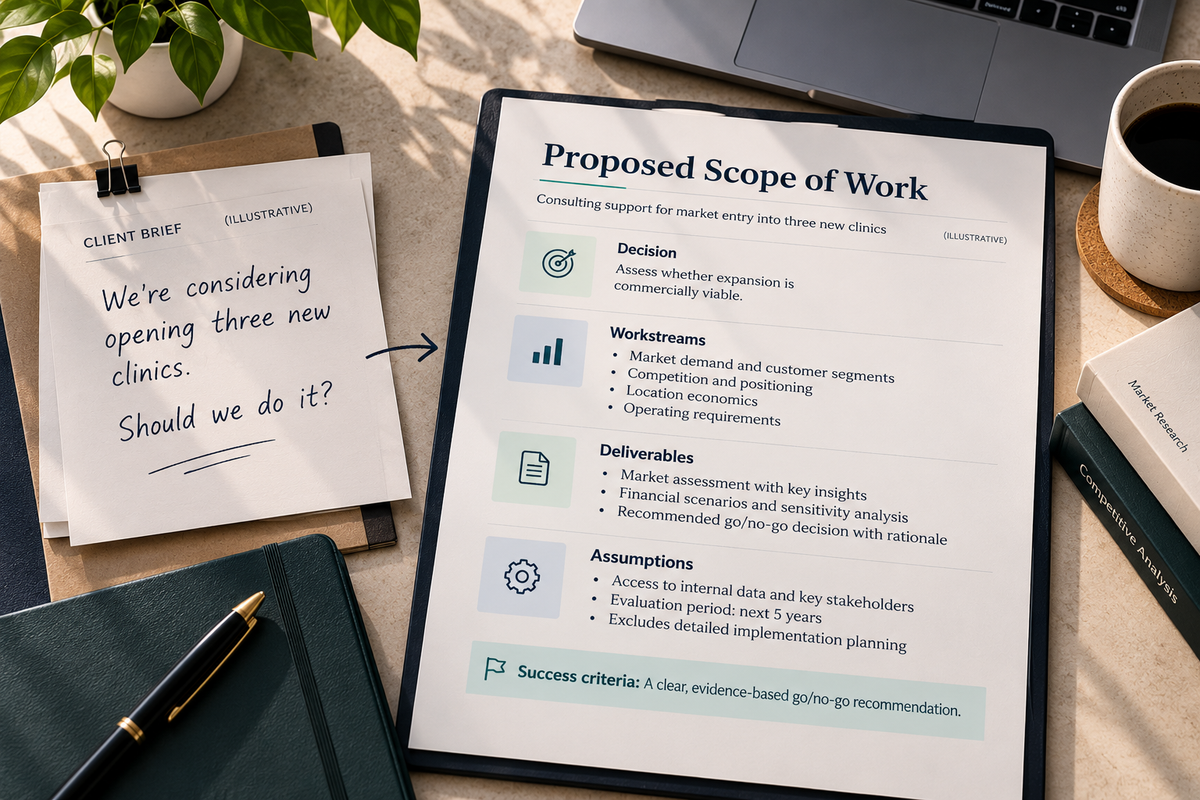
Consider a company evaluating expansion into three new locations. A broad interpretation might involve an extensive market study, a detailed competitor database, customer surveys, property research, a hiring plan and a five-year financial model. Before committing to that work, the consultant should establish what management is trying to decide. Does the company need to choose one location, determine whether expansion is viable at all, or compare several investment options?
If the immediate decision is whether to proceed with a first location, the engagement may need to prioritise local demand, competitive intensity, operating requirements, investment costs and a small set of financial scenarios. A detailed multi-location implementation plan might be better treated as a subsequent phase, once the initial decision has been made.
Defining the decision does not automatically eliminate complexity. It creates a basis for deciding which analyses are necessary, which are optional and which can be deferred. It also gives the consulting team a practical test for new requests: will this work materially improve the decision the engagement was designed to support?
Translate the Business Question Into Clear Workstreams
Once the desired decision is understood, the next step is to identify the work required to support it. Workstreams should be specific enough to guide delivery but not so detailed that the scope becomes difficult to maintain.
For a market-entry engagement, workstreams might include market attractiveness, customer demand, competitor positioning, operational feasibility and financial viability. For a cost-transformation project, the workstreams might cover the cost baseline, underlying cost drivers, savings opportunities, implementation feasibility and expected financial impact. The right structure depends on the client's problem rather than a standard template.
Each workstream should have a clear purpose. Market sizing, for example, should explain the potential scale of the opportunity and the assumptions behind the estimate. Competitor analysis should identify the competitive factors that could influence the decision, rather than simply produce a long list of companies. Financial modelling should test the economics of the options being considered and make important assumptions visible.
This discipline prevents the engagement from becoming a collection of loosely connected analyses. It also helps the team identify gaps early. If the decision depends on customer willingness to pay but the proposed workstreams contain no credible way to assess it, the scope needs further discussion before the team begins execution.
Consultants should also distinguish core workstreams from optional extensions. Some analyses may be useful only if an earlier finding meets a particular threshold. Others may be valuable but unnecessary for the immediate decision. Making those distinctions visible allows the client to choose where additional depth is worth the investment.
Define Deliverables That Have a Clear Purpose
A list of activities does not, by itself, define what the client will receive. “Conduct competitor research,” “analyse costs” and “review market potential” describe work, but they do not establish the expected output.
A stronger scope describes the deliverables and their intended use. Instead of promising competitor research, the team might commit to a competitor comparison that assesses positioning, pricing where reliable information is available, target segments and strategic implications. Instead of simply analysing costs, the team might produce a cost baseline, a driver-based forecast and a prioritised set of savings opportunities.
Deliverables should also have reasonable boundaries. If the engagement includes a financial model, the scope should clarify its intended horizon, level of detail, key scenarios and the information required from the client. If the team is producing a market assessment, it should specify the markets and customer segments being considered, along with any important exclusions.
This does not mean every engagement needs a lengthy specification. A small project may require only a concise statement of objectives, workstreams, outputs, assumptions and timing. The aim is to remove ambiguity where it could materially affect the work, not to create paperwork for its own sake.
The deliverable should ultimately reflect the decision being supported. A senior leadership team deciding whether to invest may need a concise recommendation and a transparent financial case. An operational team implementing an approved decision may need a more detailed roadmap, ownership structure and delivery plan. Defining the audience and purpose early helps prevent unnecessary revisions later.
Make Assumptions and Exclusions Explicit
Even a well-defined engagement depends on assumptions. The team may expect the client to provide historical financial data, access to selected stakeholders, existing market research or internal operating information. It may assume that a particular geography, customer segment or time horizon will be included. If these assumptions remain unstated, they can become sources of delay and disagreement.
A useful scope identifies the information the client must provide, the stakeholders who need to participate, the decisions that must be made during delivery and the constraints that could affect the analysis. It should also explain how material data gaps will be handled. If reliable customer data is unavailable, for example, the team may need to rely on secondary research or revise the confidence level of its conclusions.
Exclusions are equally important. A market assessment may exclude detailed legal advice, implementation support, primary customer research or a full operational design. A profitability review may exclude a complete technology audit or a redesign of the organisation's compensation structure. These activities may become relevant later, but their relevance does not mean they should be silently added to the current engagement.
Exclusions should be communicated constructively. Rather than presenting them as a list of things the consultant refuses to do, explain how they protect focus, timing and the quality of the agreed work. Where an excluded activity is likely to be important, offer to discuss it as a separate phase or a formally agreed extension.
Clear assumptions and exclusions also improve the quality of recommendations. When the final analysis depends on limited data or specific operating conditions, the client should understand those limitations rather than mistake a qualified conclusion for an unconditional guarantee.
Agree on Success Criteria Before Delivery Begins
An engagement can be completed on time and still disappoint the client if the parties disagree about what success looks like. One stakeholder may expect a strategic recommendation, while another expects a detailed implementation plan. A partner may believe the presentation is the final deliverable, while the client expects a supporting model and a workshop with the leadership team.
Success criteria should therefore be discussed during scoping. These criteria might specify the decision to be supported, the questions the analysis must answer, the deliverables to be provided, the expected level of evidence and the stakeholders who will review the work. They may also include timing requirements or a decision deadline.
For example, a market-entry engagement might be considered complete when the client has a documented assessment of market attractiveness, a comparison of selected locations, a transparent financial scenario model and a recommendation that identifies the key risks and unresolved questions. The criteria should not guarantee that the answer will be positive. A well-executed assessment may conclude that the opportunity is unattractive, provided the agreed questions have been addressed appropriately.
It is also useful to agree on the review process. Establish who consolidates feedback, how many formal review rounds are included, who has authority to approve the deliverables and how conflicting stakeholder opinions will be resolved. These details reduce the risk of repeated revisions caused by feedback arriving from multiple people at different stages.
Manage Scope Changes Without Damaging the Client Relationship
A clearly scoped engagement will still encounter change. New information may emerge, senior stakeholders may revise their priorities, or the client may identify a question that was not visible at the outset. In many cases, addressing the new requirement is the right commercial decision. The important distinction is between an agreed adjustment and an informal expansion of work.
When a new request appears, the consultant should first clarify why it matters. Does it address a critical gap in the original analysis? Has the client's decision changed? Is it a minor clarification, or does it require a new workstream, additional data collection or a different deliverable?
The next step is to explain the impact. A request may affect the timeline, require additional team capacity, change the fee or reduce the time available for another workstream. The client should understand these trade-offs before the team commits to the change.
A simple change-control process can be sufficient for many boutique engagements. Record the request, assess its impact, agree on the revised scope or delivery plan, and confirm the decision with the appropriate stakeholder. Smaller adjustments that do not materially affect the engagement can be handled pragmatically, while substantial changes should be formally agreed.
This approach does not need to feel adversarial. A consultant can acknowledge the value of the request while explaining the options: include it by replacing a lower-priority activity, extend the engagement, or schedule it as a separate phase. The conversation becomes a discussion about priorities and trade-offs rather than a disagreement about whether the client is allowed to ask for more.
Protect the Economics of a Boutique Consulting Engagement
Scope creep is not only a delivery issue. It can also affect project profitability and the capacity of a boutique firm to take on new work.
When additional analysis is absorbed without adjusting the scope, the team spends more time than planned while the fee remains unchanged. Senior consultants may become involved in repeated revisions, analysts may be diverted from other engagements, and delivery dates may slip. Even if the client is satisfied with the extra work, the firm may have weakened its project economics.
This is particularly important for firms that rely on a small number of experienced consultants. Their capacity is limited, and time spent on unplanned activities can affect other client commitments. A pattern of informal scope expansion can also make future proposals less reliable because historical delivery effort no longer reflects the scope originally sold.
Tracking actual effort against the planned work can help identify recurring problems. If projects regularly require more interviews than expected, additional modelling or several rounds of senior review, the issue may be a weakness in the scoping process rather than an isolated client request. Firms can use those lessons to improve their proposals, assumptions, pricing and delivery templates.
Commercial discipline should not come at the expense of client value. Sometimes absorbing a small additional task is sensible because it strengthens the relationship or materially improves the outcome. The goal is to make that decision deliberately, understanding the trade-off, instead of allowing many small requests to accumulate without review.
Use a Repeatable Scoping Process
A repeatable scoping process gives consultants a consistent way to move from an initial client conversation to a defined engagement. It should be structured enough to prevent avoidable ambiguity while remaining flexible enough for different project types.
Begin by documenting the business problem and the decision the client needs to make. Identify the questions that must be answered, then define the workstreams and deliverables required to answer them. Establish the assumptions, data requirements, exclusions, stakeholders, review process and success criteria. Finally, confirm the timeline, responsibilities and process for approving changes.
Before finalising the scope, conduct a practical challenge review. Ask whether each workstream supports the decision, whether each deliverable has a clear purpose, whether the team has access to the required information and whether the timeline reflects the work involved. Consider which activities could expand unexpectedly and how those changes would be handled.
The result should be a scope that the delivery team can use throughout the engagement, not merely a proposal document that is forgotten after approval. When new requests arise, the team should be able to compare them with the agreed objectives and decide whether they fit within the original plan.
ConsultantAI's scoping workflow can support consultants in turning an initial business requirement into a more structured scope of work. The generated structure should be reviewed and adapted to the client's objectives, contractual terms, available evidence and delivery constraints. Professional judgement remains essential: a tool can help organise the scope, but it cannot independently determine what the client should buy or what a consulting team can realistically deliver.
A Better Scope Creates a Better Client Conversation
The most effective way to prevent scope creep is not to become more rigid after a project begins. It is to establish clarity before the team commits to delivery. When clients and consultants agree on the decision, workstreams, deliverables, assumptions, exclusions and success criteria, they create a shared reference point for managing the engagement.
That clarity also improves the client conversation. It helps the consultant explain why certain analyses are necessary, which questions can be addressed within the current engagement and what additional work would require. It makes trade-offs easier to discuss because the parties can see how a new request affects the original objective.
For boutique consulting firms, this discipline protects more than project timelines. It helps preserve delivery quality, strengthen commercial performance and build trust through transparent expectations. A concise scope that reflects the right decision is often more valuable than a long proposal that attempts to cover every possible question.
The next time a client sends a two-line brief, treat it as the beginning of the scoping process—not the scope itself. Ask what decision needs to be made, define the work that will support it, and agree on what successful delivery looks like before the analysis begins.
This article is intended for general informational purposes. Engagement scopes should be tailored to the client's circumstances, contractual requirements and professional obligations.
Get new posts and free tools
Join the list: one email when we publish. No spam.