
Enterprise AI Has an Accountability Problem
Organisations have invested heavily in artificial intelligence. They have introduced new models, built internal applications, purchased AI platforms and experimented with automation across multiple business functions. For many enterprises, AI is no longer an isolated technology experiment. It is becoming part of their operating strategy.
Yet a significant question remains: are these investments delivering the business results organisations originally expected?
A recent study by HFS Research, conducted in partnership with Rackspace, suggests that the answer is still disappointing for many enterprises. Its research, based on 502 senior AI decision-makers, found that only 33% of respondents said their most significant AI programme had met or exceeded its original business case. At the same time, 96% reported significant governance gaps, while 78% considered governance failures a greater threat to scaling AI than technology failures.
These findings point towards a problem that goes beyond choosing the right model or investing in better infrastructure. Organisations may have the technology, the implementation partners and executive sponsorship, but still lack clear accountability for how all these components work together once AI is deployed.
For consulting firms, this creates an important opportunity. Enterprise clients need more than recommendations about which AI tools to purchase. They need help connecting technology investments with operational ownership, governance, cost management and measurable business outcomes.
The next challenge in enterprise AI is not simply getting systems into production. It is making sure someone is accountable for what happens after they go live.
The Numbers Behind the Enterprise AI Accountability Gap
The HFS Research report, Run Your AI as One, or Keep Paying for Parts That Never Add Up, examines the challenges enterprises face when moving AI from experimentation into production.
The research surveyed 502 senior AI decision-makers at organisations with annual revenues of at least $100 million. The survey was conducted between August and September 2026 across eight industries and four regions.
Three findings deserve particular attention.
1. Only 33% Have Met or Exceeded Their AI Business Case
Only one-third of surveyed enterprises reported that their most significant AI programme had met or exceeded its original business case.
This means that most respondents had not yet achieved the full business outcome they initially expected from their largest AI initiative.
The report also identifies an important difference between deployment stages. Among enterprises deploying AI in one business function, 37% had met or exceeded their business case. This fell to 28% among organisations deploying AI across several functions.
The finding suggests that expanding AI across an organisation can introduce additional challenges. Different departments may use different platforms, maintain separate processes and work with different implementation partners.
As the number of deployments increases, managing the connections between these systems becomes more difficult.
2. 96% Report Significant Governance Gaps
The second finding highlights an even broader problem.
Almost every surveyed enterprise reported significant governance gaps as AI scales.
These gaps can involve monitoring AI systems in production, understanding how information moves between platforms, managing business context and maintaining appropriate oversight.
The report identifies monitoring what autonomous AI actually does in production as the most commonly reported governance gap, selected by 55% of respondents.
This is particularly important as organisations move beyond simple AI assistants and introduce systems that can perform more complex tasks across business workflows.
A company may understand how an AI application was designed, but that does not automatically mean it has sufficient visibility into how the application behaves after deployment.
Governance therefore needs to extend beyond initial approval. It must include ongoing monitoring, ownership and review.
3. 78% Consider Governance Failures a Bigger Threat Than Technology Failures
Perhaps the most significant finding is that 78% of respondents consider governance failures a greater threat to scaling AI than technology failures.
This challenges the assumption that enterprise AI progress depends primarily on better models, faster infrastructure or more advanced applications.
Technology remains important, but organisations also need to establish how AI systems are managed, monitored and evaluated.
A technically successful deployment can still fail to create business value if no one is responsible for its operating costs, performance, integration and governance.
The distinction is important: getting AI to work is not the same as making AI work for the business.
Why Enterprise AI Programmes Struggle to Deliver Their Business Case
The gap between AI investment and business results is rarely caused by a single issue.
In many organisations, different teams are responsible for different parts of the AI environment. Technology teams manage infrastructure, vendors provide platforms, business departments define use cases and leadership establishes strategic priorities.
Each group may perform its individual responsibilities effectively. However, the overall system can still lack a single operating structure.
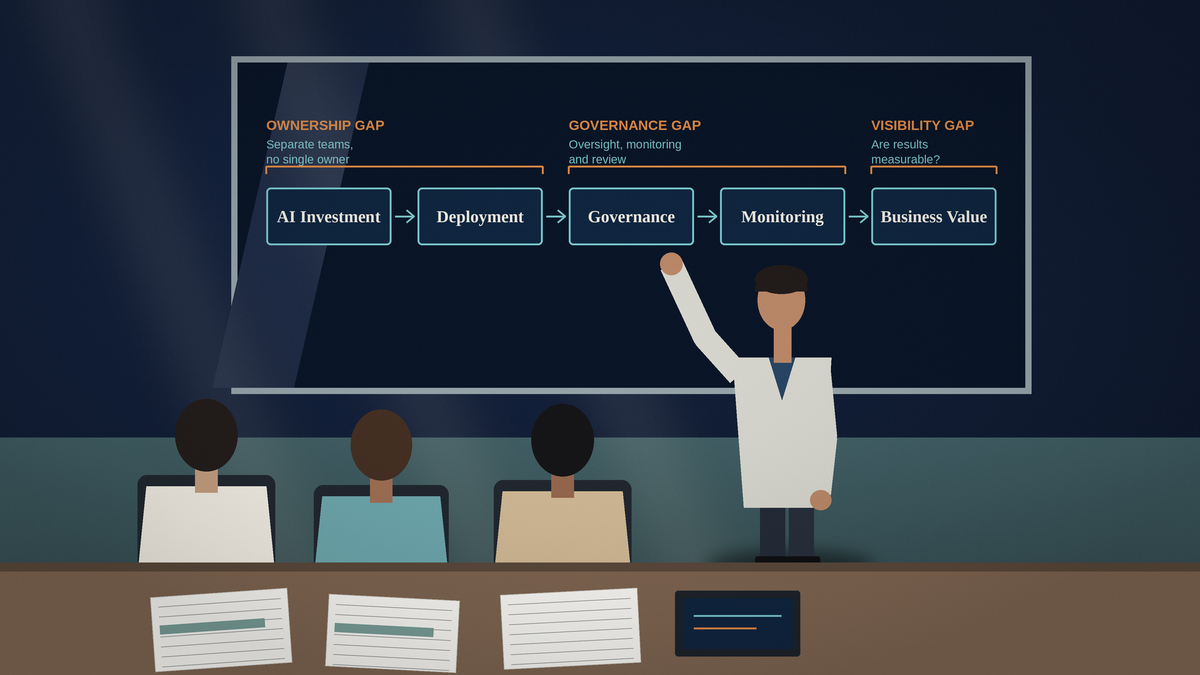
HFS Research identifies three interconnected gaps that contribute to this problem.
1. The Ownership Gap
Enterprise AI programmes often involve multiple stakeholders, but responsibility for the complete outcome can become fragmented.
The technology team may be responsible for deployment, while business leaders are responsible for expected returns. External vendors may manage specific platforms or infrastructure, and operational teams may oversee individual workflows.
The problem emerges when these responsibilities do not connect.
For example, an organisation may successfully deploy an AI-powered customer support system. The technology provider ensures that the system is operational, while the business team expects improvements in service efficiency.
However, who is responsible for monitoring the complete workflow, identifying performance problems, managing operating costs and ensuring that the system continues to meet its original objectives?
If responsibility is divided across multiple teams without clear coordination, important issues can remain unresolved.
This is the ownership gap: individual responsibilities exist, but accountability for the overall result is unclear.
2. The Repeatability Gap
A second challenge appears when organisations attempt to expand successful AI experiments across multiple departments.
An AI workflow that performs well in one function may not be easy to reproduce elsewhere. Different departments may have different data structures, processes, security requirements and operational expectations.
As a result, every new deployment can become a separate implementation exercise.
This creates additional complexity for organisations trying to scale AI consistently.
A repeatable approach requires more than copying an existing application. Organisations need common deployment practices, clear operating responsibilities, consistent evaluation methods and processes that can adapt to different business requirements.
Without these foundations, AI expansion can increase the number of systems without improving the organisation's ability to manage them.
3. The Visibility Gap
The third challenge concerns the ability to understand what AI systems are doing once they become part of everyday operations.
Organisations need visibility into system performance, operating costs, data usage, outputs and potential risks.
Without this information, it becomes difficult to determine whether an AI deployment is delivering its expected benefits.
For example, a business may know that an AI system is processing customer requests faster. But does it know how often the system produces incorrect responses, how much human intervention is required or whether the total cost of operating the workflow is sustainable?
These questions matter because the business case depends on the complete operating outcome, not simply whether the technology is functioning.
The visibility gap makes it harder for leadership to evaluate performance and take corrective action when results fall short.
Why Scaling AI Can Make the Problem Worse
It is tempting to assume that if an AI deployment works successfully in one department, expanding it across the organisation will automatically increase its value.
The HFS findings suggest that this assumption deserves closer examination.
The share of enterprises meeting their AI business case falls from 37% among those deploying AI in one function to 28% among those deploying it across several functions.
This does not prove that expansion itself causes weaker results. Different organisations may have different levels of maturity, complexity and implementation readiness.
However, the comparison highlights the additional challenges that can emerge as AI spreads across an enterprise.
A single-function deployment may involve a limited number of users, data sources and operating responsibilities. A multi-function deployment can introduce several platforms, different approval processes and more complicated dependencies.
For example, consider an enterprise introducing AI across finance, customer operations and human resources.
The finance team may use AI for reporting support, customer operations may use it for service workflows, and HR may use it for internal information management.
Each application may have its own requirements, data access arrangements and review processes.
If these deployments are managed independently, the organisation may struggle to maintain consistent oversight across the entire environment.
Scaling AI therefore requires organisations to think beyond individual use cases. They need an operating model that connects technology, people, processes and accountability.
From AI Investment to Business Value: What Needs to Change?
The findings raise an important question for enterprise leaders: how can organisations make AI investments more accountable?
The answer begins with changing how success is defined.
Rather than measuring progress through the number of AI tools deployed or pilots completed, organisations need to connect every major initiative to a clearly defined business outcome.
1. Define the Business Case Before Deployment
Every significant AI programme should begin with a specific business objective.
This could involve reducing processing costs, improving customer experience, increasing workforce productivity or improving decision-making.
The organisation should establish how the outcome will be measured before implementation begins.
It should also document the assumptions behind the expected benefits, including implementation costs, operating expenses, required resources and potential risks.
Without a clear baseline, it becomes difficult to determine whether the programme has delivered the expected value.
2. Assign End-to-End Operational Ownership
Organisations should identify who is responsible for the performance of an AI programme once it becomes operational.
This responsibility should cover more than technical availability. It should include business outcomes, operating costs, governance requirements and ongoing improvement.
Ownership does not necessarily mean appointing a completely new external provider. It could involve an internal team, an existing group of service providers operating under a shared remit or a managed services partner.
What matters is that responsibility for the overall operation is clearly established.
3. Build Governance Into Everyday Operations
Governance should not be treated as a final approval stage before deployment.
Organisations need processes for monitoring AI behaviour, reviewing outputs, managing data access, handling exceptions and identifying potential issues.
These controls should be appropriate to the sensitivity and importance of each workflow.
A low-risk internal productivity application may require different oversight from an AI system involved in financial decisions or customer-facing operations.
4. Monitor the Complete Cost of AI
AI operating costs can involve more than model usage or infrastructure.
Organisations may also need to account for integration, data preparation, monitoring, maintenance, human review and the resources required to manage multiple providers.
A programme that appears financially attractive during a pilot may have a different cost profile when deployed across several functions.
Leaders should therefore evaluate cost per completed business outcome rather than relying only on the initial implementation budget.
5. Review Business Performance Continuously
AI programmes should be evaluated after deployment, not only during the initial implementation.
Organisations need to compare actual performance with the original business case and identify whether the intended benefits are being achieved.
If the results fall short, leadership should understand whether the issue involves technology, process design, operating costs, governance or unclear ownership.
This creates a continuous improvement process and helps prevent AI investments from continuing without sufficient evidence of value.
What the HFS Research Findings Mean for Consulting Firms
For boutique consulting firms, the enterprise AI accountability gap creates an opportunity to move beyond traditional technology recommendations.
Clients may already have access to AI platforms, implementation partners and internal technology teams. What they often need is help connecting these elements to business outcomes.
Consultants can contribute in several practical areas.
AI Business Case Assessment
Consultants can help organisations review existing AI investments and compare expected benefits with actual results.
This includes examining the original assumptions, implementation costs, operating expenses and performance measures.
The objective is to identify where the business case remains realistic and where changes are required.
Operating Model and Accountability Design
Consulting teams can help clients clarify the responsibilities of technology teams, business departments, internal owners and external providers.
This involves identifying ownership gaps, defining escalation processes and establishing who is responsible for the performance of AI once it becomes operational.
Governance and Risk Assessment
Consultants can review existing AI policies, monitoring practices, data-handling procedures and output review processes.
They can identify where controls are missing and help organisations establish governance requirements that reflect the importance of each AI application.
Scaling and Performance Measurement
Consultants can help clients identify which AI workflows are suitable for expansion and what additional capabilities are required before scaling.
They can also establish performance measures that connect operational improvements with financial and business outcomes.
This allows organisations to make more informed decisions about whether to expand, redesign or discontinue individual AI initiatives.
For boutique consulting firms, this creates an opportunity to build longer-term relationships by helping clients manage the entire journey from investment decisions to operational results.
Where ConsultantAI Fits Into the Consulting Workflow
ConsultantAI provides AI-powered tools designed to support analytical activities used in management and strategy consulting, including market sizing and financial modelling.
These tools can support consultants during the preparation and analysis stages of an engagement, helping structure information and examine business assumptions.
However, enterprise AI accountability requires more than analytical tools. Consultants still need to evaluate evidence, assess operational requirements and understand how recommendations connect to the client's business objectives.
The objective is to make analytical preparation more manageable while keeping professional judgment and client-specific decision-making central to the consulting process.
Explore the available tools at ConsultantAI.
Conclusion: Enterprise AI Needs Someone Accountable for the Outcome
The HFS Research findings highlight a problem that enterprise leaders cannot solve simply by purchasing better technology.
Only 33% of surveyed AI-active enterprises reported meeting or exceeding the business case for their most significant AI programme. At the same time, 96% reported significant governance gaps, and 78% viewed governance failures as a greater threat to scaling AI than technology failures.
These findings suggest that the next stage of enterprise AI will depend on more than model performance or the number of deployments.
Organisations need clear ownership, repeatable operating practices, visibility into system performance and governance that continues after deployment.
For consulting firms, the opportunity is to help clients close the gap between AI investment and business value. That means examining the operating model, clarifying accountability, measuring results and ensuring that technology remains connected to the outcomes it was introduced to deliver.
The enterprises that succeed will not necessarily be those that deploy the most AI systems. They will be those that understand how to manage them as part of one accountable business operation.
AI investment creates potential. Accountability turns that potential into measurable business value.
Sources and Further Reading
Get new posts and free tools
Join the list: one email when we publish. No spam.