
A Question Consulting Firms Can No Longer Ignore
Artificial intelligence is becoming a regular part of how consulting firms prepare and deliver their work. Consultants use AI to organise research, summarise information, explore market questions, prepare initial drafts and support repetitive activities.
For smaller consulting firms, these tools can make everyday work more manageable. A team that previously spent hours organising research can now establish an initial structure more quickly. Consultants can use the time saved to examine findings, challenge assumptions and focus on client priorities.
But as AI becomes more involved in client engagements, a new question deserves attention: should clients be told when AI has contributed to the work they receive?
Some clients may be comfortable with AI being used for research or preparation, provided the final work is reviewed by experienced consultants. Others may have strict confidentiality requirements, contractual restrictions or concerns about how their information is processed.
The issue is not simply whether a consultant uses AI. It is whether the client understands how the work is being delivered, what information is involved and who remains responsible for the final outcome.
Professional guidance is increasingly addressing this question. The UK's Law Society, for example, distinguishes between routine internal uses of AI and situations involving identifiable client information or confidentiality risks. Accounting guidance from ACCA and ICAEW also encourages firms to consider transparency and appropriate disclosure within client engagement arrangements.
For boutique consulting firms, this is an opportunity to establish a clearer relationship with clients before questions about AI use become a source of misunderstanding.
Why AI Disclosure Is Becoming a Client Relationship Issue
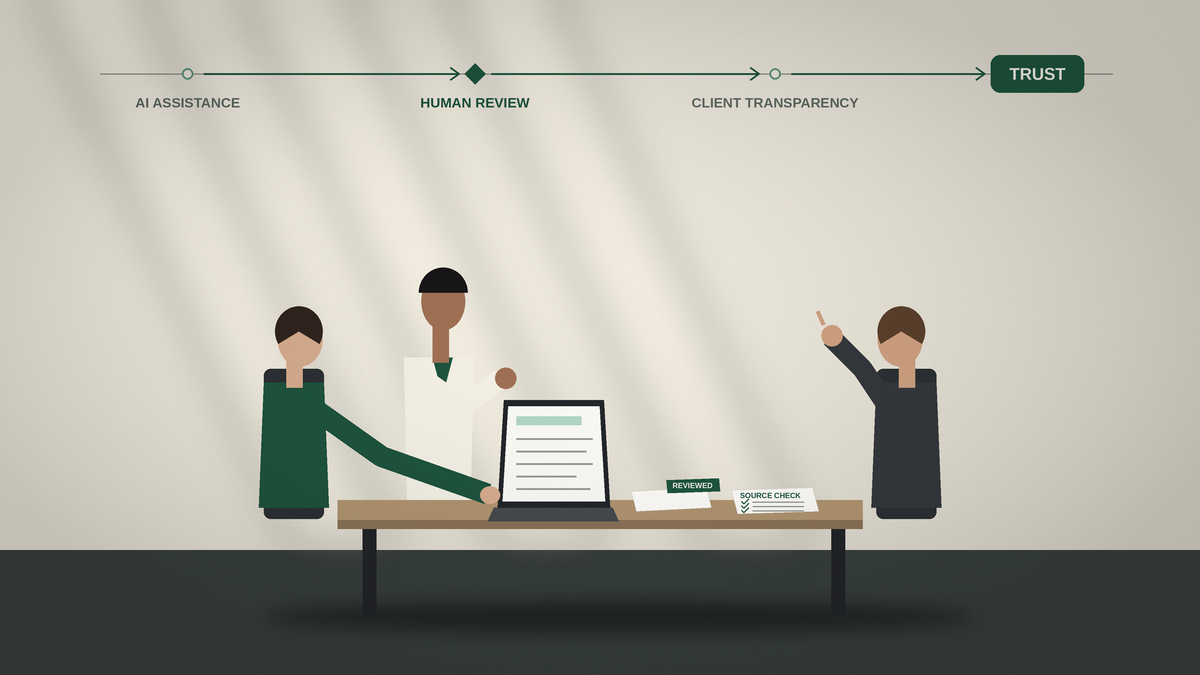
When clients hire a consulting firm, they are not simply purchasing a report or presentation. They are paying for professional expertise, independent thinking and the ability to make sense of complex business problems.
AI can contribute to the preparation process, but clients still need confidence in the quality and reliability of the final work.
Consider a strategy consulting engagement involving market-entry research. The consultant may use AI to organise publicly available information, summarise industry reports and prepare an initial research structure. The final recommendation is then developed through additional analysis, source verification and discussions with the client.
There is nothing inherently wrong with this approach. The important questions are whether the AI use is permitted, whether client information is handled appropriately and whether the consultant has reviewed the resulting work.
Problems can arise when clients have different expectations from the consulting firm.
A client may assume that all research was conducted manually. Another may be comfortable with AI assistance but expect to know if confidential documents are processed by an external platform.
If these expectations are never discussed, even an otherwise useful deliverable can create questions about transparency.
This is why AI disclosure should be considered part of client communication rather than an administrative detail added at the end of an engagement.
When Should Consultants Tell Clients About AI Use?
Not every use of AI requires the same level of disclosure. A grammar correction is different from using an AI system to analyse confidential client information or prepare a substantial part of a strategic recommendation.
Consulting firms should consider the nature, importance and risks of the AI contribution.
1. Routine Internal Assistance
Some AI activities have limited involvement in the actual client deliverable.
Examples include:
- Organising publicly available research.
- Improving internal notes.
- Correcting grammar and formatting.
- Preparing internal brainstorming outlines.
- Structuring meeting agendas.
Where these activities do not involve restricted client information and are permitted under the engagement terms, separate client disclosure may not always be necessary.
However, firms should still follow their internal AI policies and any contractual or professional requirements.
The important distinction is between using AI as an ordinary productivity aid and relying on it to perform a substantial part of the service promised to the client.
2. AI Makes a Material Contribution to Client Deliverables
The situation changes when AI plays a significant role in producing a client-facing report, analysis or recommendation.
For example, a consulting firm may use AI to prepare a substantial research summary, develop an initial financial analysis or generate parts of a presentation that will be delivered to the client.
In these situations, transparency becomes more important.
Clients should understand the role AI played, what review process was followed and who is responsible for the final work.
ACCA guidance for professional accountants recommends considering AI disclosure within engagement letters and informing clients directly when AI is fundamental to the work being performed. The exact requirements depend on the professional context and applicable rules.
The broader lesson for consulting firms is straightforward: when AI materially changes how a service is delivered, clients should not be left to discover that involvement later.
3. Client Information Is Being Entered Into AI Systems
This is one of the most sensitive situations.
Consultants often work with confidential business information, including financial records, commercial strategies, acquisition plans, internal reports and customer information.
Before entering this information into an AI platform, firms need to understand how the tool processes and stores data, whether information may be used for model training, who can access it and what contractual protections apply.
The UK's Law Society guidance emphasises that using identifiable client information in AI systems must be consistent with confidentiality, data protection and professional obligations. Where confidential information could be exposed or reused, specific client consent may be required.
A consultant should not assume that information is safe to upload simply because the AI tool is widely used or commercially available.
In these circumstances, checking the engagement terms, the platform's data practices and any applicable consent requirements should come before using the tool.
What Clients Actually Need to Know
Transparency does not mean sending clients a long technical explanation every time an AI tool is used.
Most clients need clear information about the aspects that affect their engagement.
A useful disclosure should address four areas.
1. How AI Is Being Used
Explain whether AI is supporting research, information organisation, analysis, drafting or another activity.
Avoid vague descriptions such as "we use AI to improve efficiency". Clients should understand the practical role of the technology in delivering the service.
2. What Information Is Being Shared
Explain whether client information will be entered into an AI system.
If it will, the firm should understand the platform's data-handling arrangements and establish whether the proposed use is permitted under the engagement terms and applicable obligations.
Where possible, confidential information should be minimised or appropriately anonymised.
3. How the Work Is Reviewed
Clients should know that AI-generated material is not automatically accepted as final work.
The consulting firm should have a suitable process for checking important figures, sources, assumptions and conclusions before the material is delivered.
This is especially important when the work supports commercial decisions or financial recommendations.
4. Who Remains Responsible
The use of AI does not transfer responsibility for professional work to the software provider.
The consulting firm should remain accountable for the quality of its deliverables and make clear who reviews and approves the final output.
Clients should be able to understand where professional judgment enters the process and who is responsible for the recommendation they receive.
What Happens When Consultants Do Not Disclose AI Use?
Lack of transparency can create problems that extend beyond the technology itself.
Client Trust Can Be Damaged
Imagine a client discovers that a substantial part of a report was generated using AI, even though the consulting firm never discussed this possibility.
The client may begin questioning how the research was conducted, whether the sources were verified and whether confidential information was handled appropriately.
Even if the final report is accurate, the absence of prior communication can create unnecessary doubt.
Contractual Expectations May Be Breached
Some clients include specific requirements relating to AI-generated material, third-party software, data processing and confidentiality in their contracts.
If a consulting firm uses AI without reviewing these conditions, it may create contractual or compliance problems.
This is particularly relevant for firms working with larger enterprises, regulated businesses and clients with strict information-security requirements.
Quality Concerns Can Become Reputation Issues
AI-generated content can contain inaccurate figures, unsupported claims and incomplete interpretations.
If the consulting firm does not review the work properly, errors can reach the client.
When this happens alongside a lack of disclosure, clients may question not only the quality of the deliverable but also the firm's overall approach to professional responsibility.
Trust is difficult to rebuild once clients begin questioning how their work was prepared.
How Boutique Consulting Firms Can Establish an AI Disclosure Approach
Smaller consulting firms do not necessarily need a complicated AI governance department to address these questions.
They need clear working practices that reflect the type of services they provide and the expectations of their clients.
Step 1: Review Client Engagement Terms
Before using AI in a client engagement, review the contract, statement of work and confidentiality provisions.
Check whether the client has restrictions on AI use, third-party platforms, data processing or AI-generated deliverables.
If the terms are unclear, obtain appropriate legal advice before proceeding.
Step 2: Classify AI Use by Its Impact
Create a simple internal distinction between routine assistance, material contributions to deliverables and activities involving confidential client information.
This helps teams determine when additional review, disclosure or consent may be needed.
Step 3: Establish Clear Data-Handling Rules
Define which types of information employees can enter into approved AI tools.
Include guidance on confidential documents, personal information, commercially sensitive material and anonymisation.
Make sure the rules reflect the actual data practices and contractual terms of the tools being used.
Step 4: Agree on Review Responsibilities
Identify who checks AI-assisted work before it reaches the client.
The review should cover the accuracy of important claims, the reliability of sources, the assumptions behind the analysis and the relevance of the final recommendations.
The level of review should reflect the importance of the deliverable.
Step 5: Discuss Material AI Use Early
Where AI will play a significant role in delivering the service, discuss it with the client before the work begins.
Explain the intended use, relevant safeguards and review arrangements.
This gives clients an opportunity to raise concerns and clarify their expectations before work progresses.
A Simple Example of How to Communicate AI Use to Clients
Consultants do not need to make disclosure unnecessarily complicated.
For engagements where AI assistance is permitted and the statement accurately reflects the firm's actual practices, a short explanation could look like this:
"AI-enabled tools may be used to support selected research, information organisation and drafting activities during this engagement. All client-facing deliverables remain subject to review and approval by our consulting team. Client information will only be processed through tools and arrangements permitted under the engagement terms and our applicable data-handling requirements."
This is an illustrative starting point, not a universal legal clause. Firms should adapt any disclosure to the actual tools, data practices, client agreement and applicable requirements.
The purpose is to make the firm's approach understandable without overwhelming the client with technical detail.
Why Transparency Can Become a Competitive Advantage
Some consulting firms may worry that disclosing AI use will make clients question the value of their services.
However, the opposite can also be true.
Clients are increasingly familiar with AI and may already expect professional service providers to use technology where it improves the delivery process.
What they want to understand is whether the firm is using it appropriately.
A consultant who can explain where AI contributes, how information is protected and how the final work is reviewed demonstrates a clear understanding of professional responsibility.
Transparency can also create more productive conversations about the engagement itself.
Clients can clarify which activities they are comfortable with AI supporting, which information must remain restricted and what level of human involvement they expect.
For boutique firms, this can strengthen relationships by making expectations clearer from the beginning.
The differentiator is not whether a firm uses AI. It is whether it can explain and stand behind the way it uses it.
Where ConsultantAI Fits Into This Shift
ConsultantAI provides AI-powered tools designed for analytical activities used in management and strategy consulting, including market sizing and financial modelling.
These tools can support parts of the preparation and analytical process, helping consultants structure their work and examine business assumptions.
However, using AI in consulting still requires clear professional boundaries. Consultants need to evaluate information, verify important findings and ensure that their use of technology is consistent with client expectations and engagement requirements.
The objective is to make analytical preparation more manageable while keeping client trust, professional judgment and accountability at the centre of the work.
Explore the available tools at ConsultantAI.
Conclusion: Clients Do Not Need Every Technical Detail. They Need Honesty.
The question of whether consultants should disclose AI use does not have one universal answer for every engagement.
The appropriate approach depends on the role AI plays, the type of information involved, the client's expectations, contractual requirements and applicable professional obligations.
Routine internal assistance may require a different approach from using AI to prepare a substantial client deliverable or process confidential business information.
But one principle applies across these situations: consulting firms should be able to explain how AI contributes to their work and who remains responsible for the final result.
For boutique consulting firms, transparency should be treated as part of good client communication, not simply a compliance exercise.
AI can make research, preparation and analysis more efficient. It should not create uncertainty about the quality of the work or the trust between a consultant and a client.
Clients do not necessarily expect consultants to avoid AI. They expect consultants to use it responsibly, communicate honestly and stand behind the work they deliver.
Sources and Further Reading
Get new posts and free tools
Join the list: one email when we publish. No spam.