All posts

The AI Agent Cost Trap: Why Faster Workflows Don't Always Deliver Better ROI

AI agents can accelerate consulting workflows, but token usage, repeated processing and human review can erode the savings. Learn how to measure total cost and design workflows that deliver measurable value.

ConsultantAI Team10 min read

The AI Agent Cost Trap: Why Faster Workflows Don't Always Deliver Better ROI

AI agents are moving beyond experimentation. Businesses are beginning to use them to coordinate tasks, analyse information and carry work across multiple stages of a workflow. For consulting firms, the opportunity is significant: less time spent gathering information, more consistent analytical processes and greater capacity to deliver valuable work to clients.

But there is a problem that becomes harder to ignore as adoption grows. The cost of running an AI workflow does not always fall in proportion to the time it saves.

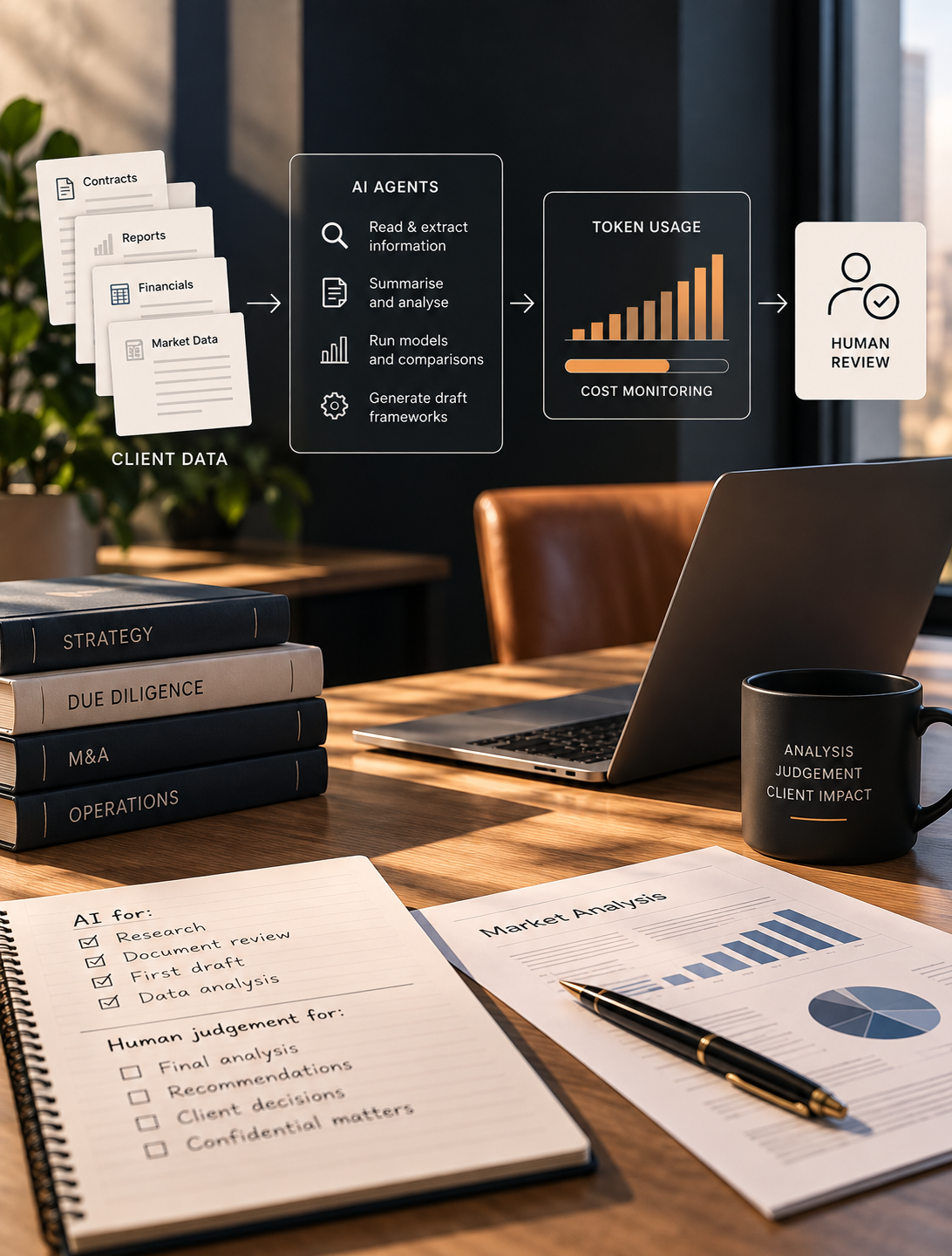
An agent may need to read hundreds of documents, call several tools, retrieve information repeatedly and ask another model to review its output. Each step can add processing costs, latency and opportunities for errors. A workflow that looks efficient in a demonstration may become expensive when it runs across real client engagements.

For boutique consulting firms, this creates a more important question than whether AI can complete a task: what does it cost to produce a reliable, client-ready result?
The AI Agent Cost Trap: Why Faster Workflows Don't Always Deliver Better ROI  AI agents are moving beyond experimentation. Businesses are beginning to use them to coordinate tasks, analyse information and carry work across multiple stages of a workflow. For consulting firms, the opportunity is significant: less time spent gathering information, more consistent analytical processes and greater capacity to deliver valuable work to clients.  But there is a problem that becomes harder to ignore as adoption grows. The cost of running an AI workflow does not always fall in proportion to the time it saves.  An agent may need to read hundreds of documents, call several tools, retrieve information repeatedly and ask another model to review its output. Each step can add processing costs, latency and opportunities for errors. A workflow that looks efficient in a demonstration may become expensive when it runs across real client engagements.  For boutique consulting firms, this creates a more important question than whether AI can complete a task: what does it cost to produce a reliable, client-ready result?  The gap between AI adoption and business value  McKinsey's The State of AI in 2026: On the Road to ROI, published on 25 August 2026, highlights this gap between adoption and measurable business impact.  In its survey, 40% of respondents at organisations with annual revenues above $1 billion reported scaling AI agents in at least one function. Around 20% of respondents said AI-related operating costs, including token costs, were constraining AI use. Meanwhile, 37% of respondents attributed at least some enterprise-level EBIT impact to AI use, while only about 6% qualified as high performers reporting significant impact of at least 5% of EBIT.  These figures describe survey respondents, not every enterprise, and they should not be interpreted as proof that token costs alone explain the gap in financial returns. They do, however, point to a practical challenge: deploying AI and realising measurable economic value are different achievements.  For consulting firms advising clients on AI adoption, this distinction matters. A business can have several agents in production and still struggle to demonstrate whether those systems are reducing total costs, improving outcomes or creating additional work elsewhere.  The right measure is not the number of agents deployed. It is the value the complete workflow delivers relative to its total cost and risk.  Why AI agent costs can grow unexpectedly  1. Every additional step has a cost  A simple AI task might involve one prompt and one response. An agentic workflow can be considerably more involved.  An agent may retrieve documents, summarise them, call external tools, compare results, generate a draft, review its own work and repeat the process when information is missing. A second agent may then validate or transform the output before a human reviews it.  This architecture can be useful when the additional steps improve the result. But if the workflow repeats similar analysis, passes unnecessarily large amounts of text between agents or retries tasks without a clear stopping condition, the cost can grow without a corresponding improvement in quality.  The answer is not to minimise every model call regardless of its purpose. It is to understand which steps contribute to the result and which introduce unnecessary work.  2. More context is not always better  Consulting engagements often involve long reports, spreadsheets, interview notes, contracts and historical presentations. Giving an AI workflow access to all available material may seem like the safest way to provide context.  In practice, indiscriminately processing large volumes of information can increase cost and make it harder to isolate the evidence relevant to a particular question.  A more deliberate approach starts by identifying the task, retrieving the documents that are relevant to it and preserving references to the original material. The system should bring in additional context when the task requires it, rather than repeatedly processing the entire document collection.  This is particularly important in due diligence, market research and financial analysis, where different questions require different subsets of the available evidence.  3. Repeated review can erase the expected savings  Verification is necessary, but the workflow should be designed so that review effort is proportionate to the risk.  Consider a process that generates a market-sizing model, asks an agent to review it, regenerates the model, repeats the review and then sends the entire result to a second agent for another pass. Some of those steps may catch meaningful errors. Others may repeat the same checks without resolving the underlying uncertainty.  If the system cannot identify what failed, what needs to change or when to stop, it may consume additional resources while producing little improvement.  A better design defines validation criteria in advance. If a source is missing, the workflow should flag the gap. If a calculation fails, it should identify the relevant inputs. If the evidence remains insufficient, the process should escalate the issue rather than endlessly regenerate a confident-sounding answer.  The consulting bottleneck is workflow design  Consulting teams frequently use AI for research, document synthesis, market sizing, competitor analysis and the preparation of client presentations. These tasks are suitable candidates for assistance, but they are rarely isolated activities.  A research summary may feed a market model. The model may influence a strategic recommendation. That recommendation may then be incorporated into a presentation reviewed by several people.  If the steps are poorly connected, a time saving at one stage can create additional work at the next. The analyst may receive a faster summary but spend longer checking the sources. The model may be generated quickly but require extensive correction. The presentation may be drafted earlier but still need substantial senior review.  This is why workflow design matters more than simply adding agents to existing processes.  Start with the decision, not the agent  Before automating a task, define the outcome the client or consulting team needs. Is the goal to identify potential acquisition risks, compare suppliers, estimate market demand or evaluate a cost-reduction opportunity?  Then determine which steps are necessary to produce that outcome, which can be automated and which require professional judgement.  This prevents teams from building complex agent systems around tasks that could be handled more simply. It also makes it easier to assess whether an additional agent or model call provides a genuine benefit.  Give every step a defined purpose  Each stage should have a clear input, expected output and completion condition.  For example, a competitor research workflow might retrieve relevant sources, extract specific facts, compare the companies against defined criteria and produce a summary with references. It should not repeatedly regenerate the entire comparison when only one source needs checking.  Clear boundaries make the workflow easier to test, troubleshoot and improve. They also help teams identify where costs are accumulating.  Five practical controls for more cost-efficient AI workflows  Consulting firms do not need to begin with a sophisticated autonomous system. They can start by measuring existing workflows and introducing controls that make costs and results easier to understand.  1. Measure cost per completed outcome  Track the total cost of producing a completed result, not simply the cost of an individual model call.  For a consulting workflow, that may mean the cost of producing a reviewed research summary, a verified market-sizing analysis or a completed supplier comparison. Include relevant model usage, retrieval and tool costs, as well as human review and rework where practical.  A workflow that uses fewer tokens but requires extensive manual correction may not be more efficient than one with slightly higher processing costs and substantially better output quality.  2. Set budgets and stopping conditions  Define an acceptable cost range for a workflow and establish what should happen when that limit is reached.  Depending on the system, controls may include maximum processing steps, limits on retries, model usage budgets, timeouts and escalation rules. More expensive operations can require approval, particularly when they involve sensitive information or consequential decisions.  The purpose is not to prevent useful work. It is to make sure that the workflow cannot continue consuming resources indefinitely without producing a meaningful result.  3. Use the right model for the task  Not every step requires the most capable or expensive model available.  A straightforward classification or formatting task may be handled by a smaller model, while complex synthesis or ambiguous reasoning may justify a more capable one. The choice should be based on testing the quality of the output for the specific task, not on price alone.  If a lower-cost model produces results that require extensive correction, the apparent saving may disappear. Conversely, using a premium model for every routine transformation can create unnecessary expense.  4. Retrieve relevant evidence instead of repeatedly processing everything  Organise source documents so that workflows can retrieve the material needed for a particular question. Preserve the source references and relevant context so reviewers can inspect the evidence behind important claims.  For consulting work, this is especially valuable when the same client has large document collections or when several analyses depend on different parts of the same source material.  Efficient retrieval should not become an excuse to omit relevant evidence. The objective is to make context more targeted while retaining enough information to support the analysis.  5. Track quality alongside cost  Cost controls alone can encourage the wrong behaviour if a workflow becomes cheaper by skipping important checks.  Measure whether the result meets the required standard. Depending on the task, that could include source traceability, calculation accuracy, completeness, consistency with client requirements and the amount of human rework needed.  The best workflow is not necessarily the cheapest one. It is the one that delivers the required quality at an acceptable total cost and risk.  A simple example: automating due diligence  Imagine a boutique consulting firm reviewing a collection of supplier contracts for a client considering a procurement transformation.  An initial workflow extracts contract terms, identifies renewal provisions and organises the findings into a comparison table. The team then reviews the results and develops questions for the client.  The workflow becomes unnecessarily expensive if every contract is repeatedly processed in full, every output triggers multiple undirected review passes, and the system regenerates the entire table whenever a single clause needs clarification.  A more deliberate process would define the required fields, retrieve relevant sections, preserve document references and validate extracted terms against the original contracts. Unclear clauses would be flagged for review rather than treated as confirmed findings.  The result is not just a potentially lower processing bill. It is a workflow that is easier to understand, easier to audit and more useful to the consultant responsible for the final recommendation.  This example is illustrative, not a claim about a measured saving from a specific product. The actual economics depend on document volume, model choice, system design and the amount of review required.  What this means for boutique consulting firms  Large enterprises may have dedicated engineering teams, AI governance functions and infrastructure budgets to optimise complex agentic systems. Boutique consulting firms often need a more focused approach.  Start with a small number of high-value workflows where the work is repeatable and the outcome can be evaluated. Measure the current process, identify where time and cost accumulate, and introduce automation only where the benefit can be demonstrated.  Keep a record of what the workflow costs, what it produces and how much human review remains necessary. Revisit the design when model prices, usage patterns or client requirements change.  Most importantly, do not confuse a faster process with a better commercial result. A workflow that saves preparation time but increases rework or introduces avoidable risk may not improve the economics of an engagement.  For fixed-fee projects, this can affect margins directly. For advisory work billed by time, it can affect the balance between delivery effort and the value the client receives. In either case, the firm needs to understand the complete workflow rather than focusing on one stage in isolation.  Where ConsultantAI fits  ConsultantAI is designed around the analytical work that management and strategy consultants carry out, including tasks such as market sizing and financial modelling.  For consulting teams exploring AI-assisted workflows, the broader objective is to structure work so that research, assumptions and analysis can be examined rather than treated as a black box. Efficient processes should make it easier to understand how a result was produced and where additional review is needed.  Specific capabilities such as automatic token budgets, model routing, cost caps or guaranteed source verification should only be attributed to a product when they have been confirmed in the current platform. These are architectural considerations for teams building cost-efficient AI workflows, not claims that any one tool necessarily provides all of them.  You can explore ConsultantAI's available tools here: https://www.consultantai.online/  The real goal is measurable value, not more AI activity  The next phase of AI adoption will require more than deploying agents across additional tasks. Organisations need to understand how those systems affect the cost, quality and speed of the work they perform.  For consulting firms, that means designing workflows with clear objectives, relevant context, sensible cost limits and appropriate validation. It also means measuring the complete result, including human review and rework, rather than celebrating the speed of the first draft.  AI agents can create real value when they remove unnecessary effort and improve how work gets done. But complexity is not a substitute for efficiency, and automation is not proof of return on investment.  Before adding another agent to a consulting workflow, ask three questions: What outcome will it improve? What will the complete result cost? And how will we know the result is reliable?  Those answers are a better starting point for sustainable AI adoption than simply counting the number of agents deployed.

The gap between AI adoption and business value

McKinsey's The State of AI in 2026: On the Road to ROI, published on 25 August 2026, highlights this gap between adoption and measurable business impact.

In its survey, 40% of respondents at organisations with annual revenues above $1 billion reported scaling AI agents in at least one function. Around 20% of respondents said AI-related operating costs, including token costs, were constraining AI use. Meanwhile, 37% of respondents attributed at least some enterprise-level EBIT impact to AI use, while only about 6% qualified as high performers reporting significant impact of at least 5% of EBIT.

These figures describe survey respondents, not every enterprise, and they should not be interpreted as proof that token costs alone explain the gap in financial returns. They do, however, point to a practical challenge: deploying AI and realising measurable economic value are different achievements.

For consulting firms advising clients on AI adoption, this distinction matters. A business can have several agents in production and still struggle to demonstrate whether those systems are reducing total costs, improving outcomes or creating additional work elsewhere.

The right measure is not the number of agents deployed. It is the value the complete workflow delivers relative to its total cost and risk.

Why AI agent costs can grow unexpectedly

1. Every additional step has a cost

A simple AI task might involve one prompt and one response. An agentic workflow can be considerably more involved.

An agent may retrieve documents, summarise them, call external tools, compare results, generate a draft, review its own work and repeat the process when information is missing. A second agent may then validate or transform the output before a human reviews it.

This architecture can be useful when the additional steps improve the result. But if the workflow repeats similar analysis, passes unnecessarily large amounts of text between agents or retries tasks without a clear stopping condition, the cost can grow without a corresponding improvement in quality.

The answer is not to minimise every model call regardless of its purpose. It is to understand which steps contribute to the result and which introduce unnecessary work.

2. More context is not always better

Consulting engagements often involve long reports, spreadsheets, interview notes, contracts and historical presentations. Giving an AI workflow access to all available material may seem like the safest way to provide context.

In practice, indiscriminately processing large volumes of information can increase cost and make it harder to isolate the evidence relevant to a particular question.

A more deliberate approach starts by identifying the task, retrieving the documents that are relevant to it and preserving references to the original material. The system should bring in additional context when the task requires it, rather than repeatedly processing the entire document collection.

This is particularly important in due diligence, market research and financial analysis, where different questions require different subsets of the available evidence.

3. Repeated review can erase the expected savings

Verification is necessary, but the workflow should be designed so that review effort is proportionate to the risk.

Consider a process that generates a market-sizing model, asks an agent to review it, regenerates the model, repeats the review and then sends the entire result to a second agent for another pass. Some of those steps may catch meaningful errors. Others may repeat the same checks without resolving the underlying uncertainty.

If the system cannot identify what failed, what needs to change or when to stop, it may consume additional resources while producing little improvement.

A better design defines validation criteria in advance. If a source is missing, the workflow should flag the gap. If a calculation fails, it should identify the relevant inputs. If the evidence remains insufficient, the process should escalate the issue rather than endlessly regenerate a confident-sounding answer.

The consulting bottleneck is workflow design

Consulting teams frequently use AI for research, document synthesis, market sizing, competitor analysis and the preparation of client presentations. These tasks are suitable candidates for assistance, but they are rarely isolated activities.

A research summary may feed a market model. The model may influence a strategic recommendation. That recommendation may then be incorporated into a presentation reviewed by several people.

If the steps are poorly connected, a time saving at one stage can create additional work at the next. The analyst may receive a faster summary but spend longer checking the sources. The model may be generated quickly but require extensive correction. The presentation may be drafted earlier but still need substantial senior review.

This is why workflow design matters more than simply adding agents to existing processes.

Start with the decision, not the agent

Before automating a task, define the outcome the client or consulting team needs. Is the goal to identify potential acquisition risks, compare suppliers, estimate market demand or evaluate a cost-reduction opportunity?

Then determine which steps are necessary to produce that outcome, which can be automated and which require professional judgement.

This prevents teams from building complex agent systems around tasks that could be handled more simply. It also makes it easier to assess whether an additional agent or model call provides a genuine benefit.

Give every step a defined purpose

Each stage should have a clear input, expected output and completion condition.

For example, a competitor research workflow might retrieve relevant sources, extract specific facts, compare the companies against defined criteria and produce a summary with references. It should not repeatedly regenerate the entire comparison when only one source needs checking.

Clear boundaries make the workflow easier to test, troubleshoot and improve. They also help teams identify where costs are accumulating.

Five practical controls for more cost-efficient AI workflows

Consulting firms do not need to begin with a sophisticated autonomous system. They can start by measuring existing workflows and introducing controls that make costs and results easier to understand.

1. Measure cost per completed outcome

Track the total cost of producing a completed result, not simply the cost of an individual model call.

For a consulting workflow, that may mean the cost of producing a reviewed research summary, a verified market-sizing analysis or a completed supplier comparison. Include relevant model usage, retrieval and tool costs, as well as human review and rework where practical.

A workflow that uses fewer tokens but requires extensive manual correction may not be more efficient than one with slightly higher processing costs and substantially better output quality.

2. Set budgets and stopping conditions

Define an acceptable cost range for a workflow and establish what should happen when that limit is reached.

Depending on the system, controls may include maximum processing steps, limits on retries, model usage budgets, timeouts and escalation rules. More expensive operations can require approval, particularly when they involve sensitive information or consequential decisions.

The purpose is not to prevent useful work. It is to make sure that the workflow cannot continue consuming resources indefinitely without producing a meaningful result.

3. Use the right model for the task

Not every step requires the most capable or expensive model available.

A straightforward classification or formatting task may be handled by a smaller model, while complex synthesis or ambiguous reasoning may justify a more capable one. The choice should be based on testing the quality of the output for the specific task, not on price alone.

If a lower-cost model produces results that require extensive correction, the apparent saving may disappear. Conversely, using a premium model for every routine transformation can create unnecessary expense.

4. Retrieve relevant evidence instead of repeatedly processing everything

Organise source documents so that workflows can retrieve the material needed for a particular question. Preserve the source references and relevant context so reviewers can inspect the evidence behind important claims.

For consulting work, this is especially valuable when the same client has large document collections or when several analyses depend on different parts of the same source material.

Efficient retrieval should not become an excuse to omit relevant evidence. The objective is to make context more targeted while retaining enough information to support the analysis.

5. Track quality alongside cost

Cost controls alone can encourage the wrong behaviour if a workflow becomes cheaper by skipping important checks.

Measure whether the result meets the required standard. Depending on the task, that could include source traceability, calculation accuracy, completeness, consistency with client requirements and the amount of human rework needed.

The best workflow is not necessarily the cheapest one. It is the one that delivers the required quality at an acceptable total cost and risk.

A simple example: automating due diligence

Imagine a boutique consulting firm reviewing a collection of supplier contracts for a client considering a procurement transformation.

An initial workflow extracts contract terms, identifies renewal provisions and organises the findings into a comparison table. The team then reviews the results and develops questions for the client.

The workflow becomes unnecessarily expensive if every contract is repeatedly processed in full, every output triggers multiple undirected review passes, and the system regenerates the entire table whenever a single clause needs clarification.

A more deliberate process would define the required fields, retrieve relevant sections, preserve document references and validate extracted terms against the original contracts. Unclear clauses would be flagged for review rather than treated as confirmed findings.

The result is not just a potentially lower processing bill. It is a workflow that is easier to understand, easier to audit and more useful to the consultant responsible for the final recommendation.

This example is illustrative, not a claim about a measured saving from a specific product. The actual economics depend on document volume, model choice, system design and the amount of review required.

What this means for boutique consulting firms

Large enterprises may have dedicated engineering teams, AI governance functions and infrastructure budgets to optimise complex agentic systems. Boutique consulting firms often need a more focused approach.

Start with a small number of high-value workflows where the work is repeatable and the outcome can be evaluated. Measure the current process, identify where time and cost accumulate, and introduce automation only where the benefit can be demonstrated.

Keep a record of what the workflow costs, what it produces and how much human review remains necessary. Revisit the design when model prices, usage patterns or client requirements change.

Most importantly, do not confuse a faster process with a better commercial result. A workflow that saves preparation time but increases rework or introduces avoidable risk may not improve the economics of an engagement.

For fixed-fee projects, this can affect margins directly. For advisory work billed by time, it can affect the balance between delivery effort and the value the client receives. In either case, the firm needs to understand the complete workflow rather than focusing on one stage in isolation.

Where ConsultantAI fits

ConsultantAI is designed around the analytical work that management and strategy consultants carry out, including tasks such as market sizing and financial modelling.

For consulting teams exploring AI-assisted workflows, the broader objective is to structure work so that research, assumptions and analysis can be examined rather than treated as a black box. Efficient processes should make it easier to understand how a result was produced and where additional review is needed.

Specific capabilities such as automatic token budgets, model routing, cost caps or guaranteed source verification should only be attributed to a product when they have been confirmed in the current platform. These are architectural considerations for teams building cost-efficient AI workflows, not claims that any one tool necessarily provides all of them.

You can explore ConsultantAI's available tools here: https://www.consultantai.online/

The real goal is measurable value, not more AI activity

The next phase of AI adoption will require more than deploying agents across additional tasks. Organisations need to understand how those systems affect the cost, quality and speed of the work they perform.

For consulting firms, that means designing workflows with clear objectives, relevant context, sensible cost limits and appropriate validation. It also means measuring the complete result, including human review and rework, rather than celebrating the speed of the first draft.

AI agents can create real value when they remove unnecessary effort and improve how work gets done. But complexity is not a substitute for efficiency, and automation is not proof of return on investment.

Before adding another agent to a consulting workflow, ask three questions: What outcome will it improve? What will the complete result cost? And how will we know the result is reliable?

Those answers are a better starting point for sustainable AI adoption than simply counting the number of agents deployed.

Get new posts and free tools

Join the list: one email when we publish. No spam.