
The Request List That Saves Week One: A Better Way to Start Consulting Engagements
The first week of a consulting engagement often determines how effectively the project moves forward. Before a team can analyse performance, identify operational gaps, evaluate a new market, or recommend a business strategy, it needs access to the right information. That information may sit across finance reports, customer relationship management systems, operational dashboards, internal documents, and the knowledge of different stakeholders. Collecting it sounds straightforward, but the process can quickly become one of the first bottlenecks in a consulting project.
A consulting team might begin with a clear statement of work and an agreed set of objectives, yet still spend several days figuring out what to request from the client. One team member asks for financial reports, another requests customer data, and a third follows up for operational metrics. Some requests overlap, others are too broad to act on, and important inputs may be missed entirely. By the time the information is assembled, the team may already have lost valuable time that could have been spent on analysis.
The problem is rarely that consultants need more documents. The real challenge is identifying which information is necessary, why it matters, who can provide it, and when it needs to be available. A well-structured information request list turns these questions into a practical starting point for the engagement.
The goal is not to create the longest possible checklist or to collect every document a client has ever produced. It is to build a focused, prioritised list that connects the engagement's objectives to the evidence needed to answer its most important questions. When that process is handled well, consultants can begin work with greater clarity, clients know what is expected of them, and both sides have a shared understanding of the next steps.
Why the First Week of a Consulting Engagement Matters
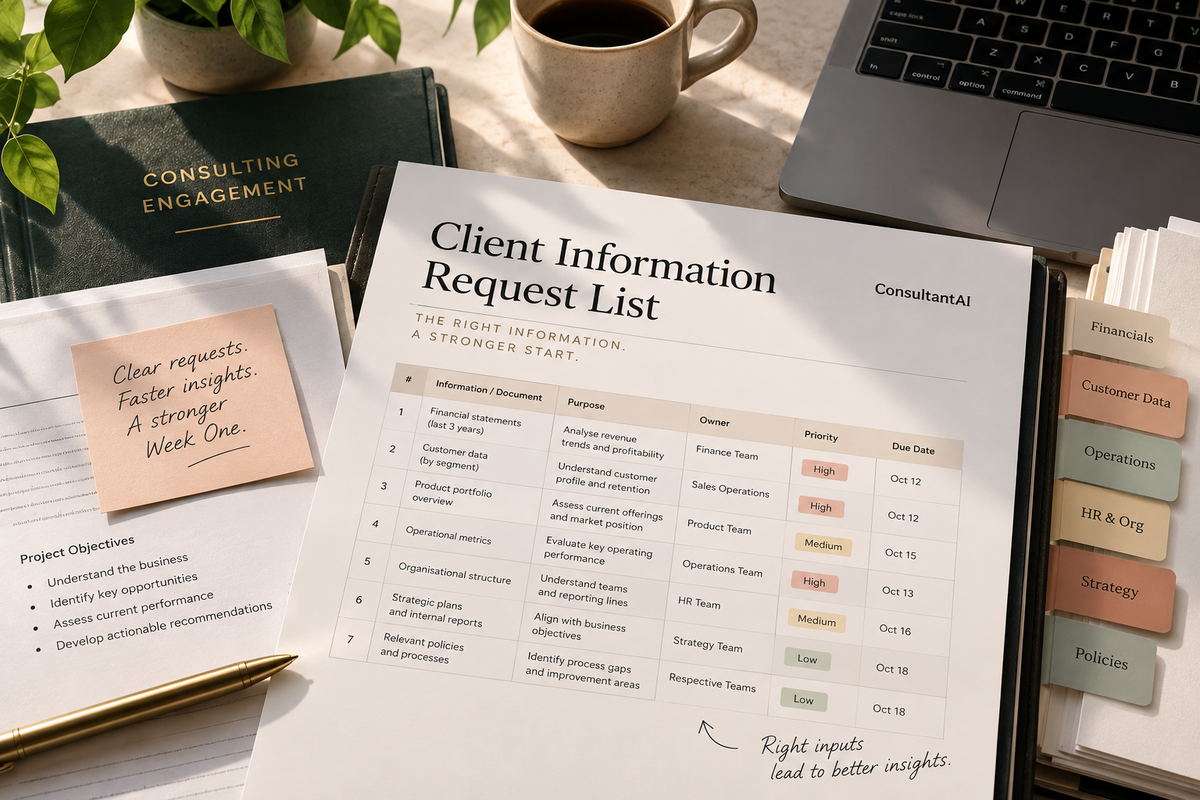
The first week is often a period of discovery, coordination, and expectation-setting. Consultants need to understand the client's operating environment, confirm the scope of the assignment, identify key stakeholders, and establish how the work will be carried out. At the same time, the client is managing its regular responsibilities and may be responding to requests from several departments or external partners.
This creates a coordination challenge. The consulting team needs information quickly, but the client may need time to locate reports, obtain internal approvals, reconcile data, or determine who owns a particular document. Without a clear process, these dependencies remain hidden until they begin to affect the project schedule.
An information request list can make those dependencies visible early. It provides a structured record of what the team needs, the reason for each request, the person responsible for providing it, and the stage of the project in which it will be used. Rather than relying on scattered emails and informal reminders, the team has a shared reference point for managing the initial flow of information.
A strong start does not guarantee that the entire engagement will run without delays. However, it gives the team a better foundation for identifying problems early, making realistic plans, and using its time more effectively.
Why Client Information Requests Often Become a Bottleneck
Information requests are sometimes treated as an administrative task that can be completed quickly after a project begins. In reality, the quality of the request process can influence how quickly the consulting team develops a reliable understanding of the business.
Generic Checklists Do Not Always Fit the Engagement
Consulting firms often reuse request lists from earlier projects because templates save time and help standardise common requirements. This is a sensible starting point, but a template should not replace project-specific thinking.
A request list created for a market-entry engagement may contain information that is unnecessary for a cost-reduction project. Similarly, a company-wide transformation may require operational and organisational data that would not be relevant to a narrow pricing study. When consultants send a generic checklist without adapting it, clients can spend time collecting information that does not materially contribute to the work.
The solution is to use templates as reference material, then review every request against the current scope. Each item should have a clear purpose. If the team cannot explain how a document or data point will support the analysis, it may not belong in the initial request.
Broad Requests Create Unnecessary Clarification
Requests such as “share the financials,” “provide customer data,” or “send the latest operational reports” appear simple, but they leave room for interpretation. The client may not know whether the consultant needs monthly or annual figures, historical or current data, consolidated or business-unit-level reports, or raw exports rather than presentation-ready summaries.
This ambiguity often leads to a chain of clarification emails. The client provides one version, the consultant explains what is missing, and the client prepares another. The resulting delay could have been reduced by specifying the required reporting period, level of detail, format, and relevant business unit from the beginning.
Specificity does not mean making every request unnecessarily complicated. It means providing enough context for the recipient to understand what a useful response looks like.
Unclear Ownership Delays Responses
A request may be easy to fulfil once it reaches the right person, but the consulting team may not know who owns the relevant information. Financial data might be maintained by the finance team, customer records by sales operations, and workforce information by HR. In some organisations, the same information may require approval from multiple stakeholders before it can be shared.
When ownership is unclear, requests can remain unanswered even when the information exists. Identifying a likely owner or client-side point of contact helps establish accountability and reduces the need for repeated follow-ups.
Poor Prioritisation Makes Everything Seem Urgent
A long request list can create the impression that every item is equally important. This makes it difficult for the client to decide what to address first, particularly when several teams are involved.
Some information may be essential for the first analysis session, while other material will only become relevant after the team has reviewed initial findings. Treating these requests differently helps both sides allocate time according to the actual needs of the project.
What a High-Quality Information Request List Should Include
An effective request list is more than a collection of document names. It is a working tool that connects business objectives, information requirements, responsibilities, and timing.
1. A Clear Link to the Engagement Objectives
Every request should support a business question, analytical task, or decision within the agreed scope. This link makes the list easier to review and helps consultants avoid collecting information simply because it is available.
Consider a consulting engagement focused on improving customer retention. The team may need customer churn figures, retention rates by segment, customer feedback, renewal data, and details of the current customer success process. These requests are connected because each can help the team investigate why customers leave and where improvements may be possible.
The same engagement may not initially require detailed information about unrelated business functions. Additional requests can be introduced later if the findings reveal a reason to investigate them.
Connecting requests to objectives also improves communication with the client. When the purpose of an item is clear, stakeholders can better understand why the information matters and whether an alternative source might satisfy the requirement.
2. Priority Levels Based on Dependencies
A useful list distinguishes between information needed immediately and information that can be collected later. The distinction should reflect the sequence of the work rather than an arbitrary ranking.
For example, a market assessment may require the client's product portfolio, target customer segments, existing market assumptions, and historical sales data before the team can begin evaluating growth opportunities. More detailed competitor information or additional customer research may be requested once the initial analysis identifies the areas that need further investigation.
This approach allows the team to make progress while later requests are being fulfilled. It also reduces the burden on the client by avoiding a large, undifferentiated list of tasks at the start of the project.
Priorities should be revisited as the engagement develops. New findings may make an earlier request less important or reveal that an additional source of information is necessary.
3. A Named Owner or Responsible Team
Each request should identify the person, department, or stakeholder group expected to provide the information, where that can reasonably be determined.
Ownership helps clarify who is responsible for the next action. It also makes it easier to identify whether a delay is caused by an unclear request, an unavailable data source, an approval requirement, or a competing internal priority.
The consulting team should avoid assuming that the first person contacted is necessarily the data owner. During the kick-off, it is useful to confirm the appropriate contacts and agree on how requests should be routed when several departments are involved.
4. Realistic Deadlines and Delivery Expectations
Due dates should be based on when the information is needed and how much effort is required to prepare it. A report that can be exported directly from an existing system may be available quickly, while a custom analysis requiring coordination across departments may need more time.
A realistic deadline helps the client plan the work and helps the consulting team understand which dependencies could affect the schedule. It also creates an opportunity to agree on alternatives when the requested information cannot be delivered in its original form.
Deadlines should not become arbitrary administrative targets. Their purpose is to support the project plan and make dependencies visible, not to create pressure without regard to the effort involved.
5. Clear Specifications for Format and Scope
Where necessary, requests should state the reporting period, units of measurement, level of detail, file format, geography, business unit, or other relevant parameters.
For instance, a request for monthly revenue by product line over the previous two financial years is more actionable than a general request for revenue data. If the analysis requires transaction-level information rather than a summary report, that distinction should also be explained.
At the same time, consultants should be practical about what the client can provide. If the requested format is unavailable, a comparable report or alternative data source may be sufficient. The objective is to obtain evidence that supports the analysis, not to insist on a particular file format without a clear reason.
6. A Status and Follow-Up Mechanism
The request list should remain useful after it has been sent. A simple status field can show whether an item is not started, in progress, received, under review, or blocked.
The team should also record when received information is incomplete or requires clarification. Marking an item as received does not necessarily mean it is ready for analysis; the material may still need to be checked for missing periods, inconsistent definitions, or other limitations.
A shared tracker makes these details easier to manage and reduces reliance on individual memory. It also helps the project lead see which outstanding items are genuinely blocking progress.
How to Build the Request List Before the Kick-Off
Creating a useful list begins with understanding the work that needs to be done. The process can be broken into a few practical steps.
Step 1: Translate the Scope Into Business Questions
Start with the engagement brief, statement of work, and any information already collected during initial discussions. Identify the decisions the client wants to make and the questions the consulting team must answer to support those decisions.
A profitability project, for example, may require the team to understand revenue trends, direct costs, overhead allocation, product mix, and differences in performance across business units. These questions provide a basis for identifying the initial information requirements.
Avoid beginning with a list of documents alone. Start with the questions, then determine which documents, data sets, or stakeholder inputs could help answer them.
Step 2: Map Each Question to the Required Evidence
For every major business question, identify the information needed to investigate it. Some questions may require quantitative data, while others may depend on process documentation, interviews, or existing business policies.
This mapping helps reveal gaps. It may also show that the same data source supports several questions, allowing the team to consolidate duplicate requests and avoid asking the client for the same information multiple times.
At this stage, distinguish between information that is essential to begin the work and information that would simply be useful to have. This keeps the initial list focused.
Step 3: Divide Requests Into Work Stages
Group requests according to when they are likely to be needed. The initial group should contain the inputs required to begin the agreed analysis. A second group can cover requests expected during the next stage, while a later group can include items that depend on what the team learns from the initial findings.
This staged approach creates a more manageable process for the client. It also gives consultants the flexibility to refine their requirements as the engagement moves forward.
Step 4: Review Feasibility With the Client
Before finalising the list, discuss the availability of the requested information, likely data owners, access restrictions, and expected delivery timelines. The client may already have a report that satisfies a request, or it may explain that a particular data set does not exist in the requested form.
These conversations are valuable because they replace assumptions with practical information. They also help the team identify alternative sources and plan around known limitations before those limitations become unexpected delays.
Step 5: Send the List With Clear Instructions
The list should explain what is required, why it matters where that context is useful, who is responsible, and when the information is needed. A short introductory message can explain how the requests are grouped and whom the client should contact if an item is unclear.
Avoid sending a large attachment without explaining how the recipient should use it. The communication surrounding the list is part of the process, not a separate administrative detail.
Step 6: Review and Update the List Throughout the Engagement
Once work begins, the team should check whether received information meets the original requirement and whether the outstanding requests still support the analysis.
If early findings change the direction of the work, update the list accordingly. Remove requests that are no longer necessary, clarify items that have caused confusion, and add new requirements only when they are justified by the scope and emerging evidence.
The request list should support the engagement as it develops rather than remain a static document created on the first day.
A Practical Example: Preparing for a Market Expansion Project
Imagine a consulting team engaged to assess whether a business should expand into a new region. The team needs to understand the company's current performance, target customers, competitive position, operating capabilities, and potential commercial constraints.
A broad request for “all sales and market data” would not give the client enough direction. A more structured list would specify the initial information needed and explain how it will be used.
The first group might include historical revenue by product and geography, current customer segments, existing pricing information, the product portfolio, and the company's current expansion assumptions. These inputs help establish a baseline before the team begins evaluating the opportunity.
The next group might include customer research, competitor comparisons, distribution arrangements, local operating requirements, and interviews with relevant stakeholders. Depending on the engagement, some of these materials may already exist, while others may need to be developed during the project.
For each request, the team can specify an owner, a due date, the required reporting period or format, and any known dependencies. If the client cannot provide a particular data set, the team can record the limitation and discuss whether another source is appropriate.
This example illustrates why the quality of the request list depends on the quality of the questions behind it. The objective is not to collect a large volume of material. It is to assemble the evidence needed to evaluate the expansion decision in a structured and defensible way.
Common Mistakes to Avoid When Sending Client Requests
Even a detailed list can create problems if the process around it is poorly managed.
Sending Every Possible Request on Day One
A long list may appear thorough, but it can overwhelm stakeholders and make it difficult to distinguish immediate priorities from optional material. Start with the inputs that enable the first stage of work, then add requests as the analysis develops.
Using Vague or Inconsistent Terminology
Different departments may interpret the same terms differently. Specify the required period, unit, format, and level of detail when these distinctions matter. Where the client uses different internal terminology, agree on a common definition before comparing the data.
Ignoring Data Availability and Access Constraints
Some information may be restricted, stored in multiple systems, or subject to internal approval. Confirming these constraints early helps the team plan appropriately. Sensitive information should only be requested and handled through approved channels and in accordance with the client's access and data-handling requirements.
Treating Receipt as Proof of Quality
A file arriving does not mean it is complete, accurate, or suitable for analysis. Consultants should check whether the material covers the requested period, includes the required fields, and uses definitions that are consistent with the rest of the evidence.
Any limitations should be documented rather than silently ignored. This is particularly important when conclusions depend heavily on the quality or completeness of the supplied data.
Following Up Without a Clear Next Action
Repeated reminders are not a substitute for a clear process. When a request is overdue, determine whether the issue is ownership, availability, ambiguity, approval, or timing. The next action should address the underlying problem instead of simply repeating the original message.
Using AI to Draft a Better Information Request List
AI-assisted tools can help consultants turn an engagement description into a structured first draft of the information they may need from a client. This can be useful when the project involves several workstreams or when the team needs to organise its initial requirements quickly.
For example, a consultant can describe a business requirement and identify the services involved. An AI tool may then suggest relevant documents, data categories, or supporting information that the team can review and refine.
ConsultantAI's Information Requests tool is designed to support this part of the workflow. It accepts a business requirement and optional service details to generate a structured list of client documents and data to request.
You can explore the tool here: https://www.consultantai.online/tools/info-requests
The benefit is not that AI automatically knows everything a consulting project requires. Rather, it can help produce a starting structure that the consultant can evaluate instead of beginning with a blank page.
Review the Output Against the Actual Scope
An AI-generated request list may include items that are unnecessary for the engagement or omit requirements that depend on the client's specific circumstances. Review every suggested item against the agreed scope and the questions the team needs to answer.
Remove irrelevant requests, add missing requirements, and ensure that each item has a clear purpose. The output should be treated as a working draft rather than a final list ready to send without review.
Add Priorities, Owners, and Deadlines
A generated list may identify useful information categories, but the project team still needs to decide when each item is required and who should provide it.
Priorities should reflect the work plan, while ownership and deadlines should be confirmed with the client wherever possible. These decisions depend on the actual project context and cannot be assumed simply because an AI tool has generated a well-formatted response.
Check Assumptions and Protect Client Information
Before sharing the final list, verify that the wording is appropriate, the requested information is relevant, and any assumptions have been checked. Avoid including confidential client information in tools unless their use has been approved and is consistent with the applicable data-handling requirements.
The consultant remains responsible for reviewing the final request, communicating it clearly, and determining whether the supplied information is sufficient for the work.
Measuring Whether the Request Process Is Working
The effectiveness of an information request process can be assessed through practical project indicators rather than the length of the list itself.
Teams can review how long it takes to receive essential inputs, how many requests require clarification, how often duplicate requests occur, and how frequently missing information blocks planned work. These observations can help identify whether the problem lies in request quality, client coordination, data availability, or project sequencing.
For example, frequent clarification requests may indicate that the team needs to specify reporting periods or formats more clearly. Repeated delays involving the same department may suggest that ownership or approval requirements should be discussed earlier. A high number of requests that are eventually unused may indicate that the initial list needs better prioritisation.
These measures do not need to become a complicated reporting exercise. Even a short retrospective at the end of the first week can help the team improve its approach for the remainder of the engagement and for future projects.
Building a Repeatable Process Across Consulting Projects
For consulting firms that manage multiple engagements, a repeatable request process can reduce unnecessary variation. A central library of request templates, organised by project type or business function, can help teams start with relevant examples rather than creating every list from scratch.
However, standardisation should not mean sending the same checklist to every client. Templates need clear guidance on when each request applies, which fields should be customised, and which items require confirmation before they are sent.
Teams can improve these templates over time by recording recurring clarification issues, identifying frequently overlooked inputs, and incorporating lessons from completed projects. The result is a process that becomes more useful through experience while still allowing consultants to adapt it to the engagement.
AI-assisted drafting can complement this approach by helping teams assemble an initial list from a project description. Combined with reviewed templates, clear ownership, and human oversight, it can support consistency without removing the need for professional judgment.
Conclusion: Make the First Week More Deliberate
A consulting engagement does not become effective simply because the team has collected a large amount of information. Progress depends on whether the right evidence is available when it is needed, whether the team understands its limitations, and whether the information supports the decisions the client wants to make.
A well-designed request list brings structure to that process. It connects each request to the project objectives, separates immediate needs from later requirements, identifies ownership, sets realistic expectations, and gives the team a way to track outstanding work.
AI tools can help consultants prepare an initial draft more efficiently, but the final list still needs to reflect the actual engagement, the client's operating environment, and the sequence of the analysis. Clear communication and thoughtful review remain essential.
The request list that saves the first week is not the one that asks for everything. It is the one that helps everyone understand what matters first, why it matters, and what needs to happen next. That clarity gives the consulting team a stronger foundation for the work ahead.
Get new posts and free tools
Join the list: one email when we publish. No spam.