
From AI Experimentation to Governed Workflows
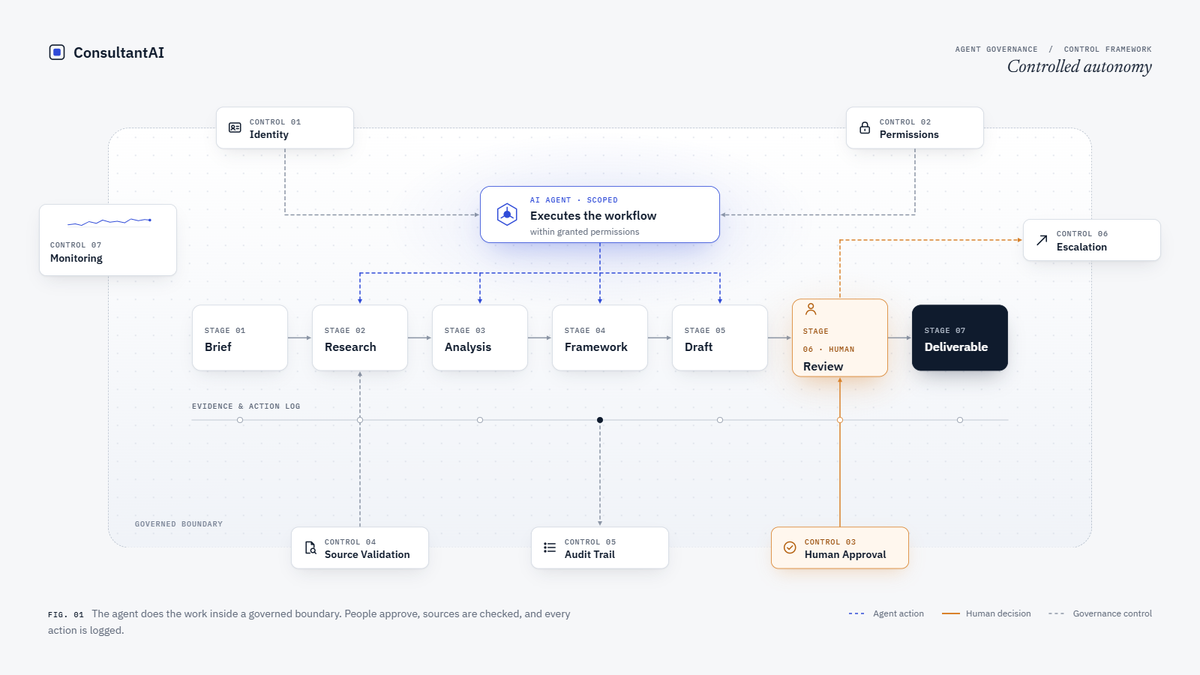
AI agents are moving beyond simple chat interfaces and becoming active participants in professional workflows. Instead of asking an AI model a question and receiving a single response, consulting teams can now use AI systems to gather research, analyze documents, apply frameworks, generate drafts, and support the preparation of client deliverables. As AI becomes capable of handling multiple steps within a workflow, the question of governance becomes increasingly important. The issue is no longer simply whether an AI model can produce a useful answer. It is whether the organization has defined the boundaries within which an AI agent should operate.
For consulting teams, this distinction matters because AI-generated work can influence analysis, recommendations, presentations, strategic decisions, and ultimately client outcomes. A workflow that allows an AI agent to move between research, analysis, and content generation without clear controls can create uncertainty around access, accountability, source quality, and human responsibility. Governance therefore needs to become part of workflow design rather than something added after an AI system has already been deployed.
A traditional AI workflow might look like Human → AI → Human. A consultant asks a question, reviews the response, and decides what to do next. Agentic workflows are more complex. An AI system may move through several steps before producing an output: Brief → Research → Analysis → Framework → Draft → Review → Deliverable. Every additional step creates another point at which permissions, evidence, approval, and accountability need to be considered.
Why AI Agent Governance Matters for Consulting Teams
Consulting work depends heavily on information quality, professional judgment, and the ability to explain how conclusions were reached. AI can accelerate many of these activities, but increased automation does not remove the need for accountability. In fact, the more responsibility an AI system takes within a workflow, the more important it becomes to define what the system can access, what actions it can perform, and where human judgment must remain involved.
Effective governance should not be viewed as a collection of restrictions designed to slow down AI adoption. A well-designed governance framework should make AI workflows more predictable. When consultants understand what an AI agent is allowed to do, which sources it can use, when human approval is required, and how important actions are recorded, teams have a clearer basis for using AI confidently.
The objective is therefore not to eliminate autonomy. It is to create controlled autonomy, where AI can handle structured and repeatable work while humans retain responsibility for decisions that require context, judgment, and professional accountability.
1. Start With Identity and Permissions
The first governance question should be straightforward: what is the AI agent actually allowed to access and do? An AI agent should not automatically receive unlimited access simply because it is connected to a consulting workflow. Its permissions should reflect the role it performs and the specific tasks it is expected to complete.
For example, an AI agent responsible for research may need access to approved research sources and project documents, but it may not need permission to modify a final client deliverable. An agent supporting financial analysis may need access to structured project data while remaining restricted from changing the underlying source information. Separating these responsibilities creates clearer boundaries and makes the workflow easier to manage.
Define Access Based on the Agent's Role
A practical permission framework can distinguish between read access, analysis access, drafting access, editing access, approval-required actions, and restricted actions. This allows organizations to give an agent enough access to complete its assigned work without giving it unnecessary authority.
The principle is simple: give an AI agent the minimum access required to perform its role effectively. This approach can reduce unnecessary exposure while making it easier for teams to understand where the agent's responsibility begins and ends.
2. Define Human Approval Points
Human oversight does not mean that a consultant needs to manually approve every action an AI system takes. Requiring approval at every step would remove much of the efficiency that agentic workflows are designed to provide. Instead, consulting teams should identify the points where human judgment has the greatest value.
An AI agent might be allowed to gather approved research, organize information, identify patterns, apply a predefined analytical framework, and prepare an initial draft. However, when the workflow reaches a client-facing recommendation, a strategic conclusion, or another high-impact output, the process can require human review before the work moves forward.
Identify High-Value Review Stages
Potential approval points can include source validation, important assumptions, strategic recommendations, high-impact calculations, client-facing claims, and final deliverables. The objective is to place human review where it can meaningfully improve the quality of the result rather than treating human oversight as a requirement for every automated action.
This creates a more practical workflow: AI handles repetitive and structured activities, while consultants remain responsible for decisions that require professional judgment. The important question is therefore not whether humans should review everything, but where human judgment matters most.
3. Validate the Sources Behind the Output
A fluent AI response is not automatically a reliable response. An AI agent can produce a well-written explanation while relying on incomplete, outdated, or inappropriate information. For consulting teams, this makes source validation an important part of workflow governance.
A governed workflow should make it possible to understand where important information came from. Depending on the use case, this can involve identifying the original source, recording which document was used, preserving source references, distinguishing sourced information from AI-generated interpretation, and flagging assumptions that require additional validation.
This becomes particularly important when AI-generated analysis eventually becomes part of a client presentation or recommendation. The workflow should provide a clear path from evidence to analysis and from analysis to recommendation.
From Source to Recommendation
A useful principle is:
Source → Evidence → Analysis → Recommendation
Rather than:
AI answer → Recommendation
The distinction is important because the consultant remains responsible for the quality and relevance of the final work. AI can help accelerate the process, but governance should make the supporting evidence visible enough for a human reviewer to assess the result.
4. Build an Audit Trail
Another important governance question is whether a team can understand what happened inside an AI workflow. An audit trail does not mean recording every interaction in an overwhelming log. Instead, it means preserving the information necessary to understand important actions, decisions, and approvals.
A useful workflow record might identify which workflow was executed, which sources were accessed, which tools were used, what important assumptions were introduced, where human approval occurred, which version of an output was produced, and who approved the final result.
This information becomes especially valuable when a result needs to be reviewed later. Imagine a client questioning where a particular number in a presentation came from. A governed workflow should make it easier to trace that number back to its source and understand how it entered the final deliverable.
Make Important Decisions Traceable
Traceability does not require every AI interaction to become a formal compliance process. Instead, teams should identify which decisions and outputs are important enough to preserve. The goal is to create a reasonable record of how significant work moved through the system.
That transforms an AI workflow from a black box into a process that can be reviewed and understood.
5. Create Escalation Rules
AI systems will encounter uncertainty. A well-designed workflow should not force an agent to continue simply because it has been instructed to complete a task. In some situations, the correct action is to stop, identify the uncertainty, and request human input.
Escalation rules provide the mechanism for doing this. An agent might be required to escalate when required information is missing, sources conflict, a requested action exceeds its permissions, an important assumption remains unresolved, or a client-facing claim cannot be adequately supported.
Know When the Agent Should Stop
A workflow can therefore move from AI → Continue to AI → Flag uncertainty → Human review. This is not necessarily a failure of automation. It is a control mechanism that prevents the system from treating uncertainty as permission to continue.
An effective AI workflow should therefore define not only what the agent should do when information is available, but also what it should do when information is incomplete or ambiguous.
6. Monitor the Workflow, Not Just the Model
AI governance is often discussed as though the AI model itself is the only component that needs monitoring. In practice, consulting teams should evaluate the entire workflow around the model.
A model may perform well in isolation while the overall workflow still produces poor results. The wrong source might be selected, an important document could be missing, an assumption could be carried forward incorrectly, or a generated recommendation might not receive the required human review.
Monitoring should therefore consider both AI performance and workflow performance. Teams can examine whether outputs are being reviewed, whether validation steps are being completed, whether certain stages produce repeated errors, whether users bypass required controls, and whether outputs become more consistent over time.
Use Monitoring as a Feedback Loop
Monitoring should not simply identify problems after they occur. It can also provide information for improving the workflow itself. If a particular step repeatedly produces errors or requires human intervention, that may indicate that the workflow needs better instructions, stronger source controls, additional permissions boundaries, or a different division of responsibilities between humans and AI.
This turns governance into an ongoing improvement process rather than a one-time implementation exercise.
A Practical AI Agent Control Framework
For consulting teams, AI agent governance can be organized around six core controls: identity, permissions, approval, evidence, escalation, and monitoring. Together, these controls provide a practical structure for deciding how an AI agent should operate inside a professional workflow.
Identity: Who Is the Agent?
Define the agent's role, purpose, and responsibility within the workflow. An agent designed for research should not automatically be treated as an agent authorized to approve client-facing recommendations.
Permissions: What Can the Agent Access or Change?
Limit access to the information and actions required for the agent's role. Permissions should reflect the specific workflow rather than providing unrestricted access by default.
Approval: Where Does a Human Make the Decision?
Define the points where human judgment is required. These may include important assumptions, strategic recommendations, high-impact calculations, or final client deliverables.
Evidence: What Supports the Output?
Maintain appropriate source visibility and traceability. Important conclusions should be connected to the evidence and information that supports them.
Escalation: What Happens When the Agent Is Uncertain?
Create explicit conditions under which the workflow pauses or routes the task to a human. Uncertainty should be treated as a reason to review, not as a reason to guess.
Monitoring: How Do We Know the Workflow Is Working?
Track quality, exceptions, approvals, and workflow performance over time. Monitoring can reveal where the workflow needs improvement and whether controls are being followed consistently.
Together, these controls create a simple principle: give AI agents autonomy inside clearly defined boundaries.
Governance Should Be Part of Workflow Design
One of the biggest mistakes organizations can make is treating governance as something that happens after an AI system has already been deployed. When controls are introduced only after problems appear, teams may have to redesign workflows that were never built with accountability in mind.
A better approach is to design governance alongside the workflow. Instead of thinking Build → Deploy → Add Governance, consulting teams can think Design → Define Controls → Build → Review → Deploy → Monitor.
This approach changes the role of governance. It becomes less about adding restrictions and more about creating predictable operating boundaries. When consultants know what an agent can do, what it cannot do, when human intervention is required, and how important outputs are reviewed, AI becomes easier to integrate into established working practices.
The Goal Is Controlled Autonomy
The future of AI-assisted consulting is unlikely to be completely manual or completely autonomous. A more practical model is controlled autonomy, where AI handles work that can be structured and repeated while humans remain responsible for decisions that require context, professional judgment, and accountability.
A consulting workflow might allow AI to research and organize evidence, apply a defined analytical framework, and prepare initial findings. A consultant can then challenge assumptions, validate important evidence, approve recommendations, and work with the system to produce the final deliverable.
The exact division of responsibility will vary by project and workflow. What matters is that the boundaries are intentional rather than accidental.
Building Trust Into the Workflow
Trust in AI-assisted work does not come simply from using a more capable model. It comes from knowing how the system operates, what information it uses, what it is permitted to do, where humans remain involved, and how important decisions can be reviewed.
That is why governance should be treated as part of the workflow itself. When controls are designed into the process, AI can become a more useful component of professional work without requiring organizations to surrender accountability.
Final Takeaway
AI agents can make consulting workflows faster, more structured, and more scalable. But increasing autonomy also increases the importance of governance. The question is no longer simply whether an AI agent can perform a task. The more important question is under what conditions it should perform that task, what it should be allowed to access, when a human should intervene, and how the team can understand what happened.
For consulting teams, those controls can be built directly into the workflow through identity, permissions, human approval, source validation, audit trails, escalation rules, and continuous monitoring. These controls are not necessarily obstacles to AI adoption. When designed properly, they provide the operating structure that allows teams to use AI more consistently and responsibly.
The goal is not to give AI unlimited autonomy. It is to give AI the right autonomy, with the right controls around it.
Get new posts and free tools
Join the list: one email when we publish. No spam.